
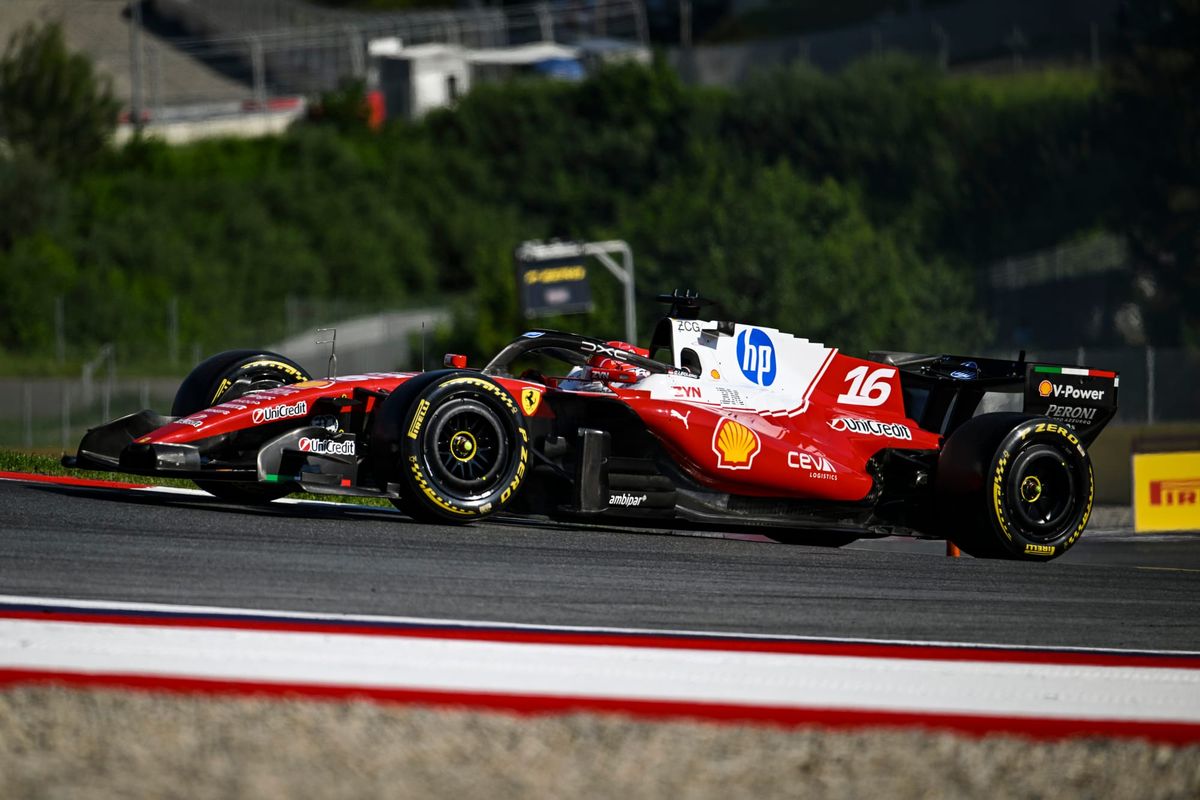
Ferrari and its rivals were caught out by a deeply underwhelming debut race for its much-anticipated engine upgrade at Formula 1’s Austrian Grand Prix.
Qualifying in Austria promised so much, with Charles Leclerc and Lewis Hamilton getting between the Mercedes duo, potentially setting up a Barcelona rematch.
But Sunday in Austria proved to be nothing like Barcelona. Ferrari was well-beaten by Mercedes, jumped by the upgraded Red Bull, and even pipped by McLaren, leaving it fourth-best as Hamilton was almost half a minute adrift of the victory in fifth.
Things were even worse for second-place starter Leclerc, who was another 19 seconds down the road from Hamilton in eighth.
Both drivers were baffled at that day-on-day downturn, something Leclerc described as being “difficult to understand”.
So what exactly went so wrong for Ferrari? How did it go from race winner to fourth-best at the very next round despite successfully upgrading its power unit?
A deceptive Saturday
First off, there was the deceptively good qualifying, in which Leclerc ended up only two and a half tenths off George Russell’s polesitting Mercedes and ahead of Kimi Antonelli’s.
This gap should have been closer to four to five tenths, but Russell had to lift for single-waved yellow flags for Max Verstappen’s crashed Red Bull.
The fact that Russell was still two and a half tenths clear with such a lift into the Turn 9 right-hander on such a short circuit was overlooked evidence of Mercedes’ superiority over Ferrari.
Had Antonelli not mistaken the yellow flag for a double-waved one, it would have almost certainly been an all-Mercedes front row. And had Verstappen’s RB22 not malfunctioned transitioning from straight to corner mode at Turn 9, then Verstappen wouldn’t have speared into the barriers and would also have been a threat to the Ferraris.
That alone doesn’t explain why Sunday was so disastrous, but a weaker-than-it-looked Saturday consequently made the downturn look more dramatic than it was.
But while the signs were there in qualifying, Ferrari’s biggest weaknesses were exposed in the race.
A big power issue
The only reason Ferrari was able to bring an engine upgrade to Austria in the first place was that it knew F1’s first Additional Development and Upgrade Opportunities (ADUO) rankings would determine its internal combustion engine to be over 2% adrift of the benchmark, therefore entitling it to a mid-season engine upgrade.
In fact, the Ferrari power unit was judged to be over 4% off, so it’s been granted two mid-season upgrades and two for 2027. And The Race’s sources believe Ferrari’s internal combustion engine was actually 6-8% off the Red Bull Powertrains benchmark.
Ferrari’s Austria engine upgrade worked as expected, but it was never going to be enough to bridge the large power unit deficit it has.
It’s particularly exposed at a circuit such as the Red Bull Ring, but hidden somewhere like Barcelona, where there are plenty of opportunities to recharge.
You only have to look at the GPS traces to see the Ferrari deployment tailing off before the end of the straights versus the Mercedes and the Red Bull. For example, the Ferrari was routinely losing 20km/h to them on the run to the Turn 4 right-hander.
Or for another visual example, F1’s own ghost car comparison between Russell and Leclerc’s qualifying laps showed how the Mercedes pulled well clear on the run to Turn 4.
Russell 🆚 Leclerc
Heading onboard with Charles Leclerc in our Ghost Car comparison from their quickest runs in Q3 😮💨#F1 #AustrianGP pic.twitter.com/J6KVwMnLL6
— Formula 1 (@F1) June 27, 2026
The recovered energy comes from the internal combustion engine, and Ferrari’s can’t produce enough during super clipping in Austria, with only a couple of big braking zones and protracted full-throttle sections.
In fact, even third-place finisher Antonelli was caught out by the Ferrari’s weak deployment, saying in the post-race cooldown room: “They were deploying so weirdly, I almost crashed with Leclerc in Turn 1.”
Antonelli was also able to make an unusual pass at Turn 9 early in the race as Leclerc’s Ferrari ran out, desperately harvesting energy well before the braking zone.
While it’s the internal combustion engine that matters for the ADUO rankings, Ferrari is clearly lacking in the strength of its electrical components, too, compared to the market-leading Mercedes.
Hamilton said Mercedes had “far more power than everybody else this weekend” and did not know where it was coming from.
He said he was “grateful” to Ferrari for delivering an engine upgrade in Austria, but he knows his team needs another step from its power unit if it’s to be a match for Mercedes.
That second upgrade, likely to be an improvement to the Ferrari’s turbo, won’t arrive until after the summer break at Zandvoort or Monza.
A small turbo gives Ferrari a good kick off the corners, but it is arguably contributing to why it’s lacking by the end of the straights.
It’s also particularly punishing at high altitude, so at tracks such as Austria, because the turbo has to work even harder, which can lead to overheating issues. That’s likely why Hamilton was being told to switch to “mode TS” for temperature reasons.
Of course by the time that improved turbo arrives, there’s no guarantee Mercedes won’t have raised the benchmark even further.
Mercedes brought a number of reliability fixes for its engine to Austria, potentially eliminating the big Achilles’ heel of its 2026 power unit with improvements to its previously vulnerable battery, and also sured-up its internal combustion engine.
As it was judged to be more than 2% off the benchmark engine in the FIA’s ADUO findings, Mercedes can also bring a performance upgrade mid-season, as well as an extra upgrade for 2027.
The power unit deficit isn’t Ferrari’s only headache either as Austria exposed another shortcoming that is likely to resurface.
Another weakness exposed
Austria was another extremely hot race with track temperatures soaring to around 50°C for a second successive race weekend, but the picture was very different to Barcelona.
The Red Bull Ring is much tougher on rear tyres, while Barcelona is far more balanced between front and rear degradation.
Plus, at Barcelona things were much more finely balanced between two and three pitstops. So Ferrari, with its poorer tyre degradation, could somewhat bail itself out by committing to a three-stop strategy, reducing the need for tyre conservation.
In Austria it was clear that the two-stop was the quicker strategy, but Ferrari had to use the slower three-stop strategy because its tyre degradation was that bad.
It could live with Verstappen’s Red Bull over a single lap, but so much damage was done to its rear tyres over a race distance that it was only the third- or fourth-best car on Sunday.
Leclerc called it an “incredibly difficult race” and complained of “very, very low grip” at the rear.
Neither driver was likely helped by the large cooling inlets Ferrari required atop the engine cover, which were bigger than those on the Mercedes and Red Bull.
They’re a necessary evil to cool the power unit, but would have only added to Ferrari’s rear tyre degradation because of the aerodynamic efficiency penalty it carries.
And to make matters worse for Ferrari, mistakes were made because it ended up racing the wrong cars.
Team principal Fred Vasseur admitted the Ferraris pushed too hard in the opening laps, reacted too aggressively on strategy and erroneously focused on the Mercedes.
Vasseur admitted “realistically, that wasn’t our race” as Ferrari was instead fighting McLaren and the second Red Bull of Isack Hadjar.
Hamilton felt he could have beaten McLaren’s Oscar Piastri to fourth had the team granted his request to start on the softs rather than the mediums he and Leclerc used in the first stint.
Hamilton explained: “I thought the deg was going to be massive for us. So I wanted to start on the soft, but the team were nervous.”
A ‘reality check’
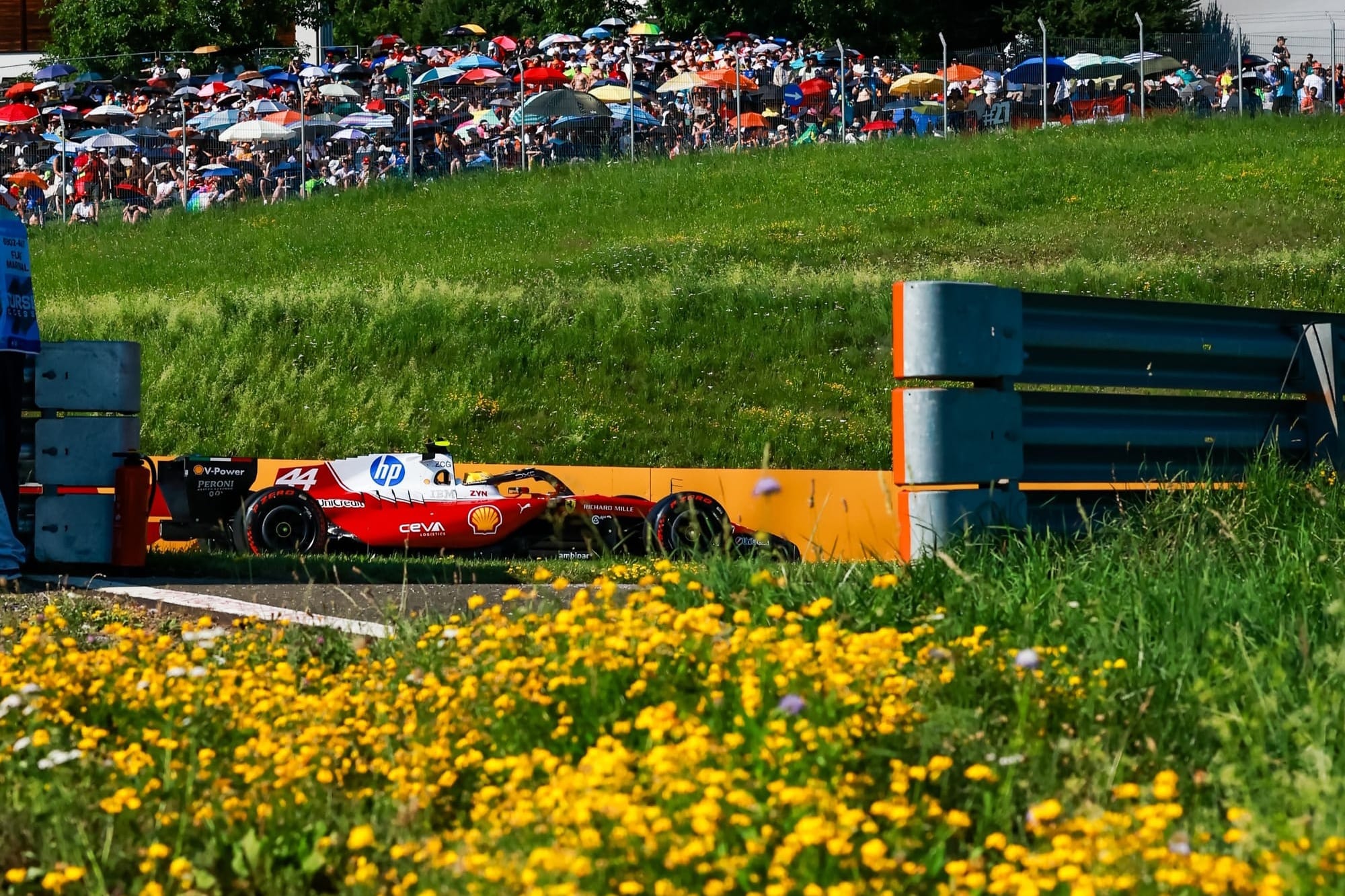
Piastri probably was beatable for Hamilton, but as Leclerc said: “You can always do slightly better with hindsight, but I think whenever the pace is not good, whatever strategy you do, it doesn’t look great.”
Ferrari was certainly never going to end up anywhere near the podium, whatever strategy it was on.
It’s why Hamilton called it a “reality check” for the team, and part of the problem is Ferrari doesn’t fully understand why it was so strong on Sunday at Barcelona, as well as why the pace disappeared in Austria.
If you looked closely enough, the signs were there at Barcelona that Ferrari’s tyre management wasn’t a match for Mercedes’.
And with hindsight, you might suggest Barcelona was simply a perfect storm of factors. Hamilton could run four aggressive stints with minimal tyre conversation on a track where the impact of Ferrari’s energy deployment shortfall is lessened.
That Mercedes-beating weekend could still well be repeated, but it does suggest Ferrari isn’t yet a title contender, if its challenge falls so dramatically off at circuits such as the Red Bull Ring.
And next up is Silverstone, a track with similar energy demands to Austria; not good news for Ferrari, or for Hamilton’s hopes of challenging for victory on home soil.
As Hamilton was at pains to point out whenever he was asked about his hopes for Silverstone in Austria: “There are a lot of straights at Silverstone. Lots of straights and lots of deployment, and not many places to recover the power.”
And there are very few big braking zones where the Ferrari can recover the energy it needs to avoid tailing off quicker than the Mercedes and Red Bull at places like the run down to Copse.
Silverstone is going to be a really tough energy challenge as Verstappen’s early sim review showed; he said he started laughing when driving his first laps in a 2026 car in the virtual world on it.
He said “you can’t really charge the batteries”, that it was basically “constantly flat”, and that there is very little energy to spend on the next straights. And that sounds like Ferrari’s worst nightmare.
The title dream is still far from over. Ferrari’s car is still great in the corners, but its current straightline speed deficit means it’s hard to see how it can be a regular Mercedes-beater – at least until its all-important next engine upgrades arrives after the summer break.