
Walt Murphy’s News and Results Service ([email protected])
This Day in Track & Field–April 20
(The 1st Penn Relays, Heartbreak Hill, ’64 Boston-Great Documentary/Birthdays-Debbie Flintoff, Dave Nielsen, Betty Cuthbert, Bill Alley/R.I.P-McGrady, Betty Cuthbert/Columbine)
1895–The Penn Relays Begin.
The first Penn Relays was a smash success. Held on April 20, 1895 (the linked article above incorrectly lists the date as April 21), in conjunction with the University’s Spring Handicap Track and Field Games, the meet, until this year the longest uninterrupted collegiate track meet in the country, was a greater success than hoped for, drawing an attendance of approximately 5,000, the largest track and field crowd to that time in Philadelphia. At the dawn of the 20th century, track and field in the United States was centered around the three large eastern cities of Boston, New York, and Philadelphia, so it is evident that, in addition to being the largest track crowd in Philadelphia, it was immediately one of the largest ever in America.
The pre-history of the Penn Relays and the history of relay running as a sport began in 1893 at the University of Pennsylvania. While earlier relay races were run, nowhere else did the concept take hold and flourish. In fact, the history of relay racing cannot be told without linking it to the Penn Relay Carnival.
When the University Track Committee, chaired by Frank B. Ellis ‘93, looked for ways of adding interest to their 1893 spring handicap meet, they struck on the idea of a relay, four men each running a quarter mile in succession. The idea created enough interest that a team from Princeton was invited to contest the event. Held at the end of the meet on May 12, the Princeton team of J.A. Chapman, George McCampbell, Isaac Brokow, and Theodore Turner pulled away in the homestretch to beat Penn by eight yards with a time of 3:34.0.
The following year, Penn exacted its revenge against the Princeton team on the University Field track, located at 37th and Spruce Streets, where the Quad Dormitory is now. Interest in the first two years’ races was such that the committee decided to sponsor a relay meet in 1895 with hopes of reviving sagging interest in Penn track. The first Penn Relays also served as the dedication for Franklin Field, built on the same ground it occupies today, but under a different guise. The only grandstand at the time was a wooden single-tiered bleacher on the South side of the field, along what is now the sprint straightaway.
The facilities were rudimentary, even for the period, but the potential for one of the best athletic facilities in the country existed. The track, which partially surrounded a combination baseball and football field, was not yet completed. The top layer of cinders had not arrived in time, leaving the surface a rough bed of clinkers. Permanent dressing facilities were also lacking, but tents were set up around the perimeter of the track, and were used yearly until Weightman Hall was built in 1904.
The festive atmosphere of the tent camp gave rise to the term “Carnival,” which was officially adopted as part of the meet’s name in 1910. Today, the carnival atmosphere still exists, both inside Franklin Field and the surrounding Carnival Village, and outside on the nearby streets.
The first year’s schedule included nine relay events, four for high schools and prep schools, four for colleges, and the college championship. All were held at 4×440 yards, which became the classic mile relay. In each race there were but two teams, and Harvard defeated Penn with a time of 3:34.4 to win the first Carnival championship. The other teams competing in the inaugural meet were Cornell, Columbia, Lafayette, Lehigh, Rutgers, Swarthmore, College of the City of New York and New York University among the colleges, and Central High School of Philadelphia, Central Manual Training of Philadelphia, Haverford School, Cheltenham Military Academy, Germantown Academy, William Penn Charter, Episcopal Academy and DeLancey School among the high schools and prep schools.
1936— The last of Newton’s hills on the Boston Marathon course was given the nickname “Heartbreak Hill” by Boston Globe reporter Jerry Nason. When John A. Kelley caught eventual champion Ellison “Tarzan” Brown on the Newton hills, Kelley made a friendly gesture of tapping Brown on the shoulder. Brown responded by regaining the lead on the final hill, and as Nason reported, “breaking Kelley’s heart.” (Kelley faded to 5th-2:38:49)
500,000 spectators lined the course.
NY Times(for subscribers):
1957—The University of Texas, coached by Hall-of-Fame Clyde Littlefield, set a World Record of 39.7 in the 440-yard relay at the Kansas Relays with a lineup of Wallace Wilson, Eddie Southern, Hollis Gainey, and Bobby Whilden. It was the 3rd straight WR for the school, which had run 40.5 in 1954 and 40.2 in 1955 (with Whilden on the anchor).
Southern was the silver medalist in the 400-meter hurdles at the 1956 Olympics, while Whilden has become a legend in Masters competition. 86 at the time, he set a World Age-Group Indoor Record of 9.63 in the 60-Meters at the 2022 U.S. Masters Indoor Championships at NY’s Armory
1964—Belgium’s Aurele Vandendriessche won his 2nd straight Boston Marathon in 2:19:59. A great documentary on the race, featuring the late Yale and Harvard professor (and noted author—“Love Story”) Erich Segal, has recently been found and posted on YouTube. It’s a “Must-View” piece of history. Vandendriessche competed in 3 Olympic marathons (1956-1964), finishing 7th in Tokyo in 1964.
5th in the race was noted running historian Hal Higdon (2:21:55), and 7th was John Kelley (the “Younger”) in 2:27:23.
1968—Following coach Bill Bowerman’s instructions prior to the dual meet with Washington State, Oregon’s Arne Kvalheim let Gerry Lindgren build an early lead in the 2-mile with his usual front-running tactics before gradually closing the gap. Passing Lindgren on the final turn, Kvalheim went on to win with the Collegiate Record time of 8:33.2.
1979—Missouri set a Collegiate Record of 3:13.7 (the fastest ever run in the event) in the Sprint Medley (yards) at the Baylor Inv. in Waco, Texas. Hurdler Dan Lavitt (21.6) and Ed Ofili (20.6) handled the opening 220y legs, Dele Udo put the team into the lead with a 45.4 carry on the 440y leg, and Scott Clark finished off the Record run with a 1:46.1 anchor.
Since Ofili and Udo were from Nigeria, runnerup Rice, which ran 3:14.5, thanks to a great 1:45.7 anchor by Bruce Gingrich, got credit for the World & American Records. (not an official record event)
(From Track & Field News)
1985–Portugal’s Carlos Lopes, who had won Olympic gold in L.A. the previous year, set a World Record of 2:07:12 at the Rotterdam Marathon. Lopes was also a 3-time World X-Country Champion (’76, ’84, ’85).
(The IAAF (now World Athletics) didn’t recognize official World Records in Road Events until January 1, 2004).
1986—Joe Dial raised his own American Record in the Pole Vault to 19-3 ½ (5.88) in El Paso,TX.
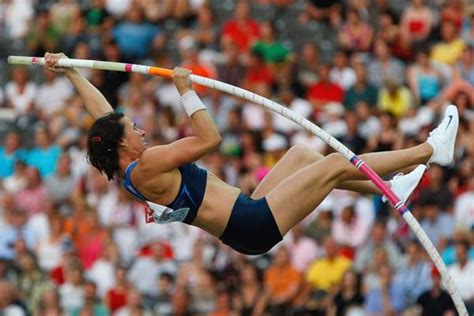
1996—Stacy Dragila cleared 13-6 ½ (4.13) in the Pole Vault at the Kansas Relays to set the first American Record of her legendary career.
1997—Dragila set her 6th AR with a clearance of 13-11 (4.24) at the Mt.SAC Relays in Walnut,CA.
Hall of Fame Bio:
2008—Running a day before the traditional marathon, 35-year old Deena Kastor, the bronze medalist in Athens 4 years earlier, qualified for her 2nd Olympic team with her first-place finish at the U.S. Marathon Trials in Boston. Joining Kastor on the team that would compete at the Beijing Olympics were Magdalena Lewy-Boulet and Blake Russell.
Russell would finish 27th (2:33:13) in Beijing, while Kastor and Lewy-Boulet were both DNFs.
2018—With pacing help from Lopez Lomong, among others, New Mexico’s Josh Kerr, a junior from Edinburgh, Scotland, ran 3:35.01 for 1500-meters at the Bryan Clay Inv. in Azusa,CA, to break the 37-year old Collegiate Record of 3:35.30 that was set by Villanova’s Sydney Maree in 1981 while winning the NCAA title. Syracuse’s Justyn Knight finished 2nd in 3:36.07 (#7 All-Time College at the time). Kerr had won his 3rd NCAA title (Mile) in March, having previously won Indoors (Mile) and Outdoors(1500) in 2018.
“The Collegiate Record was very important to me”, Kerr told T&F News. “We looked at it right at the start of the year and thought, ‘You know, especially after last year’s race (when he ran 3:35.99), that’s kind of always been in the back of our minds—that it’s point seven of a second over 1500 meters. It’s not a lot of time.’”
2019—There were some excellent early-season performances at 3 different venues on this day.
Michael Norman ran 43.45, a sensational time for so early in the season, for 400-meters at the Mt.SAC Relays in Torrance, California, to move to #5 on the All-Time Performers’ List.
At the Long Beach(CA) Invitational, Ryan Crouser threw the Shot 74-7 ¼ (22.74) and 74-7 (22.73), the 2 longest throws of his career at the time, and Omar Craddock got a personal best of 58-1/4 (17.68) in the Triple Jump (beating Christian Taylor in the process).
Finally, Texas Tech’s Divine Oduduru ran personal bests of 9.94 (100) and 19.76 (200) at the Michael Johnson Invitational in Waco, Texas. His 200 time was the 2nd-fastest ever run by a collegian, trailing only Walter Dix’s CR of 19.69 (2007). Oduduru would improve to 9.86 and 19.63 while winning both sprints at the NCAA Championships in June.
2020—The Boston Marathon was originally scheduled to take place on this date, but had been postponed until September 14, 2020, due to the coronavirus. Since it was evident that the crisis wouldn’t end anytime soon, it was decided in May to conduct a “virtual” race.
“On matters of public health and safety we take our guidance from the officials entrusted with protecting the public in this area,” said Tom Grilk, C.E.O. of the B.A.A. “We understand our role, along with our partners, in ensuring a safe environment for all participants, volunteers, spectators, and supporters that meets the standards set by those officials.”
Born On This Day*
Filip Ingebrigtsen—Norway 33 (1993) Bronze medalist in the 1500 at the 2017 World Championships; 2019-semis
2016 European Champion-1500; 2018 European X-Country Champion
2-time Olympian-1500 (2016-DQ heat, 2021-heat)
Middle brother of the running family—Jakob being the youngest, Henrik the oldest.
PBs: 1:46.74 (‘20), 2:16.46 (‘20), 3:30.01 (‘18), 3:49.60 (‘19), 4:56.91 (‘20), 7:34.00 (’21), 13:11.75 (’19)
2025 SBs: 3:36.32, 7:39.97i, 13:12.10; 2026 SB: 3:45.69i
Ken Flax 63 (1963) 1986 NCAA Champion—Hammer (Oregon—Set 2 Collegiate Records in the final: 256-4 [78.14] and
257-0 [78.34]/since broken)
2-time U.S. Olympian (qualifying round-1988, 1992); Competed at 2 World Championships (1987, 1991-7th)
2-time U.S. Champion (1988,1990); also the winner at the 1988 U.S. Olympic Trials
PB:262-6 (80.02/1988/#6 All-Time U.S.)
Debbie Flintoff-King—Australia 66 (1960) 1988 Olympic gold medalist—400-Meter Hurdles (won in final stride)
Silver medalist—1987 World Championships; PB-53.17 (’88)
Dave Nielsen 73 (1953) Former pole vaulter (best of 17-5 ¾ [5.33]). Retired from his position as the head coach at
Idaho State in 2016. Best known for introducing one of his athletes, Stacy Dragila, to the Pole Vault!
(2012 Article):
Bill Alley 89 (1937) 2-time NCAA Champion—Javelin(Kansas/1959,1960)…1959 win helped Kansas win the team title
Former American Record holder (270-1 ½ [82.33]/1959)
1960 U.S. Olympian (qualifying round)
Alley threw 283-8 (86.46) in 1960, which bettered Al Cantello’s World Record of 282-3 (86.04), but the mark
was never ratified, since it was determined to have been made on “sloping ground”.
Before transferring to Kansas, Alley won the 1956 IC4A title while competing for Syracuse.
A native of New Jersey, Alley, a prolific inventor, moved to Vermont in 1969 to open Research Engineering Corporation, a company that manufactures everything from T&F equipment to fishing poles to medical devices.
Deceased
Martin McGrady 60 (1946—April 29,2006) The original “Chairman of the Boards” (Before Eamonn
Coghlan inherited the title. Known for his mastery of indoor running, especially in his legendary
battles at 600-yards with Hall-of-Fame runner Lee Evans. His world record of 1:07.6 stood for 22
years until Mark Everett ran 1:07.53 at the 1992 Millrose Games.
1966 NCAA Indoor Champion at 600-yards (Central State)
3-time U.S. Indoor Champion—600y (1968-1970)
Betty Cuthbert—Australia 80 (1938-Aug. 6, 2017) Australia’s “Golden Girl” won three gold medals at the 1956
Olympics in Melbourne (100, 200, 4×100). Won a 4th gold medal 8 years later in the 400-meters in Tokyo.
Passed away in August, 2017, at the age of 79