
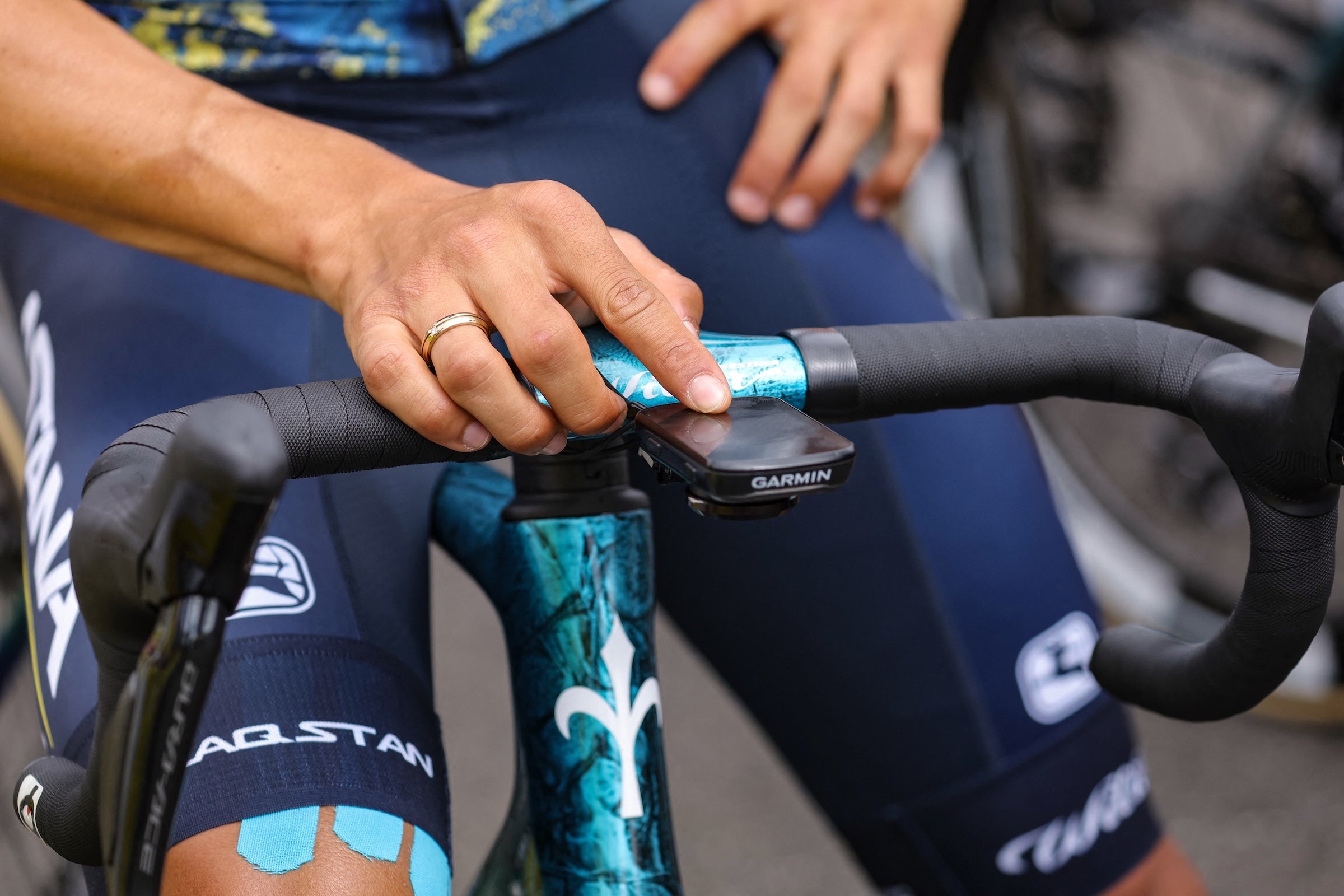
Cycling’s governing body the UCI sets out new rules about what riders are watching and wearing.
The UCI is imposing new rules in relation to bike computers (Photo: Thomas Samson / AFP) (Photo: THOMAS SAMSON)
Updated June 6, 2026 01:27PM
The UCI has imposed limits on sock heights, handlebar width, peeing and recently ejected a leading competitor out of the Giro d’Italia Women over a contested 20g weight violation.
Now it’s targeting bike computers and jersey pockets, with both to be governed by new rules controlling what is and isn’t allowed.
Technology means more and more data is available to riders but screentime at speed has become a concern. The solution? Limit what the UCI sees as a distraction, with the expansion beyond current sizes deemed too dangerous.
“The UCI has…decided to update the article concerning on-board technologies,” it said in a statement released this week.
“The maximum dimensions permitted for bike computers will be limited to 126 × 71mm, corresponding to the largest products currently available on the market.”
That’s a reference to the Wahoo Ace (125 x 70), the biggest product available at this point in time.
And while there is an argument that a larger display means that riders don’t need to strain to see their data, the UCI is having none of it.
“This decision was taken in light of the impact of on-board technologies on the cognitive load experienced by riders,” it said. “Several studies have shown that the increasing volume of data available to riders during competition can contribute to an increased cognitive workload, a key factor in the occurrence of accidents.
“Limiting the size of bike computers is intended to prevent an excessive increase in the amount of data available during races, which could significantly compromise rider safety.”
And yet while the UCI appears to have already come to a conclusion and set a ban date for January 2028, it—somewhat confusingly—suggests that more research needs to be done.
“Members of the UCI Management Committee also emphasised the importance of engaging with the relevant stakeholders to gain a better understanding of how riders interact with the various data streams available to them during competition.”
Fast fashion is a no no

There may be almost a full year and a half before your bike computer will be scrutinised in competition but more immediate implications are coming for the jerseys you might want to wear in competition.
Prompted perhaps by the use of hydration bladders in the recent Unbound Gravel, the UCI is cracking down on what it sees as an effort to gain an unfair advantage by changing body shape.
“At the beginning of 2026, the UCI observed that several riders were wearing jerseys featuring front internal pockets containing nutritional products that were generally not consumed because they were extremely difficult – or even impossible in race conditions – to access,” it wrote.
“These pockets result in significant alterations to the riders’ body shape. This trend follows the recent publication of studies demonstrating the aerodynamic advantage provided by this practice. Given the established link between aerodynamic gains, increased speed and the severity of accidents, and considering that the practice also raises issues of sporting fairness, the UCI has decided that jersey pockets must be located exclusively on the rear of the garment.”
There is one exception to the ban which will be in place on July 1 of this year: a pocket on the front of a jersey which is, in the words of the UCI, “intended solely to hold a radio communication device.”
So forget the old style jerseys seen in historic editions of the Tour de France.
Whether it’s inspired by retro fashion or aero ambition, kangaroo-style pockets will soon be a big no-no.