
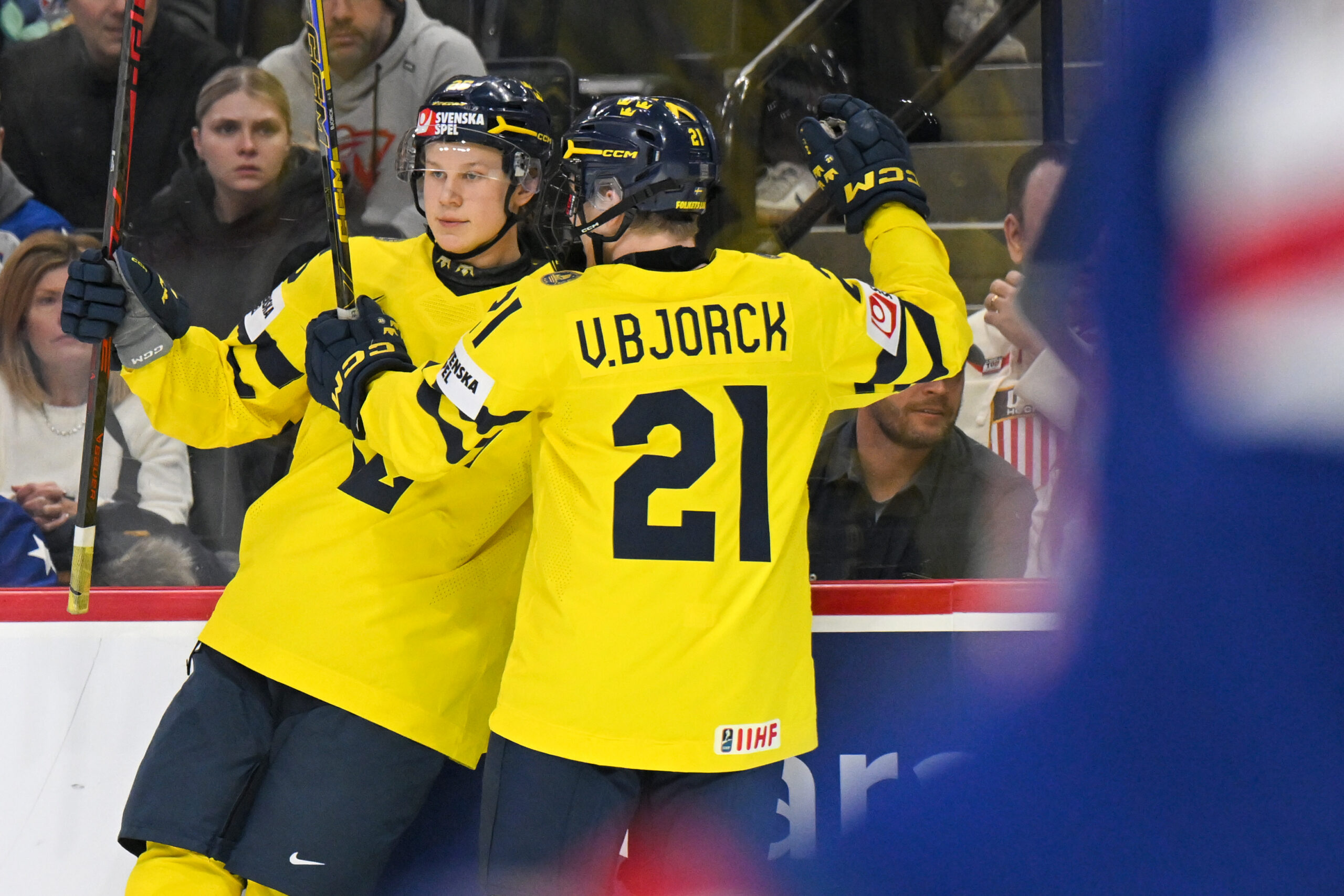
At this point, it is hardly a hot or edgy take to love Viggo Bjorck. He was, in my opinion, *the* standout draft-eligible player at the World Juniors in December, playing the leading role on a very deep Sweden team. That he did so as a true underager, versus Ivar Stenberg, who was born in September, is an incredible feat. That he did so as a 5’9″ center who isn’t overly reliant on a big shot or truly elite speed only adds to the furor. Viggo Bjorck is for real, and Dave’s hype isn’t hyperbole.
Aside: Apologies for the late start with 2026 NHL Draft coverage. Wedding planning is definitely as much work as people warned me about.
It took an outstanding performance at the Men’s World Championships (6 points in 8 games) for scouts who prioritize pro-traits, like Corey Pronman, to finally come around on Viggo Bjorck as a legitimate top player in the class. Now it seems everyone is on board with Bjorck as a consensus top ten pick, and not just as a pure forward talent, but as a legitimate top-six center prospect. To me, that means he is a serious consideration for pick 5, versus being the reach he would have been viewed as when the draft order was set in early May.
Viggo Bjorck Rankings
Below is how Viggo Björck ranks in a few of the most respected draft rankings. You can find each ranking linked, although you may need a subscription to access the full ranking:
Playstyle
The only knock against Viggo Bjorck’s toolkit is his height. Otherwise, he brings plus-to-elite-level traits across the board, which is how he has managed to stick at center at the men’s level SHL as a 17-year-old. By all accounts, Bjorck takes hockey extremely seriously, and that is reflected in his high-end competitiveness and polished game. No center prospect in this draft plays a more complete game than Bjorck, and I would argue none of them have the same offensive upside as him.
While he may not do so well on Tinder at his height, nobody who has watched Björck play would come away saying he plays small. He legitimately wins puck battles, engages physically, and he is trusted to win faceoffs. The comparison the fearless make for him is Sidney Crosby, and while he isn’t at that level of prospect, it should give you an idea of just how competitive and well-rounded he is.
And don’t be scared off by the emphasis on his compete, as I know this may trigger Rangers fans due to Lias Andersson. Bjorck has way more in his toolkit than Andersson, who lacked high-end skill and was a below-average skater. Bjorck is a good skater with legitimate high-end playmaking ability. He is also a dangerous shooter and can play many roles on a power play (trigger, passer, goal line, bumper) due to his diverse skill set.
Bjorck is outstanding defensively and has been trusted by coaches at every level to handle tough minutes. He projects as a contributor on the penalty kill as well, and was trusted there in key situations throughout the season. He was playing over 20 minutes per game for Djurgardens during their playoff run as a 17-year-old. That is actually insane.
Production & Data
The Viggo Bjorck hype is well deserved as he has the stats to back up the hype and skill set. This is a player who has been incredibly productive and broken records at every level he has played. His 15 points in 42 games are on par with the production of other elite prospects to come out of Sweden, such as Lucas Raymond, who played exclusively on the wing.
The recent examples of slightly more productive Swedish draft-eligibles were all early birthdays in the draft cycle (Leo Carlsson, Anton Frondell, William Eklund), and it’s worth noting that all of them also played wing in their draft season, unlike Viggo Bjorck, who is a true center.
For those who don’t know what NHL-e is, it’s basically a way of predicting prospect success based primarily on production. Each league is assigned a point value based on the historical success of prospects, with 1 NHL point being the benchmark. So, for example, a point in the SHL is worth .41 NHL points according to the Hockey Stats model.
According to HockeyStats.com’s model, Viggo Bjorck had the 9th highest draft year NHL-e, and the 4th highest in the class during his Draft-1 season. The model knocks him due to his height, as there are fewer successful comparables at his height. That he ranks so highly despite that weighting is only a testament to his statistical profile.

Viggo Bjorck’s micro-stat data from the SHL–hand tracked by Lassi Alanen of EliteProspects and at 5v5–are also very promising. For a 5’9″, 17-year-old center to track this well on all fronts in the second-strongest league outside North America is absolutely bonkers.
“He doesn’t fit our profile; we won’t take him”
This is the common refrain I see, and given we have very little actual information, and this draft has zero consensus, the odds say that you are probably right! But I would push back on a couple of fronts. Firstly, if the chatter surrounding Viggo Bjorck’s post-combine was that teams viewed him as a winger, I would agree. But that is not the sense I am getting at all. In fact, it seems like this spring has solidified him as a center prospect. For me, that changes things in a significant way.
As my research earlier this spring showed, the most effective way to use a top 5 pick if your goal is simply to get a top 6/top 4 player is to draft a center. If the Rangers are one of the teams that believe Bjorck is a center, assuming Caleb Malhotra is gone before pick 5, that should put him at the front of the list.
While I would argue the Rangers need a multi-season rebuild, the word out of the organization is that they will look to strengthen somehow this offseason. How is Drury going to acquire a long-term piece at center without drafting one at 5? Viggo Bjorck makes sense as a centerpiece for the retool.
Finally, I want to push back on the narrative that Bjorck doesn’t fit the mold of picks under Drury. I would strongly argue that aside from the awful 2021 draft, the only year Drury and his staff that didn’t go best player available was in 2024 with EJ Emery, who was an easily defensible pick.
Otherwise, his first picks–first picks, not necessarily first round picks–have included Adam Sykora (2022), Gabe Perreault (2023), and Malcolm Spence (2025). Sykora is undersized but is insanely competitive and endeared himself to Rangers fans this spring. Perreault is also undersized, but is probably the most skilled player in the offensive zone the Rangers have drafted in years. Spence was just an obvious good pick at the spot due to his traits and projectability, and I’d say he’s only average-sized for a prospect.
I don’t see the trend of Drury reaching for bad players with size like so many people imply, or a consistent archetype in those picks. He clearly prioritizes traits with late picks, but I just don’t see the same trend with his earlier picks. And if you want to draw similarities between his five highest picks, it’s that they are all pretty competitive players (yes, I think Perreault competes well). Well, so does Viggo Bjorck. It would be a disservice to the Rangers not to strongly consider him at pick 5. He has truly earned it and is a unique player.