
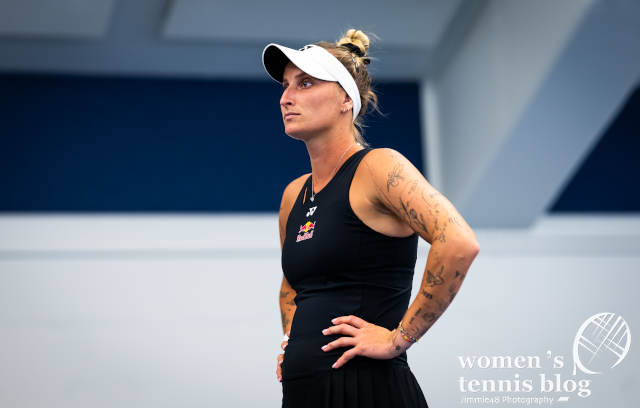
Former Wimbledon champion Marketa Vondrousova has been suspended for four years after failing to open the door to a doping control officer during an out-of-competition test in December 2025, with the ban running until June 21, 2030.
At around 8 p.m. on December 3, 2025, Vondrousova failed to provide a sample after being notified by a doping control officer during an out-of-competition testing attempt at her home. The Czech player later insisted she was not trying to evade testing, explaining that months of physical and mental strain had left her feeling unsafe about opening the door to a stranger. However, an independent tribunal found that the evidence provided offered “no compelling justification” for refusing the test and subsequently imposed a four-year ban.
Vondrousova publicly addressed the incident in April, insisting that her actions were driven by fear. The former world No. 6 said she felt particularly vulnerable given the years of threats she had received and the well-known knife attack on fellow Czech tennis star Petra Kvitova in her own home in 2016.
“For a long time, I’ve been dealing with injury, constant pressure, and ongoing sleep issues that left me feeling exhausted and fragile,” she said. “On top of that, years of hateful messages and threats have affected how safe I feel in my own space. When someone rang my door late at night without properly identifying themselves or following protocol — I reacted as a person who felt scared. In that moment it was about feeling safe, not about avoiding anything.”
The 2023 Wimbledon champion added that medical experts had diagnosed her with acute stress reaction and generalized anxiety disorder.
However, the International Tennis Integrity Agency (ITIA) rejected her explanation. Under anti-doping regulations, the standard sanction for refusing a test is equivalent to that for a positive doping result. The rule is designed to prevent athletes who may be using prohibited substances from receiving a lighter punishment simply by declining to be tested.
ITIA CEO Karen Moorhouse emphasized the importance of the testing program despite the challenges it can create for athletes. “We understand that the testing process is uncomfortable, and acknowledge that it is an additional burden for players whose jobs already come with a high level of pressure and scrutiny, but it is essential to protect fair competition,” Moorhouse said.
She also stressed that player welfare remains a priority, adding: “Safety and welfare of players and our testers is really important to us. Our testers are well-trained, professional, and the gender of our testing witness always matches the player. They carry ID at all times, and players are able to verify their identity in other ways if they are ever unsure.”
The 26-year-old Vondrousova has the right to appeal the decision to the Court of Arbitration for Sport (CAS).
“I have never doped, I have never had a positive test. Throughout my entire career I have undergone countless anti-doping controls and have always stepped onto the court with a clear conscience,” Vondrousova wrote in a statement.