
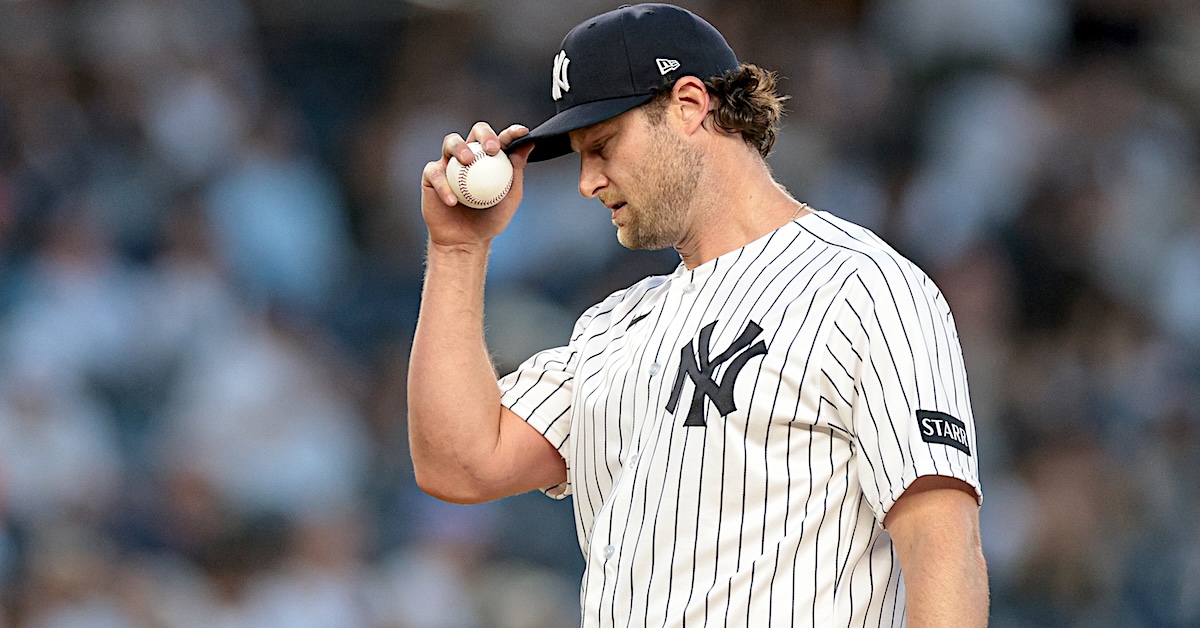
On Wednesday night, Gerrit Cole took his first loss since coming back from Tommy John surgery. After two starts of at least six scoreless innings, Cole got tagged for three home runs against the Guardians. Even so, it’s a promising return for the Yankees’ ace, who’s still throwing in the mid-to-upper 90s. His curveball is still curving, and while his fastball mix has evolved over his career in response to some trend or other, I’m confident he’ll find something that works. He always has.
I got to thinking about Cole in the context of a question I posed earlier this week about Adley Rutschman: Who’s the best draft prospect of the 21st century? Who presented the best combination of high floor and elite upside? The answer to that question is probably not Cole; if you were going for a workhorse college starter, you’d pick Mark Prior, Stephen Strasburg, or Paul Skenes. Or maybe even Carlos Rodón. But Cole definitely fits the bill; there’s a reason he was the top pick in the best draft class of the past 15 years.
And the Pirates’ decision to select Cole has been vindicated. Among players who were drafted and signed in 2011, Cole is third in career WAR, behind Francisco Lindor and Mookie Betts. But in a draft class that includes three Cy Young winners and seven Cy Young finalists (not counting Aaron Nola, who got picked in the 22nd round by the Blue Jays but went to LSU instead), Cole is still the top pitcher of his cohort.
The remarkable thing about Cole has been his reliability. He made 19 starts in his rookie season and 17 in 2024, when elbow inflammation cost him the first two and a half months of the season. In every 162-game season in between, he made at least 20 starts. When he hurt his elbow the first time, he’d missed a total of four starts in the previous seven years. And as memorable as those two crazy seasons in Houston were, it’s just as impressive that Cole has had one season of any length with an ERA over 4.00; he’s had an ERA of 3.50 or better every season since he left Pittsburgh.
He’s implacable. You can take him for granted. That’s why the Yankees made him the richest pitcher ever when they signed him to a nine-year, $324 million contract before the 2020 season. So he could do this for them forever. Nine years… who can even conceive of a time so far in the future?
Well, don’t look now, but we’re most of the way there. I know, it snuck up on me, too, because it’s felt like Cole has been 30 since 2010. But he turns 36 in September, and that nine-year contract has only two and a half years left on it.
You Aren’t a FanGraphs Member
It looks like you aren’t yet a FanGraphs Member (or aren’t logged in). We aren’t mad, just disappointed.
We get it. You want to read this article. But before we let you get back to it, we’d like to point out a few of the good reasons why you should become a Member.
1. Ad Free viewing! We won’t bug you with this ad, or any other.
2. Unlimited articles! Non-Members only get to read 10 free articles a month. Members never get cut off.
3. Dark mode and Classic mode!
4. Custom player page dashboards! Choose the player cards you want, in the order you want them.
5. One-click data exports! Export our projections and leaderboards for your personal projects.
6. Remove the photos on the home page! (Honestly, this doesn’t sound so great to us, but some people wanted it, and we like to give our Members what they want.)
7. Even more Steamer projections! We have handedness, percentile, and context neutral projections available for Members only.
8. Get FanGraphs Walk-Off, a customized year end review! Find out exactly how you used FanGraphs this year, and how that compares to other Members. Don’t be a victim of FOMO.
9. A weekly mailbag column, exclusively for Members.
10. Help support FanGraphs and our entire staff! Our Members provide us with critical resources to improve the site and deliver new features!
We hope you’ll consider a Membership today, for yourself or as a gift! And we realize this has been an awfully long sales pitch, so we’ve also removed all the other ads in this article. We didn’t want to overdo it.
That’s shocking, but Cole is far from the only player in this boat. When Bryce Harper signed with the Phillies, the $330 million price tag — a record at the time — was too much for a lot of people to get over. I lost track of how many times I had to explain that the 13-year term of the deal not only watered down the AAV, but inflation and the economic growth of the sport would make Harper’s decline phase relatively cheap. When Jesús Luzardo’s extension kicks in next year, Harper will only be the fifth-highest paid player on his own team, in terms of AAV. And he’ll only have five years left on a contract that seemingly stretched from 2019 until the Rapture.
In baseball history, there have been 41 individual player contracts worth $200 million or more. (I purposely set the bar here to exclude all but the richest pre-arbitration extensions. Those may be fashionable, but they’re a different beast than free agent contracts like Cole’s and Harper’s.) Two of those deals were ripped up (or opted out of) and renegotiated. A further 12 have run their course and expired. That leaves 27 of the 41 richest deals in baseball history still active.
Active Contracts of $200 Million or More
*Deferrals lower AAV
**Not including option years
***Opt-outs
What’s the purpose of pointing all this out? Apart from making everyone feel old because guys we remember as prospects are now on the back nine.
Signing a contract like this is to a baseball player what building a pyramid was to an ancient pharaoh: You’re going to accumulate tons of treasure and have it — along with everyone in arm’s reach — buried with you. Up until about a year ago, it took exceptional circumstances to move a $200 million contract.
As of the start of the 2025 season, that had only happened six times. On three occasions (Alex Rodriguez, Giancarlo Stanton, and the first Nolan Arenado deal), it was a case of a cheap owner biting off more than he could chew and experiencing near-immediate buyer’s remorse. You could lump the Prince Fielder-for-Ian Kinsler trade into that group as well, if you were inclined to be unkind to the late Mike Ilitch. Regardless, that deal was mostly about the contracts, not necessarily the players involved.
The other two $200 million men to get traded (Robinson Canó and David Price) were attached to in-their-prime stars (Edwin Díaz and Betts, respectively), in swaps that were part baseball trade and part salary dump.
In the past 12 months alone, we’ve seen three more of these players move: Devers, Arenado again, and Correa. Plus the Marcus Semien-for-Brandon Nimmo deal; both of those contracts barely missed the cut, but it’s the Fielder-for-Kinsler for the TikTok generation.
None of those trades are themselves novel. The Red Sox either irretrievably botched their relationship with Devers or looked at his declining contact rate, then looked at their balance sheet, and sent him across the country. (Probably a little of both.) The Correa trade was a flat-out salary dump, and the second Arenado deal had less in common with the first than with the Angels cutting the ghost of Albert Pujols in May of his walk year.
Looking at the contracts set to expire over the next few years, I don’t see an obvious trade candidate. Burnes and Tucker have opt-outs. Stanton, Arenado, and Correa seem content to play out the string like Téa Leoni and her dad at the end of Deep Impact. Yelich, Cole, Harper, and Judge are all key players on perennial contenders in cities where they’ve achieved cult hero status. I can’t conceive of a reason for any of them to seek a trade, nor any reason for their current employers to pursue one.
And at any rate, almost all of these deals come with some kind of trade protection, either written into the contract itself or as part of 10-and-5 no-trade rights. Seager is owed $157.5 million over the final five years of his deal. If Trout’s tradable, he is too.
But a team’s vibes can change faster than you’d think. Just ask Devers or A-Rod. Or Trout, who’s been a good soldier for an Angels team that’s in Year 15 of squandering his gifts. If he got fed up and wanted to chase a ring, he’s owed a little under $150 million over the last four years of his contract. That contract is probably underwater, but Kyle Schwarber and Pete Alonso both got $150 million-plus over five years last winter; the Angels might not have to pay down that much to get value back in a trade.
The future is here, and no contract is immovable.