

James Breese | Founder, Cricket Matters
All clinical standards and performance work at Cricket Matters are overseen by James Breese — Level 5 Sports Clinical Therapist (LCSP Member No. 9390) and ECB Coach. Our integrated approach holds three perspectives at once — clinical, strength training, and cricket coaching — applied to athlete safety, injury rehabilitation, and performance under load.
If you are the parent of a junior fast bowler, the load conversation is happening at your kitchen table because it is not happening anywhere else. The school coach knows what your child bowled at school. The club coach knows the club spell. The county knows the academy session. The indoor school knows nets. None of them are talking to each other. You are the only person who can see the full picture — and most of the time, the only person counting.
One coach put it on a public forum after a parent flagged a tired Under-9 boy: “I had a lad @ under 9 say he was tired because he had bowled 9 overs for his club senior side … parents when I pulled them both mentioned that 2 other lads had had 5 overs as well.” Nine overs at Under-9 across multiple senior fixtures in seven days. The rule on paper is four. Nobody had set out to break it. The system did not have a way of counting the load actually landing on the boy’s spine.
Load management isn’t about the number of overs your child bowls. It’s about what those overs do to a body that’s still developing. The right answer depends on the bowler, not the volume.
In our clinical screening at Cricket Matters, we see the result of this counting gap weekly. A fifteen-year-old asymptomatic but tired all the time. A fourteen-year-old whose back has been sore for a fortnight nobody noticed because the soreness was spread across three coaches’ awareness. A sixteen-year-old bowling well for school and club who suddenly cannot extend his back without a sharp pain nobody can name.
This post walks through what load management actually means — what the evidence says drives injury, what the ECB rules cover, what they leave open, and how to make the rest-or-play call. The point isn’t a number. It is the framework your next decision needs.
Why Bowling-Overs Counts Mislead — The Missing Variables
The first move most parents make when they start worrying about load is to count overs. It is the obvious move. The ECB rules are framed in overs. The coaches talk in overs. The scorebook records overs.
The body responds to something else.
In a prospective cohort study of professional English fast bowlers between 2010 and 2016, Alway and colleagues found bowlers with a peak seven-day workload of more than 234 deliveries were eleven times more likely to sustain a lumbar stress fracture than bowlers under 197. The study was on professionals — mean age twenty-three — but the mechanism is the same one the adolescent literature keeps converging on. The body responds to the spike, not the steady-state.
A bowler putting through twelve overs every week is in a different biological position to one putting through six one week and eighteen the next. The first is on a stable chronic load the body has time to adapt to. The second is on the same monthly average but is being asked to respond to a doubling-and-halving every seven days — when the acute load spikes above the chronic average by more than a moderate margin, the structures it lands on have not had time to adapt.
Warren and colleagues (2017) ran the direct adolescent-population study — twenty-nine male fast bowlers aged fifteen to eighteen on the ECB National Development Programme, tracked prospectively across two years. Bowlers whose acute-to-chronic workload ratio (the ratio of recent training load to longer-term average load) sat between 109 and 142% carried a relative injury risk of 1.46 compared with bowlers under 87%; bowlers at or above 142% carried a relative risk of 1.66. The finding that should anchor every parent: a high chronic workload substantially attenuated the spike’s influence. Bowlers used to bowling were better protected against a spike than bowlers who weren’t.
The Steffan Jones line: “there’s a generation of bowlers getting injured because they didn’t bowl enough deliveries when they were younger. Injuries happen when you have workload spikes — you bowl ten overs one week, and next week, fifty overs are bowled.” The body is not just responding to too much. It is responding to too much too suddenly.
The body does not count overs. It counts the rate at which the overs are changing.
Counting overs is necessary. It is not sufficient. The ECB four-overs-in-a-spell rule stops the worst-case acute exposure inside a single delivery sequence. It does not tell you whether your child’s week is loading the spine in a way the spine can absorb.
The Four Loading Variables That Actually Matter
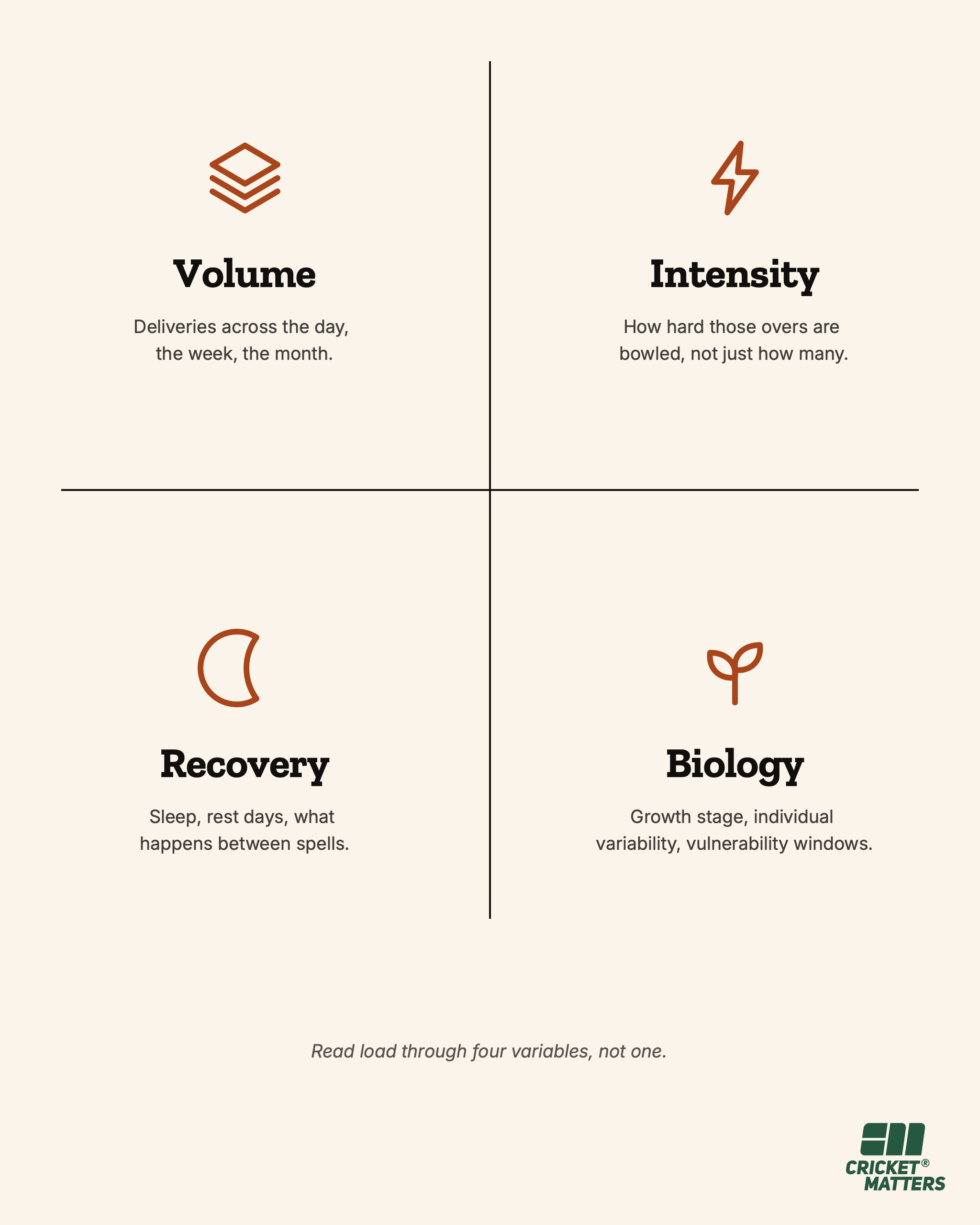
Read load through four variables, not one.
Volume. Deliveries across the day, the week, the four-week chronic window. The variable everyone counts.
Intensity. Not all overs cost the same. Bowling flat-out at ninety per cent lands more peak force on the spine than bowling at sixty. A high-intensity net session costs more than a controlled-pace match spell. The ECB rules cannot stratify by intensity — it is not measurable from the scorebook. The parent and coach are the ones who can see whether the child is bowling within themselves or running on fumes.
Recovery. What sits between the spells. Sleep. Days between bowling sessions. Whether the day after a heavy spell is a day off or a day of indoor nets. Adaptation happens in the recovery window, not during the spell. Parents who track the rest days carefully and the bowling days loosely are reading the system the right way round.
Biology. Two children of the same age, height and school year can be in entirely different biological positions. One has reached peak height velocity (PHV, the growth spurt) early and his vertebral ring epiphyses (the growth zones at the edges of the vertebrae) are well into fusion; the other is mid-growth-spurt and the weakest links in his lumbar chain are growth-cartilage. Keylock and colleagues (2023) tracked lumbar bone mineral density across the fourteen-to-twenty-four window — bone responded to load throughout, with the most marked changes in mid-adolescence. Keylock and colleagues (2022) reported a baseline lumbar bone stress injury (stress injury in the lower-back vertebrae) prevalence of 20.5% in adolescent male fast bowlers aged fourteen to seventeen, with annual incidence of 27.3 injuries per 100 players. The spine is responding to load in this window; it is also vulnerable in it.
Volume is one variable. Intensity, recovery, and biology are the other three. The first is on the scorebook. The other three are on the bowler.
The four-variable framing makes the rest-or-play decision a different kind of decision. It is no longer “did he go over the seven-over limit.” It is “where is he across all four this week.”
Back pain in a young fast bowler is rarely growing pains.
A free parent’s guide — what’s actually likely happening, what to look for at home, and what to do about it.
The ECB Guidelines — What They Say and What They Don’t Say
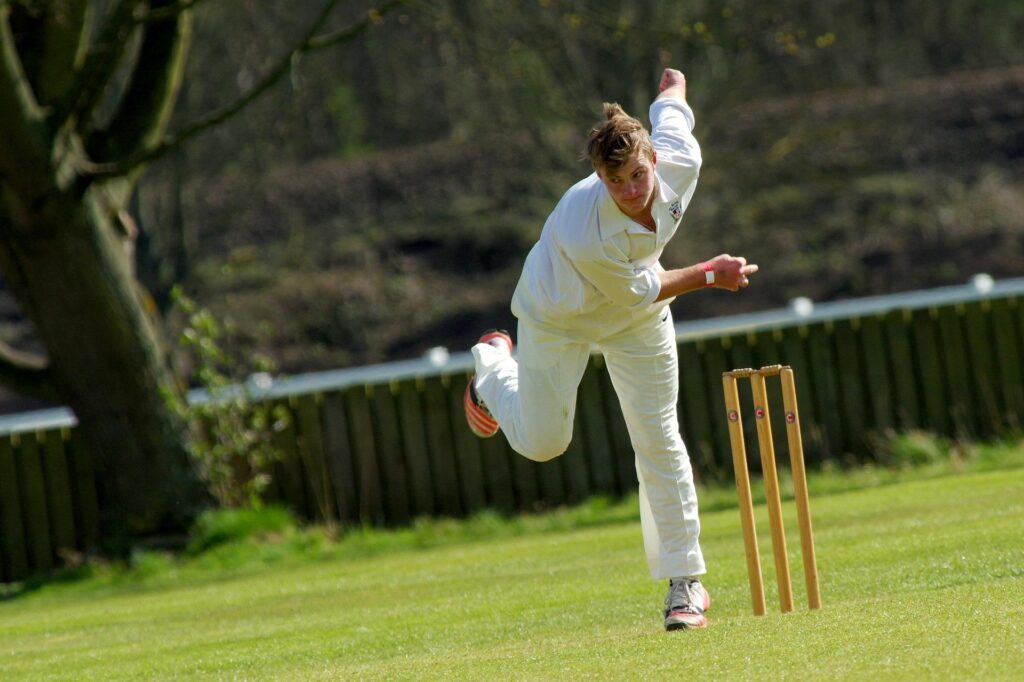
The ECB Fast Bowling Regulations for players aged 19 and below, the Recreational Cricket Safety Guidelines and the accompanying FAQ — all published in 2025 — set out per-age-band overs limits, rest intervals and recovery days. They are the floor every junior cricket programme in England and Wales is operating under.
What they cover competently: defensible per-spell, per-day and per-week limits, plus minimum rest-day allocation. The Regulations and Guidelines carry the binding rules; the FAQ carries the interpretive notes.
What they do not cover: rate-of-change, intensity, biology, the multi-team coordination problem, whether your specific child is inside the vulnerable window, whether they have the chronic load to protect against an upcoming spike.
This is not a critique. It is a statement of what regulatory documents can and cannot do. Rules cover populations, not individuals. The strongest cricket-specific workload-injury evidence — Warren 2017 — finishes its abstract: “significant individual differences in the acute:chronic workload-injury relationship were evident.” Even the evidence base the rules draw on says the relationship is not the same in every bowler.
One Cricket Yorkshire commenter put it as exasperation, on a thread about a recent rule update — “You can fight for your country at 18 but not bowl more than 7 overs in a spell!” The frustration is real; the rules sometimes sit awkwardly against the contexts they have to govern. The reframe is not that the rules are wrong. The rules are a floor. They tell you when to stop. They do not tell you when it is safe to keep going. That is a different question, and it lives in your child’s body, not the document.
The deep post on reading the ECB junior fast bowling guidelines — the parent version goes through each age-band in detail.
When School, Club, County and Indoor Cricket Add Up
The most common load-management failure in junior cricket is not breaking the per-spell limit. It is the accumulation of overs across multiple programmes when no individual programme has visibly broken anything.
A Sydney-area physio practice described the pattern in a clinic blog: parents often face a challenge where multiple cricket teams — rep trials, rep team practice, academy training — all want their child bowling as much as possible, with none of the teams talking to each other about the child’s total bowling load. The clinic was writing from Australia; the pattern is identical here. A bowler at fourteen turning out for school cricket, club junior, county academy and indoor sessions has four coaches and zero coordinators. He may be under each programme’s limit and well over the sum.
A UK youth coach put the structural cause on a forum: “parents need to take the responsible way [because] club officials have so much late information coming from the ECB on safe guarding [that] its a night mare.” Coaches operate in good faith on incomplete briefing; the parent inherits the case-management role by default.
The practical move is a notebook entry per week — one row per day, per programme, with deliveries and intensity. School nets, club training, Saturday match, Sunday county session — perhaps ninety deliveries. If the previous three weeks averaged forty, this week is a spike of more than double — well into the Warren 2017 elevated-risk band even if no individual programme exceeded its rules.
The parent’s job is not to enforce the rules. The Regulations cover that. The parent’s job is to be the one person counting across the programmes the child is inside, and to flag the rate-of-change when it crosses into territory the rules were not designed to govern.
What Symptoms Should Stop Bowling, and What Symptoms Need Watching
Some symptoms route to immediate action. Some route to watching carefully.
Symptoms that should stop bowling now and route to clinical assessment.
- Pain that wakes the child at night.
- Sharp, localised pain the child can point to with one finger that reproduces on the bowling action.
- Numbness, tingling or weakness in a leg. Loss of bladder or bowel control.
- Pain that does not ease through the over but builds — every delivery hurting more than the last.
- Fever, unexplained weight loss, or persistent night-time pain unrelated to activity.
- Pain that returns the moment bowling resumes after a rest period, repeatedly across multiple cycles.
The first four are red-flag patterns for bone-stress injury, nerve involvement or acute pathology. The fifth set routes to GP or A&E. The sixth is the recurrence pattern that sits underneath many of the conditions in the eleven-condition differential — pain that resolves with rest and returns with bowling is the body telling you something specific about how the load is landing, not a sign that more rest will fix it.
Symptoms that need watching.
- A new, dull ache in the lower back that did not exist three weeks ago.
- Tightness through the back without a specific pain location.
- Tiredness disproportionate to the training and match load — “he says he’s fine but he’s tired all the time” is the parent line worth listening to.
- A change in the bowling action a coach has noticed before the bowler reports anything.
- An asymmetry in movement that wasn’t there before — struggling to put socks on one foot; preferring to sleep on one side.
These do not need a clinic visit on day one. They need a week of honest observation: is the symptom getting worse, stable or easing? Is it correlated with bowling spells, or the weekly multi-team count? If an unresolved pattern surfaces, the clinic visit is the next move.
Pain that comes back every time bowling resumes is not the absence of recovery. It is the presence of a pattern.
How the Return-to-Bowling Decision Gets Made
When a junior fast bowler has been out of bowling — pain, a resolved injury, precautionary rest, a season break — the return decision is the highest-stakes moment in the load-management arc. Get it wrong and the spike re-injury risk is built around is the one you create yourself. A competent cricket-aware return assessment looks at six things.
The pain pattern at rest. If pain is still present at rest or first thing in the morning, the bowler is not ready for any bowling load. The easiest check and the most reliable.
The movement-system context. Hip rotation, thoracic rotation, ankle dorsiflexion. The bowling action requires range at all three; if any is restricted on the side that needs it, the spine pays for what the rest of the chain cannot manage. The cricket-specific prospective evidence (Dennis and colleagues, 2008) shows the relationship is not linear — asymmetry between sides matters more than the absolute number on either.
The pain response to graduated load. Bowling is reintroduced in stages — short approach, half-pace, controlled spell length, building to full pace and match length. At each stage: does the symptom return, stay quiet, or change pattern? A symptom returning at stage two is a different conversation to one returning at stage five.
The four loading variables looking forward. A protocol that lands the child back into a ninety-deliveries-per-week stack on week one is a re-injury setup. The return needs to land into a chronic-load build.
The bowling action under observation. Shoulder counter-rotation (the degree to which the shoulders rotate against the hips in the bowling action) across the spine is the most consistent mechanical predictor of lumbar load in the cricket biomechanics literature; Senington and colleagues’ 2018 review reported up to a twelvefold increase in lumbar injury risk associated with excessive counter-rotation. An assessment that doesn’t look at the action mechanically misses the upstream variable that may have produced the injury.
The growth-stage context. A bowler returning at fourteen during a growth spurt is in a different position to one returning at seventeen with growth slowing. The cricket-specific literature on lumbar bone adaptation (Keylock 2023) shows bone responds to load throughout the fourteen-to-twenty-four window, with the most marked adaptation in mid-adolescence. A protocol that ignores where the child sits in that window is reading half the picture.
The deep post on the staged return-to-bowling protocol covers the per-week structure.
When to Ask for Help
What to do when your child’s back hurts.
Eleven conditions cricket can produce in a teenage spine. A seven-station home screen. A clear next step for every result.
You now have the framework. Three moves are useful from here.
One — the parent’s guide. The free guide for parents of junior fast bowlers covers the home screen, the red-flag panel and the seven movement stations the clinical assessment is built around. The next step if you want to walk into the next coach conversation with the full picture rather than the per-programme slice.
Two — the deep posts in this cluster. The parent’s back-pain guide sits at the cluster’s cornerstone. The companion hub on the eleven-condition differential covers what specifically might be wrong when pain has already appeared. The deep posts on reading the ECB guidelines, the recovery-timeline question, and the staged return-to-bowling protocol each go further into a specific decision-point this hub only frames.
Three — a clarity call. A free twenty-minute conversation if the framework has produced a question about your child specifically. We do not diagnose on the call. We look at the bowling context, the load pattern and the symptom history, and tell you straight whether what your child is presenting with warrants closer assessment or whether the load math is the only piece that needs adjusting.
The load question for your specific child this week is one your son’s body is already telling you the answer to. The framework above is for reading that signal early enough to act on it before it becomes a clinic visit.
Parent Questions Answered
My child is symptom-free but bowling a lot. Should we cut his overs?
Nobody can tell you that from a number alone. The question is whether the load is stable or spiking, whether your child is in the mid-adolescent vulnerable window, and whether sleep and recovery are landing. If load is stable, the child well-recovered, no symptoms, the load is probably being absorbed. If any variable tips — particularly the rate-of-change one — the precautionary week is the higher-value move than another spell.
How do I count overs across school, club and county when none of them are talking?
A notebook or a phone notes app. One row per day, per programme, with deliveries and intensity. The aim is to be the one person who can see whether this week is more than double the chronic average. Most parents who run this for a fortnight find the count is fifty per cent higher than they had assumed.
What if the school coach says one thing and the club coach says another?
The ECB Regulations are the binding floor — neither coach can override them. The judgement on whether the load is right for this specific child this week is yours. If your view aligns with the more conservative read, take it. The dropped fixture is recoverable; the spike-driven injury loses months.
Is bowling safe at all if the rules aren’t enough on their own?
Yes. Bowlers used to bowling are better protected against a spike than bowlers who aren’t (Warren 2017). The risk is not bowling. The risk is bowling at an acutely high rate relative to what the body has adapted to. The aim is not less bowling — it is bowling at the right rate of build.
My child has back pain after bowling and the physio says muscle strain. Should we follow the rest-and-return protocol?
A muscle strain that resolves with two-to-four weeks of rest and does not return when bowling resumes is the reassuring end. A “muscle strain” label given to pain that recurs every time bowling resumes — same spot, same side — often sits over the conditions in the eleven-condition differential without naming them. If recurrence is the pattern, a cricket-aware reassessment is the next move, not another cycle of the same protocol.