
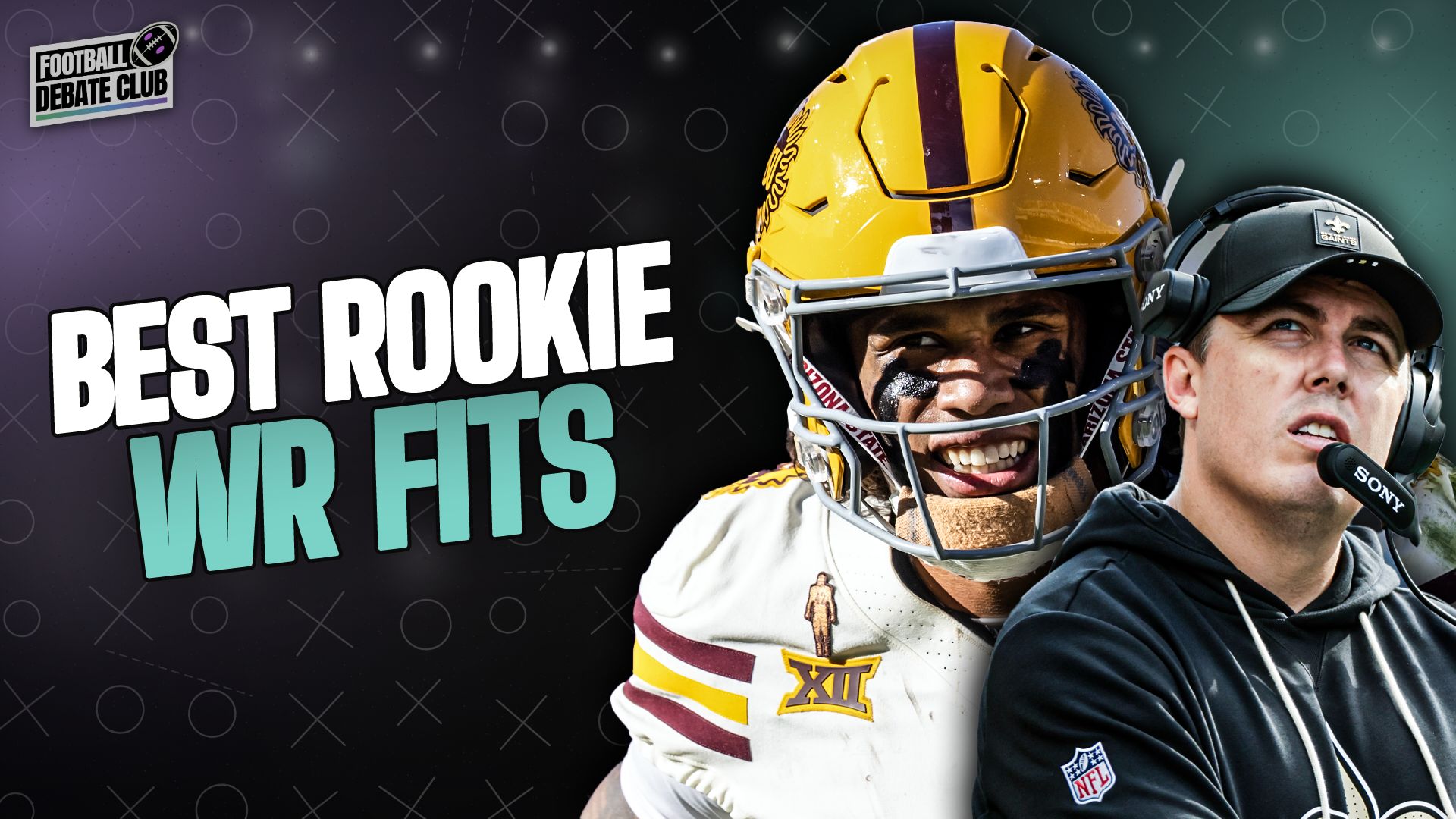
Jordyn Tyson did not come off the board as high as Carnell Tate in the 2026 NFL Draft. He may have landed in a better spot anyway.
Tate went No. 4 overall to Tennessee as the first receiver off the board. Tyson followed at No. 8 to New Orleans. When PFSN’s Football Debate Club asked which of the two drew the better situation, NFL draft analysts Ian Cummings and Alec Elijah arrived at the same name: Tyson.
Why New Orleans Is the Better Landing Spot for a Rookie Receiver
The argument starts with opportunity. New Orleans asks less of Tyson than Tennessee asks of Tate.
“In that Saints offense, you have fewer mouths to feed than you do the Titans offense, but also there’s Chris Olave there as the wide receiver one incumbent to take the pressure off of Tyson,” Cummings said.
That matters for a rookie. Olave commands the defense’s best cover man and the safety help that follows, which frees Tyson to win his routes without the full WR1 spotlight. Tennessee, by contrast, brought in Calvin Ridley and Wan’Dale Robinson and still drafted Tate to be the focal point.
The coaching fit tilts the same way. Saints coach Kellen Moore called Philadelphia’s offense in 2024, the year the Eagles won Super Bowl 59 with DeVonta Smith and A.J. Brown on the perimeter. Before that, his Dallas offense rode Dak Prescott to a 37-touchdown season in 2021. Moore has elevated receivers and quarterbacks at nearly every stop, and PFSN’s WR Impact metric credited his lone Philadelphia season with a three-point jump for both Smith and Brown.
Then there is the quarterback. Tyler Shough finished his rookie year trending up. New Orleans went 1-7 with Spencer Rattler, then 5-4 once Shough took over, and he led all rookie passers in completion percentage and passer rating. PFSN’s QB Impact ranked Shough 23rd, ahead of Tennessee’s Cam Ward at 39th. Cummings leaned on that gap.
Elijah saw the same upside. “Tyson is just going to be a stud alongside Chris Olave in New Orleans,” he said. “He’s not going to be that special teams playmaker that New Orleans got rid of in [Shaheed], but he’s still going to be a dynamic red zone threat.”
The production backs the projection. Tyson scored 19 total touchdowns across two seasons at Arizona State and topped 1,100 receiving yards in 2024 before injuries cut the year short. Elijah pegged him near the 1,000-yard mark as a rookie. That is bold, but the target share is there to chase it.
The Case for Carnell Tate, and Where It Falls Short
Tate is no consolation prize. He was the cleaner prospect, a blue-chip separator and contested-catch winner who profiles as a plug-and-play WR1, and he should see heavy volume from the jump.
The hesitation is everything around him. Ward enters Year 2 still proving he can layer the ball to all three levels, and the Titans crowded the room in free agency. Volume without efficient quarterback play caps a receiver’s ceiling, and that is the risk Tate carries that Tyson largely avoids.
BE AN NFL GM: PFSN’s Ultimate GM Simulator
Health is the swing factor. Tyson’s hamstring in 2025 and collarbone in 2024 are real flags, and a rookie cannot produce from the training room. If he stays on the field, New Orleans handed him the better runway. Tennessee handed Tate the bigger name and the harder road.