
Ferrari isolated in F1: a “CEO Racing” like Horner is needed
In Formula 1, Sunday races are won through aerodynamics, engine performance and driver talent. World championships, however, are often decided much earlier, from Monday to Saturday, inside FIA offices, around the F1 Commission table and in front of the media microphones. In this ruthless political ecosystem, Ferrari has a huge problem: it has become vulnerable.
The recent case involving the Federation modifying the starting procedure in order to neutralize the advantage of Ferrari’s turbo is viewed by many as the clearest example yet. Frederic Vasseur was left on his own to defend Maranello’s technical decisions, surrounded by rivals and without strong support from senior management. Figures like John Elkann and Benedetto Vigna remain far removed from the often hostile political dynamics of the Formula 1 paddock.
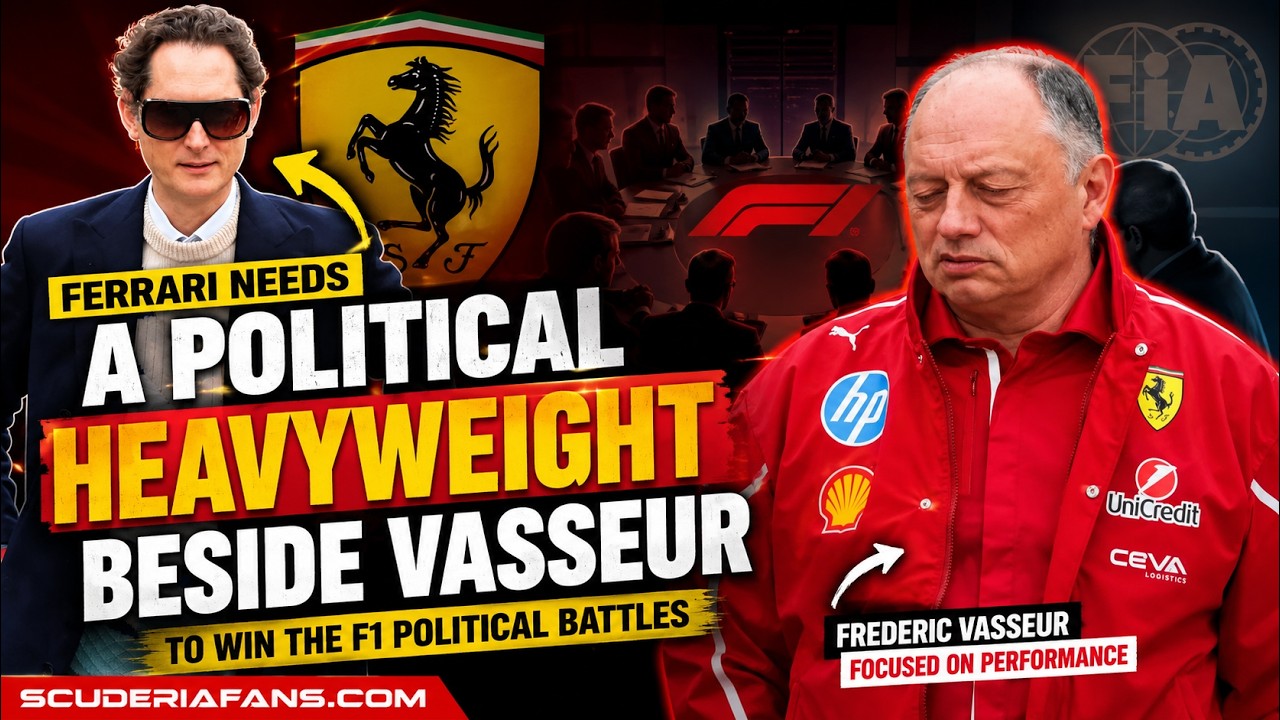
The answer to Ferrari’s sporting isolation is not replacing Frederic Vasseur. Instead, the Scuderia may need to reinforce its leadership structure by placing a political heavyweight alongside him. What Ferrari appears to lack is a dedicated “CEO Racing” figure — someone with the influence, determination and aggressive political instincts associated with Christian Horner.
The modern model: separating racing from politics
If we look at today’s leading Formula 1 teams, the all-powerful Team Principal model once embodied by Jean Todt has almost disappeared. Success in modern F1 increasingly depends on a strict division of responsibilities.
The clearest and most successful example can currently be found at McLaren. Zak Brown serves as CEO and focuses on politics, commercial relationships, sponsorship deals and public battles with rivals, as seen in discussions involving Red Bull’s multi-team ownership structure or Alpine. This allows Team Principal Andrea Stella to concentrate entirely on engineering, race operations, car setup and driver management.
Even during Mercedes’ dominant years, Toto Wolff benefited from the political weight, charisma and sharp personality of the late Niki Lauda. Together they formed a powerful leadership structure capable of handling both sporting and political challenges.

At Ferrari today, Frederic Vasseur is expected to wear too many hats. He must oversee engineering, manage team operations, support Lewis Hamilton and Charles Leclerc, represent the team publicly, handle commercial responsibilities and defend Ferrari’s interests in political debates. That is an enormous burden for a single individual.
The profile of a “CEO Racing”: why Ferrari needs its own Horner
If John Elkann were to restructure Ferrari’s racing division, the objective should be straightforward: introduce a figure operating either above or alongside Frederic Vasseur within the hierarchy. This person would serve as a chief executive dedicated exclusively to Formula 1, a political operator with deep paddock knowledge and extensive influence.
The perfect example remains Christian Horner.
Horner represents the archetype of the ruthless racing executive. He understands how to shape media narratives, apply psychological pressure to race officials and rivals, and identify the right moment to strike during crucial regulatory and political discussions.
A “CEO Racing” with these qualities could provide Ferrari with several invaluable advantages.
A shield for the pit wall: Such a figure would absorb media pressure and external controversies, allowing Frederic Vasseur, Lewis Hamilton and Charles Leclerc to focus exclusively on extracting performance from the SF-26.
Proactive technical defence: A strong political presence within FIA discussions would make it significantly harder for Ferrari innovations to be challenged or restricted. Concepts like the FTM exhaust system would face far more robust protection, backed by an experienced operator ready to engage in both legal and political battles.
A direct counterweight to Toto Wolff: At present, the Mercedes team boss remains one of the most influential voices in the paddock. Having an equally aggressive and respected figure representing Ferrari could shift the balance of power and restore some of the authority traditionally associated with the Scuderia, particularly given its unique veto rights within Formula 1 governance.
A wake-up call for John Elkann
Possessing two exceptional drivers like Charles Leclerc and Lewis Hamilton, along with a technical department capable of producing innovative concepts like FTM and Flick Tail Mode, ultimately means little if political pressure from rival teams can neutralize those innovations through regulatory intervention.
For this reason, many believe John Elkann must confront an uncomfortable reality: delegating everything to Frederic Vasseur may represent a structural weakness rather than a strength.
Ferrari needs a dedicated leader capable of fighting the political battles that increasingly shape modern Formula 1. Only by pairing Frederic Vasseur with a powerful and experienced political strategist can the Scuderia stop reacting to regulations and start influencing them once again.
Let other Scuderia Fans know about us


