
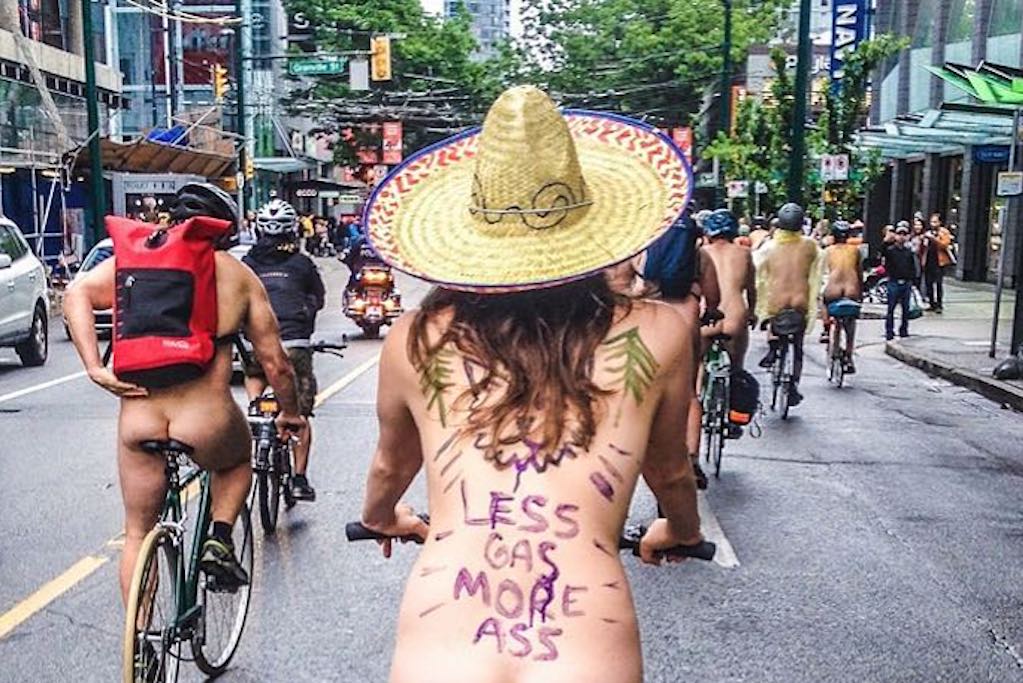
The annual World Naked Bike Ride is returning to cities around the globe this summer, bringing with it one of the most eye-catching and talked-about cycling events on the planet. From Toronto and London on June 14 to Chicago on July 12, riders will once again take to city streets in varying states of undress to promote cyclist safety, body positivity, and environmental awareness.
Part protest, part celebration, and part rolling street festival, the World Naked Bike Ride — commonly known as WNBR — has evolved from a small grassroots demonstration into a worldwide movement that now takes place in more than 70 cities across 20 countries. While the event’s nudity tends to grab headlines, organizers say the ride’s core mission is much deeper than shock value.
At its heart, the World Naked Bike Ride is about vulnerability. Cyclists ride exposed to traffic every day, often with little physical protection from vehicles around them. By stripping away clothing, participants create a visual metaphor for how unprotected people on bicycles can feel on busy urban roads dominated by cars.
The movement also embraces environmental activism and celebrates human-powered transportation at a time when cities around the world are trying to reduce congestion, pollution, and dependence on fossil fuels.
From Spain to a Global Movement
The World Naked Bike Ride traces its roots back to 2001 in Zaragoza, Spain, where activists organized an early version of the ride to protest oil dependency and car culture. The concept quickly resonated internationally. By 2004, major cities including London, San Francisco, and Vancouver were hosting their own large-scale rides.
Since then, the event has become an annual tradition in cities across Europe, North America, Australia, and Latin America. Every ride has its own local personality, but the messaging remains remarkably consistent: protect cyclists, challenge car dependency, and encourage people to rethink their relationship with transportation and the human body.
In many cities, the atmosphere feels more like a carnival than a protest march. Body paint, costumes, music, art bikes, and spontaneous dance parties are common sights as riders pedal through downtown streets cheered on by crowds of spectators.
World Naked Bike Ride Toronto (photo: Maksim Sokolov)
Why Riders Go Naked
The ride’s famous slogan — “bare as you dare” — reflects the event’s inclusive philosophy. Participants are welcome whether they choose to ride fully nude, partially clothed, or simply wearing shorts and body paint.
For many riders, nudity is not about exhibitionism. Instead, it is intended as a political and social statement. Organizers argue that the vulnerability of the naked body mirrors the vulnerability cyclists experience every day on roads designed primarily for cars.
The event also promotes body positivity in a society saturated with unrealistic beauty standards. The World Naked Bike Ride has become known for creating an unusually accepting and judgment-free atmosphere where participants of all ages, body types, genders, and backgrounds are welcomed.
For first-time participants, that atmosphere is often what leaves the biggest impression. Many riders describe the experience as surprisingly empowering and liberating, particularly in a public culture where bodies are frequently scrutinized or commercialized.
At the same time, the ride has increasingly become a platform for climate and environmental activism. Organizers in Vancouver have described the event as a protest “against car culture, oil spills, and pipelines,” while also calling it a “celebration of creativity, individuality, and the human-powered machine.”
Toronto, London, Chicago and Vancouver Prepare for 2026 Rides
Several major cities have already announced dates for their 2026 World Naked Bike Rides.
In Toronto and London, riders are expected to gather on June 14 for what are traditionally among the largest and most visible WNBR events in the world. London’s ride in particular has become legendary, often drawing thousands of participants and weaving through some of the city’s most iconic streets and landmarks.
Meanwhile, Chicago has officially scheduled its ride for Saturday, July 11. Organizers are encouraging volunteers to help support the event while calling on participants to ride in support of cyclist safety, body positivity, and energy independence.
In Vancouver, preparations are also underway for another massive summer gathering normally held in early July. Participants traditionally meet at Sunset Beach near the intersection of Beach Avenue and Bute Street, where pre-ride festivities typically begin around noon.
One of the most popular parts of the Vancouver event is the communal body-painting session, where riders transform themselves into living works of art before heading onto city streets. By mid-afternoon, cyclists depart on the “bare-as-you-dare” ride through downtown Vancouver, creating one of the most visually striking cycling events in Canada.
Following the ride, participants often gather for a celebratory picnic hosted by Naked Iconoclasts Fighting The Yoke (NIFTY), a clothing-optional rights organization that helps support the event and foster a welcoming community atmosphere.
The Art Bikes, Body Paint, and Festival Atmosphere
Beyond activism, creativity has become one of the defining characteristics of the World Naked Bike Ride.
Many participants spend weeks decorating their bicycles with elaborate lights, flowers, signs, flags, and artistic installations. The “Art Bike” tradition has become central to the event’s culture, transforming ordinary bicycles into moving sculptures and political statements.
Body paint is equally important. Riders often use paint to display slogans promoting cycling infrastructure, climate action, oil-free transportation, or body acceptance. Others simply embrace the playful spirit of the ride with colourful designs, costumes, and themes.
Portable speakers and public-address systems add to the atmosphere, with riders chanting slogans, blasting music, and turning entire city blocks into rolling celebrations of bicycle culture.
The result is an event that feels somewhere between a protest march, a parade, and a street festival.
The Most Famous World Naked Bike Ride Cities
Although dozens of cities host WNBR events each year, a handful have become particularly famous within the cycling community.
London is widely considered home to one of the largest rides in the world, often attracting thousands of participants and extensive media attention. Riders pass famous landmarks while promoting safer streets and sustainable transportation.
Amsterdam, July 11, feels like a natural fit for the event thanks to the Dutch capital’s famously bicycle-friendly streets and relaxed cycling culture.
Meanwhile, Madrid, held in June, blends activism and celebration in the city where the broader movement first gained traction more than two decades ago.

World Naked Bike Ride, London (photo courtesy: WNBR London Facebook)
What It’s Like to Participate
For newcomers, the World Naked Bike Ride can feel intimidating at first. But veterans often say the nervousness disappears quickly once the ride begins.
The atmosphere is typically welcoming, supportive, and surprisingly relaxed. Riders encourage each other, share sunscreen and body paint, and celebrate the shared experience of reclaiming city streets for people rather than cars.
Spectator reactions vary widely. Many people cheer enthusiastically from sidewalks and patios, while others stop in stunned silence to watch hundreds or even thousands of cyclists roll by. Some critics continue to view the event as inappropriate or controversial, but organizers argue that the ride’s visibility is precisely what makes its message effective.
In many ways, that tension is part of the point. The World Naked Bike Ride deliberately challenges social norms while sparking conversations about transportation, urban design, fossil fuel dependency, and public space.
Challenges and Controversies
Despite its growing popularity, the World Naked Bike Ride still faces legal and logistical challenges.
Public nudity laws vary significantly between cities and countries, forcing organizers to work carefully with municipalities and law enforcement to secure permits and clarify rules for participants. Some cities have embraced the event, while others have imposed restrictions or attempted to block rides altogether.
Weather can also play a major role. Rain, cold temperatures, or extreme heat can quickly transform the experience from liberating to uncomfortable, making preparation essential. Riders are encouraged to stay hydrated, apply sunscreen generously, and bring layers or towels when needed.
Oh, and if using bike share for the event. Umm, be sure to properly clean the saddle post ride.
Organizers also emphasize respect and consent throughout the event. Photography guidelines are common, and participants are encouraged to ask permission before taking close-up photos of riders. Maintaining a safe and respectful environment has become a major priority for WNBR communities worldwide.
Why the World Naked Bike Ride Continues to Grow
As cities grapple with climate change, traffic congestion, and rising concerns about road safety, the messages behind the World Naked Bike Ride have arguably become more relevant than ever.
Cycling advocacy has moved increasingly into the mainstream, with many cities investing heavily in bike lanes, active transportation infrastructure, and car-free public spaces. At the same time, conversations around body positivity and personal freedom have also evolved, helping broaden support for events that challenge traditional norms.
For supporters, the World Naked Bike Ride represents more than a spectacle. It is a reminder that streets are public spaces meant for people, not just automobiles.
And while the sight of thousands of nude cyclists rolling through downtown streets may initially seem shocking, participants insist the ride is ultimately about something surprisingly simple: freedom, visibility, sustainability, and the joy of moving through a city under your own power.
So the next time you spot a sea of painted bodies pedalling through the streets of your city, remember — the World Naked Bike Ride is not just about what riders are taking off. It is also about what they hope cities will leave behind: car dependency, unsafe streets, and a transportation culture built almost entirely around fossil fuels.