
In nine months, some cheerful young player who was drafted in 2026 will be standing on the stage at the NFL Honors receiving the award for Rookie of the Year. In fact, two will — offense and defense.
Immediately after last year’s draft, I stacked my personal board for both awards, with the eventual winners falling to fourth (Tetairoa McMillan) and sixth (Carson Schwesinger) on my lists. I’m pretty happy with those outcomes for early May guesstimates, as we don’t even have training camp depth charts or preseason injury news yet. Both awards follow fairly consistent bumper rails for voters, and as such, we can define favorites and (reasonable) sleepers from long distance.
Here are my way-too-early rankings for Rookies of the Year candidates, split by offense and defense. I’ll go through the possibilities and then give my final list.
Jump to: OROY | DROY

Offensive Rookie of the Year
The favorites
Three skill position players left the board in the first four picks on Day 1: quarterback Fernando Mendoza (Raiders), running back Jeremiyah Love (Cardinals) and wide receiver Carnell Tate (Titans). These are the clear big favorites and the only three players I’ll discuss up top here.
We’re fresh off a season in which a receiver won Rookie of the Year, as Panthers’ first-round wideout McMillan produced 1,014 yards and seven touchdowns in what was generally a down year for OROY options. Saints quarterback Tyler Shough finished behind McMillan in voting despite only nine starts, and had he played 17 games, the conversation would have been more interesting.
As a general rule, quarterbacks who start the majority of the season (and produce) win the award over spectacular seasons from non-quarterbacks. In 2023, Texans quarterback C.J. Stroud and Rams wide receiver Puka Nacua had excellent rookie seasons, but Nacua’s campaign was legitimately record-setting, as his 105 receptions and 1,486 yards became new marks for rookie receivers. The yardage record had stood for 63 years before Nacua broke it!
Yet Stroud didn’t just win the award. He dominated Nacua, securing 48 of 50 first-place votes. Similarly, in 2019, Cardinals quarterback Kyler Murray (with modest stats but 16 starts) beat out Raiders running back Josh Jacobs (with great production but only 13 games) for the title. Identifying early-season starters at quarterback is the quickest path to finding Offensive Rookie of the Year favorites.
As such, Mendoza should lead this clubhouse. He doesn’t need to start in Week 1, as the Raiders signed a well-paid backup in Kirk Cousins this offseason. But Cousins’ tune at his introductory news conference was quite soft: “I don’t want to start unless I’m the best option. I told Klint [Kubiak] that the best player should play.” I’m willing to bank on Mendoza’s long runway of preparation for Kubiak’s offense — he has known he was going to be a Raider since January — giving him an early leg up relative to most rookies.
The path is there for Mendoza to be productive. The Raiders aren’t bereft of pass-catching options. Brock Bowers is as good of a tight end as a young passer can ask for, and there are worse receiving rooms than the Raiders’ offering of Tre Tucker and Jalen Nailor. The Raiders might be run heavy with Ashton Jeanty and rookie fourth-rounder Mike Washington Jr. in the backfield, but remember, it’s all about starts and decent play for ROTY quarterbacks. Run heaviness won’t hurt too much.
Critically, a quarterback also doesn’t need to win games to garner OROY love. Murray won the award on a 5-10-1 Cardinals squad, while 2020 Justin Herbert led the Chargers to a 7-9 record. Any semi-respectable record (read: not 3-14 again) will let Mendoza qualify — and I think the Raiders’ roster is plenty capable of such a season.
Should Mendoza’s rookie year prove disqualifying for any of a number of reasons — injury, team collapse, a bunch of Cousins starts, Jeanty rushing for 2,000 yards, etc. — Tate and Love become more interesting.
Receivers have been in as of late. McMillan was the third receiver to win the award in the past five seasons (Jets’ Garrett Wilson in 2022 and Bengals’ Ja’Marr Chase in 2021), but he’s only the sixth wideout to win the award this century. Receivers have recently leapfrogged running backs as the non-quarterback contenders in Rookie of the Year voting — no back has won Rookie of the Year since Saquon Barkley in 2018.
Can Tate have the season McMillan just had? I’m dubious. Tate was not the primary receiver at Ohio State and will now draw WR1 attention in the NFL. I had a lower grade on Tate coming out than I had on McMillan last year, and I have more esteem for Dave Canales calling plays in Carolina than I do for Brian Daboll in Tennessee. Plus, Daboll will be tempted to funnel targets to former Giant Wan’Dale Robinson, a notorious high-volume slot receiver. The road for Tate to climb is tougher than McMillan’s was a year ago.
On the other hand, the fourth pick is the fourth pick. The Titans are telling us that they want Tate to produce heavily. I’m just not sure I buy the talent level relative to past winners such as Wilson and Chase.
Love seems like an obvious favorite for Rookie of the Year, and I get it from a talent perspective. He is the earliest drafted running back since Barkley, who is the most recent running back winner. Barkley led the league in yards from scrimmage as a rookie, and while Love is unlikely to be that productive, he does have the receiving chops to be a dynamic three-down player.
But we’ve seen more receivers than running backs win the award lately because of the changing dynamic at the position. The league doesn’t hammer one back with carries the way it once did. Barkley had 352 touches in that 2018 season, working out to 22.0 per game. In the seven seasons since, only 10 backs have exceeded that number (minimum 14 games played), and they have earned that sort of usage. The only rookie to exceed 2018 Barkley was 2021 Najee Harris with the Steelers (22.4 touches per game). The next closest was 2020 James Robinson with the Jaguars (20.6 touches per game), then 2025 Jeanty (18.9).
Of course, you don’t need 22 touches per game to win Offensive Rookie of the Year. Alvin Kamara did it on a measly 12.6 touches for the Saints in 2017, less than starting running back Mark Ingram II. Kamara reminds us that running back production is much more situational than quarterback and receiver production; it took a special playcaller (Sean Payton) and a late-career Drew Brees sprinting to the checkdown to open the door for Kamara. A bet on Love for Rookie of the Year is a bet that he’s closer to Barkley (transcendently talented, able to produce on even a bad team) than he is to Jeanty (extremely talented but still limited by poor quarterback/offensive line play).
Love joins an offense captained by the unholy product of a Jacoby Brissett/Gardner Minshew II/Carson Beck camp battle and will run behind an offensive line that was 29th in adjusted line yards last season (the FTN Fantasy stat for how much an offensive line affected a team’s running game. Improvements have been made (signing guard Isaac Seumalo and hiring coach Mike LaFleur), but I’m unwilling to buy into any Cardinals offensive success this year.
The long shots
Outside of the top-five picks, seven skill position players went in the first round. We can easily scratch QB Ty Simpson, who will be a backup in Los Angeles and will only play if Matthew Stafford is injured. We can also scratch Kenyon Sadiq since a tight end has not won the award since Mike Ditka in 1961, which was before the AFL/NFL merger. I mean, Brock Bowers didn’t win it in 2024 (though he likely would have in a down quarterback year). I will be pleased to look extremely stupid in the event that Sadiq wins the award, as I love the player. But it will be legitimately unprecedented.
Here are the five remaining with my thoughts on their legitimacy:

Jordyn Tyson, WR, Saints: WR2s don’t typically win the award, and Tyson is surely the WR2 behind Chris Olave. Of course, Olave has never played a full 17-game season or played more than eight games in a season. And Tyson does have the talent to go for a 1,000-yard season so long as he stays healthy, which is not a guarantee. The Saints were the fastest-paced NFL offense by a serious margin last season, so Tyson should see more opportunities for compiling stats. I’m intrigued but not ready to commit.
3:34
Why is Mansoor Delane such an elite pick for the Kansas City Chiefs?
SEC Network’s Chris Doering describes why Mansoor Delane was a great pick for the Chiefs and how he will impact their defense this upcoming season.

Makai Lemon, WR, Eagles: Lemon is the leader in the clubhouse for WR2 behind DeVonta Smith (assuming A.J. Brown is traded), but it’s tough to feel great about his potential for drawing volume on a run-heavy team such as the Eagles. However, any injury to Smith will immediately put Lemon in a position for eight-plus (and even 10-plus) targets per game, as there are no incumbent veterans (save for Dallas Goedert) in his way. He goes from an afterthought to potential leader in the clubhouse should that domino fall.
KC Concepcion, WR, Browns: Here’s our potential WR1. Concepcion has high volume potential as a slot receiver and high explosive potential as a serious YAC athlete with tackle-breaking ability. Browns coach Todd Monken figures to use Concepcion much as he used Zay Flowers in Baltimore, so Concepcion could see rushing production accordingly. Should the Browns find themselves trailing often, Concepcion will see an increase in volume as well. I would be all-in were it not for my fears that the QB play will be debilitatingly poor.

Omar Cooper Jr., WR, Jets: The Jets traded up in the Round 1 to secure Cooper as their every down WR2 behind Garrett Wilson. He has almost no incumbent challenge as targets at receiver, as Adonai Mitchell is the best candidate to steal some of his snaps. However, the tight end duo of Mason Taylor and Kenyon Sadiq, and the presence of running back Breece Hall do put a damper on his expected volume. Cooper is a tier below players such as Concepcion and Lemon as far as talent goes, and it’s hard to see him producing the big games necessary to steal this award from a starting quarterback or productive back.

Jadarian Price, RB, Seahawks: Price has a strong path to serious candidacy. The Seahawks split their backfield work between Zach Charbonnet and Kenneth Walker III last season, and their plan is likely to slide Price into Walker’s shoes. But Charbonnet tore an ACL in the divisional round of the playoffs, so he’ll be less than eight months removed from the injury when Week 1 hits. That gives Price an opportunity to immediately wrest control as a 15- to 20-plus touch player in the first month. Price was not much of a receiver at Notre Dame, but in Love’s shadow, his three-down potential was fairly untapped. On a Seahawks team that figures to lead many games, he could accumulate second-half touches and put together a highly productive campaign.
The longer shots
It is certainly possible to win Offensive Rookie of the Year from outside the first round. Recent such winners include Kamara (2017), Dak Prescott (2016) and Eddie Lacy (2013). There isn’t really an easy unifying thread between these late drafted winners (Anquan Boldin! Anthony Thomas! Randy Moss!) save for poor performances from the first-rounders. In this weak 2026 draft class, the window for a middle-round player to emerge is cracked slightly wider. Of course, the RB3 came off the board at No. 91 — the latest RB3 in the common draft era — so that blade cuts both ways.
A few players selected outside of Round 1 who I believe have the best shot to win Rookie of the Year:
Denzel Boston, WR, Browns: As much as Concepcion has a good chance to become the WR1 in Cleveland, so does Boston, who was drafted 15 picks later. He has a bigger body (6-foot-4, 209 pounds) with a larger catch radius, and that might be better suited to produce with the Browns’ quarterbacks of questionable accuracy.

Carson Beck, QB, Cardinals: I was not a Beck believer predraft, but there is a path for him to be the Week 1 starter if he can beat out two career backups in Jacoby Brissett and Gardner Minshew II. If he does, he has a solid group of pass catchers and a head coach stemming off the Sean McVay/Kyle Shanahan tree in Mike LaFleur. Production — even if it’s composed entirely of empty calories accumulated in trailing scripts — will not surprise me for a 23-year-old with good point guard characteristics.

Antonio Williams, WR, Commanders: A schematic overhaul is underway in Washington, where the old Kliff Kingsbury college offense has been shed for a Ben Johnson-inspired system that gets under center and hunts explosive plays off play-action. For that offense, which desperately needs a pass catcher opposite Terry McLaurin, the front office handpicked Williams, one of my favorite players in this class. Williams has some Amon-Ra St. Brown to his game since he’s as tough as nails, willing to win downfield throws through contact and slippery in his routes. I would not be surprised if he starts getting more targets than McLaurin by season’s end.

Drew Allar, QB, Steelers: In order for a middle-round quarterback to win Rookie of the Year, he must be thrust into a surprising season of full starts (think 2016 Dak Prescott off the Tony Romo injury). Given that Pittsburgh’s QB1 is expected to be 42-year-old Aaron Rodgers, who has a 2023 Achilles tear on his résumé — he still has not committed to return for 2026 and could end up elsewhere despite the Steelers using the UFA tender on him this week — Allar could have an avenue. However, Allar must be ready for those starts.
My Offensive Rookie of the Year candidate rankings
If a player is not included, it means they have zero chance of winning the award. It simply will not happen. Do not screenshot this.
-
Fernando Mendoza
-
Jeremiyah Love
-
Carnell Tate
-
Jadarian Price
-
Jordyn Tyson
-
KC Concepcion
-
Makai Lemon
-
Denzel Boston
-
Omar Cooper Jr.
-
Carson Beck
-
Drew Allar
-
Antonio Williams
Defensive Rookie of the Year
The favorites
Defensive Rookie of the Year is conveniently organized for prognosticators. Since 2000, 22 of the 26 winners (85%) have been first-round picks. The four players who didn’t go in the first round were linebackers taken before No. 40, including last year’s winner Carson Schwesinger. (The Browns took Schwesinger at No. 33 to start Day 2, and he was my featured long shot to win the award.)
Sadly, there were no linebackers taken in the second round before No. 40 this year. We can stretch our constraints slightly to fit three, maybe four, maybe five linebackers on Day 2, and we will … when we get down to the long shots.
Otherwise, we’re constrained to the first round. Thirteen defensive players were selected Thursday: two defensive tackles, five edge rushers, two linebackers (Arvell Reese is a linebacker here since that is what he’ll play with the New York Giants), three cornerbacks and a safety. For as special as Caleb Downs is, a safety has not won Defensive Rookie of the Year this century — they simply aren’t around the ball enough. Downs is a candidate to spend more time in the slot given the needs of Dallas’ defense. I am so tempted to keep him alive on the list, in that I believe he’s a spectacular player … but by the harsh reality of history, he must be cut.
Of those 22 first-rounders who won Defensive Rookie of the Year, 20 were selected in the first half of the first round. Marcus Peters (No. 18 in 2015) bucked the trend with an eight-interception season (two for touchdowns) and was voted to an All-Pro team. Jared Verse (No. 19 in 2024) was the other, but he was drafted in a historic class in which only two defenders went in the first 16 picks. While I won’t exclude the back half of Thursday’s first round altogether as favorites, I will mainly focus on five top-16 selections, excluding Downs.
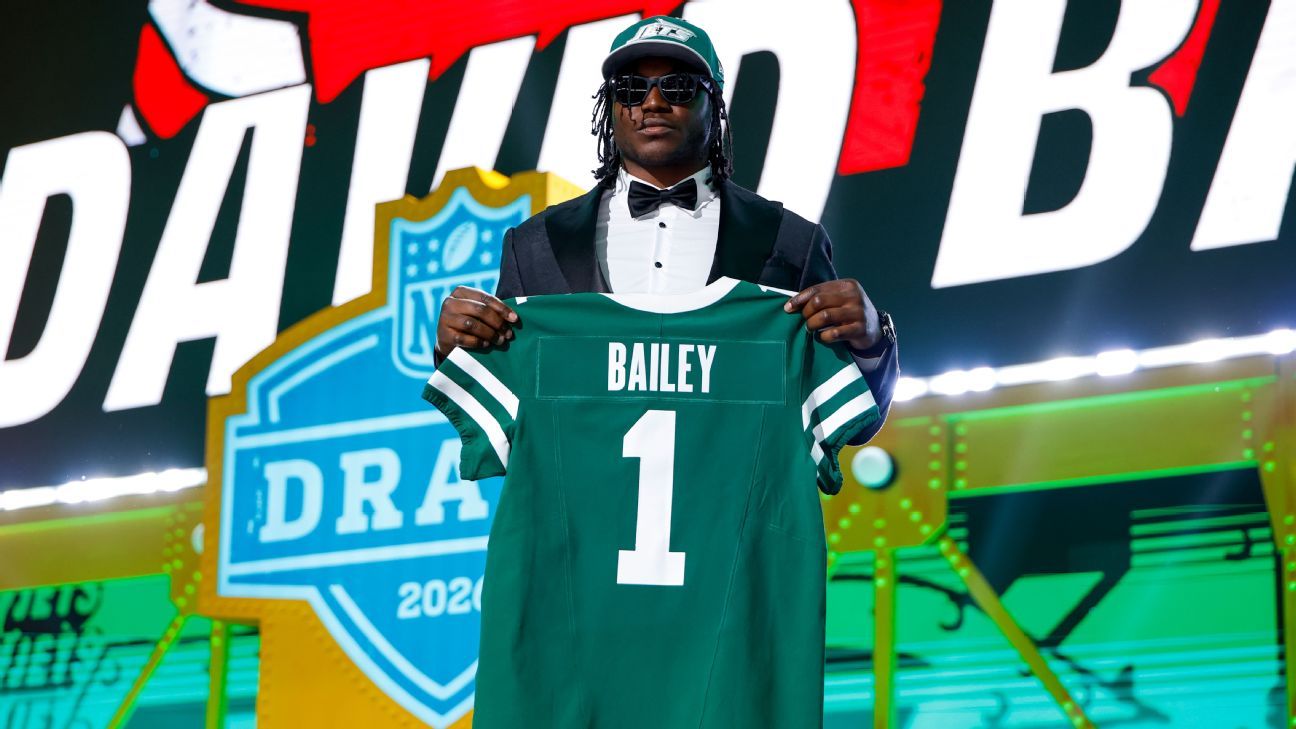
David Bailey, Edge, Jets: The highest drafted edge rusher with the highest pass-rushing ceiling, Bailey is an easy candidate for the top of the list. His running mates on the edge (Will McDonald IV, Joseph Ossai and Kingsley Enagbare) are dangerous enough that Bailey won’t see disproportionate double-team rates. As a splashy pass rusher with average run defense, he figures to save his legs for premier rush downs, which will inflate stats like sack and pressure rates. As long as the Jets aren’t always trailing and facing clock-chewing offenses, Bailey should produce eight-plus sacks.

Arvell Reese, LB, Giants: It’s harder for an off-ball linebacker to win this award than you might expect — only three have since 2009, when Brian Cushing finished a four-year run of stack linebackers bringing home the hardware. We simply value pass rushing far more than tackle collection in the modern NFL … but that might be good news for Reese, who figures to grab more pass rush reps (and sacks) than the average off-ball linebacker. The more we learn about the Giants’ plan for him, the easier he’ll be to predict. Right now, he’s mostly theory.
Mansoor Delane, CB, Chiefs: The Chiefs traded up in the first round to secure Delane, and he will have an unimpeded path to CB1 reps after they traded Trent McDuffie and let Jaylen Watson walk in free agency. Corners need production on the ball to win this award, and Delane will get tested as a rookie covering star receivers. He was quite productive in college — 11 passes defensed in 11 games during his final season. Cornerbacks don’t win the award often, but all three winners this century were after 2014. It’s hard to put Delane clearly above the edge rushers, but when corners win Rookie of the Year, they look like this.
2:20
Colts’ GM: We were excited CJ Allen was available for us to draft
Colts general manager Chris Ballard joins “The Rich Eisen Show” to discuss Indianapolis’ draft class and what he liked from it.
Sonny Styles, LB, Commanders: Bobby Wagner was a tackle vacuum for the Commanders, but can Styles do the same as he steps into his shoes? It’s a towering task, but Styles also has the DB background and unique frame (6-foot-4, 243 pounds) to make far more plays in the passing game than the average starting linebacker. Riddling out whether Styles can get 100% of the snaps in Week 1, with Frankie Luvu and Leo Chenal also on the depth chart, is the key to defining just how strong of a candidate he is. But the blend of tackle production and pass coverage might be too much for voters to ignore.

Rueben Bain Jr., Edge, Buccaneers: Bain barely slips in below the threshold, as the Bucs snagged him at No. 15. A pro-ready run defender who has little competition on the depth chart, Bain is exactly the sort of player I look for as a Rookie of the Year candidate … save for one key issue. He isn’t a high sack player. His short arms and favored power rush create a lot of disruption, but unless he lucks into some cleanup work, it’s hard to imagine Bain — who maxed out at 9.5 sacks in 16 games last season — suddenly becoming a double-digit sack artist in the league. Still, he might have enough TFLs and advanced stats to draw legit candidacy.
The long shots
From picks 16 to 32, six more defensive players went. Again, we can toss aside the safety — sorry, Dillon Thieneman — and focus on the five remainders.

Caleb Banks, DT, Vikings: No defensive tackle has won Rookie of the Year since Aaron Donald in 2014, and the only other tackle to do it this century was Ndamukong Suh. Banks is that sort of talent and an enticing bet accordingly. But he has a foot injury that’s impossible to overlook. He also plays in a Brian Flores defense that doesn’t allow defensive tackles to play the sort of unhinged, penetration-oriented style that leads to sacks. Sure, the Vikings spent an early pick on Banks — but as head coach of the Dolphins in 2019, Flores used the No. 13 pick on Christian Wilkins, and he had two sacks as a rookie. It’s hard to see the path for Banks.

Akheem Mesidor, Edge, Chargers: Mesidor figures to be the Edge3 behind Khalil Mack and Tuli Tuipulotu. Perhaps that means he brings fresh legs onto the field on pass-rush downs and accumulates sacks while that spectacular Chargers secondary forces quarterbacks to hold the ball. However, the more likely scenario is that the rotation limits too many of his opportunities. I’m not buying it.

Malachi Lawrence, Edge, Cowboys: It’s unclear just how many snaps Lawrence will get in Dallas, as second-year player Donovan Ezeiruaku and trade acquisition Rashan Gary also sit on the depth chart. But with new defensive coordinator Christian Parker, tons of snaps are up for grabs. Lawrence has elite explosive measurables and a better path to every down opportunities than late drafted pass rushers. He’s the sleeper to circle.
Chris Johnson, CB, Dolphins: It would be so cool if, mired in what’s sure to be a terrible Dolphins season, Johnson snagged seven picks and won Defensive Rookie of the Year. It’s not impossible — Sauce Gardner won it in 2022 on a 7-10 Jets squad. And Jeff Hafley’s Packers were eighth in turnovers per defensive drive over his two years in Green Bay. I’m not saying it’s likely, but interceptions have a lot of randomness to them, and there’s no Myles Garrett or Will Anderson Jr. in this edge rusher class. The door is open.
Peter Woods, DT, Chiefs: I’m willing to get totally wild and draw a world in which Chris Jones draws all the double teams, Steve Spagnuolo continues to blitz at a high rate and Woods collects a ton of behind-the-line production as a cleanup man. It’s not at all likely, but for most defensive tackles drafted at No. 29, I would tell you there’s no shot. Woods is a great penetrator, and the environment is right in Kansas City.
The longer shots
As I said above, the only players who are not first-rounders to win Defensive Rookie of the Year this century were linebackers selected at the top of Round 2. Those were Schwesinger (No. 33 in 2025), Shaquille Leonard (No. 36 in 2018), DeMeco Ryans (No. 33 in 2006) and Kendrell Bell (No. 39 in 2001).
No linebackers left the board in the 30s this year, but five were picked in Round 2. For the sake of argument, I’ll include them here in order of where they were picked:
Jacob Rodriguez, LB, Dolphins: Rodriguez is perhaps the most Schwesinger-esque of the five Round 2 options. Undersized (6-foot-1, 230 pounds) but with magnets to the ball, Rodriguez will be a fun candidate in a different defense. But there simply won’t be enough production to go around alongside All-Pro linebacker Jordyn Brooks. Linebackers need to accumulate 100-plus tackles to win the award, and Brooks will beat Rodriguez to too many spots.
Josiah Trotter, LB, Buccaneers: Trotter runs into a similar issue to Rodriguez, as he plays next to a quality veteran in Alex Anzalone. But Anzalone is a free agent addition, and Trotter’s unique skill in college was his burst and unreal football instincts to create tackles at or near the line of scrimmage. He’s in the race for the award, especially if he shows during camp that he can play faster than the aging Anzalone.
Jake Golday, LB, Vikings: Golday is an off-ball/on-ball tweener who will be stuck behind established starters at both positions: Andrew Van Ginkel and Dallas Turner at outside linebacker; Eric Wilson and Blake Cashman at inside linebacker. He will undoubtedly have flashy plays in subpackages, but he simply will not see enough snaps — barring injury — to contend for this award.

CJ Allen, LB, Colts: Here’s the player who could really win it. Allen is the unquestioned LB1 in Indianapolis, was a prolific tackler at Georgia and was drafted by the same GM (Chris Ballard) who snagged 2018 Defensive Rookie of the Year winner Shaq Leonard — a linebacker in Round 2. Coordinator Lou Anarumo’s defense was great for Logan Wilson (four straight seasons of 100-plus tackles), and Allen has a strong football IQ to succeed within it. Great fit, great opportunity.
Anthony Hill Jr., LB, Titans: We’re well into uncharted territory now. It’s tempting to say Hill — a high-ceiling but still raw prospect — is certain to start over incumbents Cedric Gray and Cody Barton. I would call it likely but not guaranteed, and as such, we’ve stretched too thin my tolerance for eliminating historical precedent. Hill simply isn’t guaranteed the snaps necessary to be a strong preseason candidate for Rookie of the Year. Check back in training camp.
My Defensive Rookie of the Year candidate rankings
While the history of winners is more restrictive, defense can also be pretty random. If Jermod McCoy plays a fully healthy season for the Raiders and catches six picks, so be it.
-
David Bailey
-
Rueben Bain Jr.
-
Mansoor Delane
-
Sonny Styles
-
Arvell Reese
-
CJ Allen
-
Malachi Lawrence
-
Akheem Mesidor
-
Chris Johnson
-
Caleb Banks
-
Peter Woods
-
Josiah Trotter
-
Jacob Rodriguez
-
Anthony Hill Jr.
-
Jake Golday