
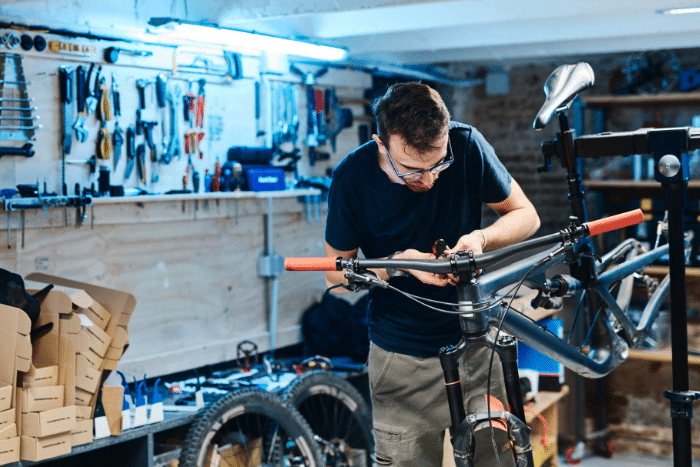
Trying to fix a bike that won’t stay still is brutal. You’re balancing the frame with one knee, holding a wrench with one hand, and watching parts roll across the garage floor. A proper maintenance stand turns that mess into a 15-minute job you actually enjoy.
The best bike maintenance stand for most cyclists is the Park Tool PCS-10.3 Deluxe Home Mechanic Repair Stand. Its 80-lb capacity, all-steel build, and professional micro-adjust clamp justify the high price. On a tighter budget, the CXWXC RS100 delivers 85% of the performance.
I tested seven stands across price points to find the right pick for every type of rider. Here’s what earned a spot, what didn’t, and how to choose.
Compare Top Bicycle Maintenance Stands
Short on time? Here’s the cheat sheet.
These are the seven bike maintenance stands worth your money, scored on stability, weight capacity, clamp quality, height adjustability, and price. Each pick earned its spot for a different reason, so the best one for you depends on the bike you ride, your budget, and the space you’ve got to work with.
If you want to skip the rest and just buy something, grab the Park Tool PCS-10.3. It’s pricier than the others, but it’s the stand pro mechanics actually use, and you’ll likely never need to upgrade. On a tighter budget? Jump to the CXWXC RS100 review below. It costs about a third of the Park Tool and punches well above its price tag.
Otherwise, keep reading. I’ll break down what each one nails and where it falls short, so you can pick the right one without buyer’s remorse.
Detailed Analysis of the Best Bicycle Stands for Maintenance
1. Park Tool PCS-10.3 Deluxe Home Mechanic Repair Stand
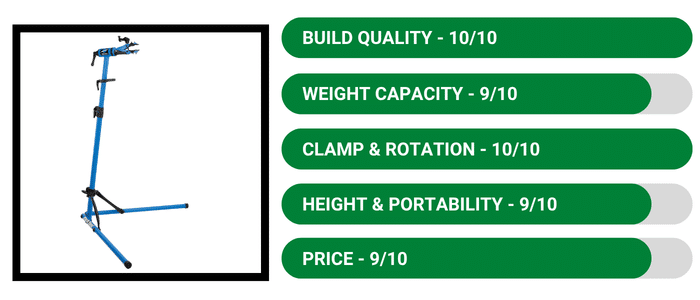
Overall Score: 94
The Park Tool PCS-10.3 is what cyclists upgrade to once their cheap stand starts wobbling. You’ll find it in pro bike shops in classic Park Tool blue, and many of those shops actually use one.
Stability is where this stand earns its price. The all-steel construction and teardrop-shaped tubing keep your bike planted while you crack a stuck bottom bracket or wrestle seized pedals. Most stands flex under that kind of torque. This one doesn’t. The 80-pound capacity covers everything from a road bike to a heavy e-MTB.
The Professional Micro-Adjust clamp is the other reason mechanics swear by it. Jaws hold rock-solid at any angle of the full 360° rotation, and the rubber pads are replaceable once they wear out (cheap stands skip that detail). The opening fits any seatpost or top tube you’ll throw at it.
Height adjusts from 39 to 57 inches, which works whether you’re 5’4″ or 6’2″. The folding legs collapse in seconds. At 16 lbs the stand isn’t featherlight, but you’re paying for stability you can trust, not portability.
The catch? Three to four times what budget picks cost. But if you wrench often, work on multiple bikes, or just want one stand for life, the math works out fast. I’d buy it again without thinking twice.
Advantages
- 80-lb capacity handles any bike, including heavy e-MTBs
- All-steel construction with no plastic parts to crack or wear out
- Professional Micro-Adjust clamp with replaceable rubber jaws
- Teardrop tubing prevents rotation under hard wrenching
- Setup and breakdown in under 30 seconds
- Park Tool’s industry reputation and easy parts availability
Disadvantages
- Three to four times the budget alternatives
- 16-lb stand weight makes it less travel-friendly than aluminum stands
- Overkill for casual riders who only do basic tune-ups
2. CXWXC RS100 Bike Repair Stand
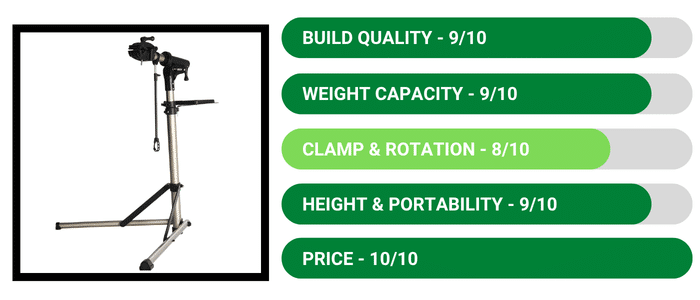
Overall Score: 90
If the Park Tool feels like overkill (or its price feels like a punch in the gut), the CXWXC RS100 is the stand to buy. It does maybe 85% of what the Park Tool does for less than a third of the price.
The aluminum frame and triangle tripod base keep the stand planted on most floors. BikeMag tested it with a 27-lb hardtail and a 55-lb commuter e-bike, and it held both without drama. Officially the capacity is 60 lbs, so it’ll handle most road bikes, mountain bikes, and lighter e-bikes. Heavy e-MTBs over 60 lbs are pushing it.
The 360° rotatable clamp opens to 3 inches and grips well on seatposts and top tubes. The plastic sliding yoke at the leg joint is the main “you get what you pay for” tell. It feels less precise than the Park Tool’s all-metal hardware. Will it last forever under daily shop use? Probably not. For weekend wrenching on your own bikes? You’ll get years out of it.
Height adjusts from 39 to 59 inches, the stand weighs only 11 lbs, and folds down to about three feet for closet storage. The included magnetic tool tray and front-wheel stabilizer rod are nice touches you don’t always get at this price.
For most home mechanics, this is the smart buy.
Advantages
- Roughly one-third the price of comparable premium stands
- 60-lb capacity covers road bikes, MTBs, and lighter e-bikes
- Lightweight 11-lb aluminum body that folds compact for storage
- Triangle tripod base feels stable on most floors
- 360° rotatable clamp with a wide 3-inch jaw opening
- Magnetic tool tray and front-wheel stabilizer rod included
Disadvantages
- Plastic yoke at the leg joint feels less refined than all-metal stands
- Not built for daily professional shop use
- Heavier e-MTBs over 60 lbs will push the limits
3. Bikehand Bike Repair Stand
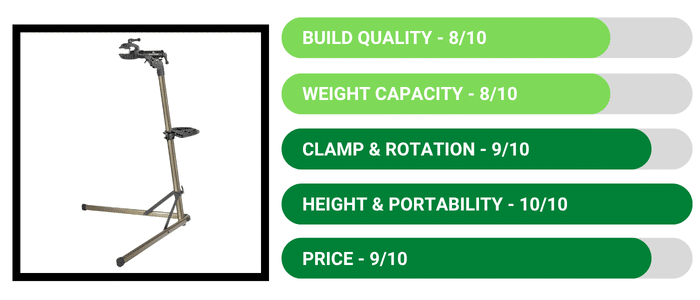
Overall Score: 88
The Bikehand looks almost identical to the CXWXC at first glance. Same price range, similar specs, two folding legs. So why pick one over the other?
For me, the answer comes down to portability and warranty.
The Bikehand weighs just 11 lbs and folds smaller than most stands in this price bracket. If you’re tossing it in the trunk for race day or hauling it out to the driveway every weekend, that matters. The aluminum tubing keeps it light, and setup takes under a minute since it ships mostly pre-assembled.
The 55-lb capacity handles road bikes, MTBs, and lightweight e-bikes without issue. Heavier rigs over 50 lbs start to feel less stable, especially at full height. The clamp opens to 2.6 inches and rotates a full 360°, with rubber-coated jaws that won’t chew up your paint.
Now the trade-off. The clamp head and rotating mechanism use plastic parts, and the teeth that lock the angle can wear down after heavy use. Reviewers who do daily repairs report some slipping over time. For occasional home use? You won’t notice for years.
Bikehand backs it with a 5-year warranty and sells spare parts directly. That’s better coverage than most budget Amazon brands offer. The Taiwanese company has been making cycling tools for over a decade, so this isn’t a fly-by-night operation.
You get a stand that punches above its weight for casual mechanics.
Advantages
- Lightweight 11-lb aluminum body folds compact for storage and travel
- 5-year warranty with spare parts available directly from Bikehand
- 360° rotatable clamp opens to 2.6 inches for fat tubes
- Rubber-coated jaws protect your bike’s paint finish
- Ships mostly assembled with under one minute of setup
- Trusted Taiwanese brand with over a decade in the cycling tools market
Disadvantages
- Plastic clamp head and teeth can wear out under heavy daily use
- Stability drops with bikes over 50 lbs or at maximum height
- Quick-release levers need to be cranked tight or the stand can slip
4. Sportneer Bike Repair Stand
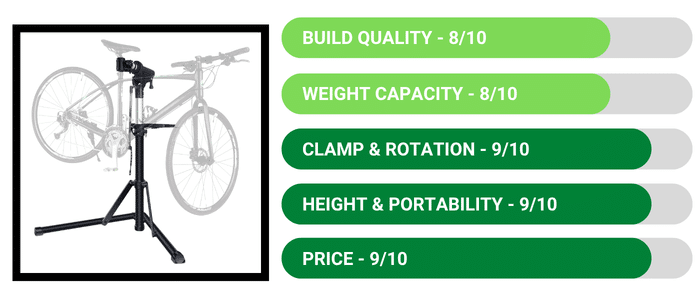
Overall Score: 86
If you ride a carbon road bike or a custom paint job you don’t want scratched, the Sportneer earns its spot on this list for one reason: foam-padded clamp jaws.
Most stands in this price range use rubber-coated plastic jaws. They grip well, but the rubber is firm, and the edges can leave marks on softer finishes or carbon tubes if you crank down too hard. Sportneer goes with softer foam padding instead. It hugs the frame without leaving impressions, which is exactly what you want for an expensive carbon seatpost.
The aluminum frame holds up to 60 lbs. Plenty for road bikes, gravel bikes, MTBs, and lightweight e-bikes. The triangle base with rubber feet feels stable on hard floors. Two retractable braces fold against the main shaft to bump up rigidity when you’re wrenching harder.
The stand extends to 5.3 feet at full height, which is taller than most budget options. The 360° rotating clamp gives you full access to every part of the bike, and the magnetic tool tray catches loose bolts and chainring nuts so they don’t roll under your car.
One thing worth knowing. Sportneer specifically recommends mounting carbon-frame bikes by the seatpost, not the top tube. Clamping carbon tubes directly is a bad idea on any stand, but the foam jaws here make seatpost mounting genuinely safe.
Lightweight, foldable, and gentle on your bike. That’s the pitch.
Advantages
- Foam-padded jaws are gentler on carbon and painted finishes than rubber
- Aluminum body keeps stand weight low and stops rust
- Triangle base with two retractable braces adds stability under torque
- Extends to 5.3 feet for comfortable working height
- 360° rotating clamp with included magnetic tool tray
- Folds flat for closet or trunk storage
Disadvantages
- Foam jaws can compress and wear faster than rubber over heavy use
- 60-lb capacity rules out heavier e-MTBs
- Clamp bolt has been reported to strip on some units after months of use
5. Yaheetech Pro Mechanic Bicycle Repair Stand
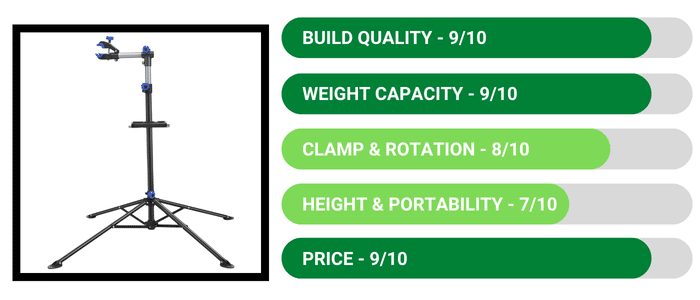
Overall Score: 84
Most stands in this price range use two folding legs or a tripod. The Yaheetech goes a different route. Four legs, wider stance, no compromises on planted-feel.
That extra leg makes a real difference when you’re putting weight on the bike. Tripod stands flex slightly when you torque a stuck pedal or wrench down on a cassette lockring. The Yaheetech doesn’t. It just stays put. For heavy bikes or aggressive wrenching, that stability is worth the extra floor space it takes up.
Capacity sits at 66 lbs, the highest of any stand on this list except the Park Tool. The high-carbon steel frame is heavier than aluminum competitors, which is partly why it feels so solid. The stand itself is more of a workshop fixture than a travel piece.
Height adjusts from 52 to nearly 75 inches. That top end is unusually tall for a budget stand, which works in your favor if you’re over six feet. Shorter users can drop it lower, but the floor of 52 inches is still higher than most options here.
The 360° clamp fits tube diameters from 1 to 1.8 inches, which is narrower than the CXWXC or Bikehand. Measure your bike’s tubes before buying if you have a fat-tubed cruiser or older steel frame.
With 1,600+ Amazon reviews, this isn’t an untested brand. The magnetic tool tray comes with dividers to keep your bolts and brake pads separated, which sounds small until you’re hunting for a 4mm Allen bolt under your workbench.
Advantages
- 4-leg base delivers stability that tripod stands can’t match
- 66-lb capacity handles MTBs, e-bikes, and steel touring bikes
- High-carbon steel construction feels workshop-grade
- Tall maximum height (75″) suits riders over six feet
- Magnetic tool tray with dividers keeps small parts organized
- 1,600+ Amazon reviews back up the real-world reliability
Disadvantages
- 1.8-inch max tube diameter excludes some fat-tubed bikes
- Heavier and bulkier than aluminum stands, less travel-friendly
- 4-leg footprint needs more floor space when set up
6. Topeakmart Portable Mechanic Bicycle Repair Stand
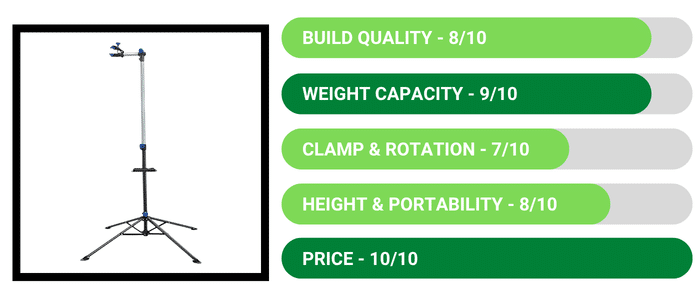
Overall Score: 84
If you’ve ever hunched over a bike stand and finished a tune-up with a sore back, this one’s for you.
The Topeakmart extends to nearly 75 inches at full height. That’s almost 6’3″ of clamp height, which is unusually tall for any stand, let alone a budget one. If you’re 6’2″+ and tired of crouching to reach your bottom bracket, the extra reach changes how working on your bike feels. Your spine will thank you.
The 4-leg base gives you a planted stance similar to the Yaheetech, with rubber feet that won’t slip on garage concrete. Capacity is 66 lbs, so you’ve got headroom for MTBs, gravel bikes, and most e-bikes. The iron frame and plastic head construction is functional rather than premium, which is reflected in the price.
The quick-release clamp tightens fast and rotates 360°, but here’s the catch: it only handles tubes up to 1.6 inches in diameter. That’s narrower than most competitors on this list. Measure your seatpost and top tube before you click “buy.” Older steel frames, fat-tubed cruisers, and some MTBs with oversized tubing won’t fit.
The minimum height of 42.5 inches is also higher than most stands, which is great for tall users but slightly tall for anyone under 5’6″. This isn’t a stand for short users to share with their partner.
Folds down for storage when you’re done. Budget-friendly. Built around a specific user, which is exactly why it earns its spot.
Advantages
- Extends to nearly 75 inches, the tallest reach in this roundup
- 66-lb capacity handles MTBs, e-bikes, and steel frames
- 4-leg base with rubber feet for solid grip on hard floors
- Quick-release clamp tightens fast and rotates a full 360°
- Folds compact for closet or garage storage
- Budget-friendly pricing for the size you’re getting
Disadvantages
- 1.6-inch tube diameter limit excludes fat-tubed cruisers and some MTBs
- 42.5-inch minimum height feels too tall for users under 5’6″
- Iron and plastic construction feels less refined than aluminum competitors
7. COTOUXKER Bike Repair Stand
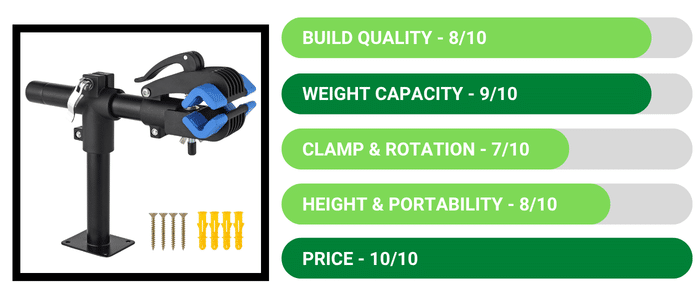
Overall Score: 84
Here’s the thing about freestanding bike stands. They eat up floor space. If you live in an apartment or share a tight garage with a car, lawn mower, and a wall of half-finished projects, that floor space is precious.
The COTOUXKER skips the freestanding design entirely. It bolts to your wall or workbench, so it takes up zero floor space when you’re working and almost none when you’re not. Four long screws and you’re done. The arm flips against the wall when you’re finished, so it disappears into the background between tune-ups.
Build is iron with a silicone-coated clamp. Capacity is 44 lbs, which is the lowest on this list. That’s fine for road bikes, hybrids, and most MTBs, but heavy steel frames or e-bikes are out. Be honest about what you’re putting on it.
Where this stand actually shines is the clamp range. It grips tube diameters from 1.2 inches all the way up to 2.5 inches, the widest range in this roundup. That covers everything from skinny carbon seatposts to fat-tubed cruisers. The silicone coating is soft enough to protect paint and grippy enough to hold tight.
The upper arm rotates to hold your bike vertically by the seatpost or horizontally by the top tube. Useful for different repair tasks.
It’s the cheapest stand here by a wide margin. If you’ve got wall space and a drill, it’s almost a no-brainer for occasional home wrenching.
Advantages
- Wall or bench mount means zero floor space when working
- Flips flat against the wall when you’re not using it
- Clamps tube diameters from 1.2″ to 2.5″, the widest range in this roundup
- Silicone-coated jaws grip firmly without scratching paint
- The cheapest stand on this list
- Rotates between vertical and horizontal bike positions
Disadvantages
- 44-lb capacity rules out e-bikes and heavy steel frames
- Requires drilling into a wall or having a solid workbench
- No height adjustability since it’s anchored to one spot
How to Choose the Right Bike Maintenance Holder
Now that you’ve seen the picks, here’s how to figure out which one fits your bikes, your space, and the kind of wrenching you actually do.
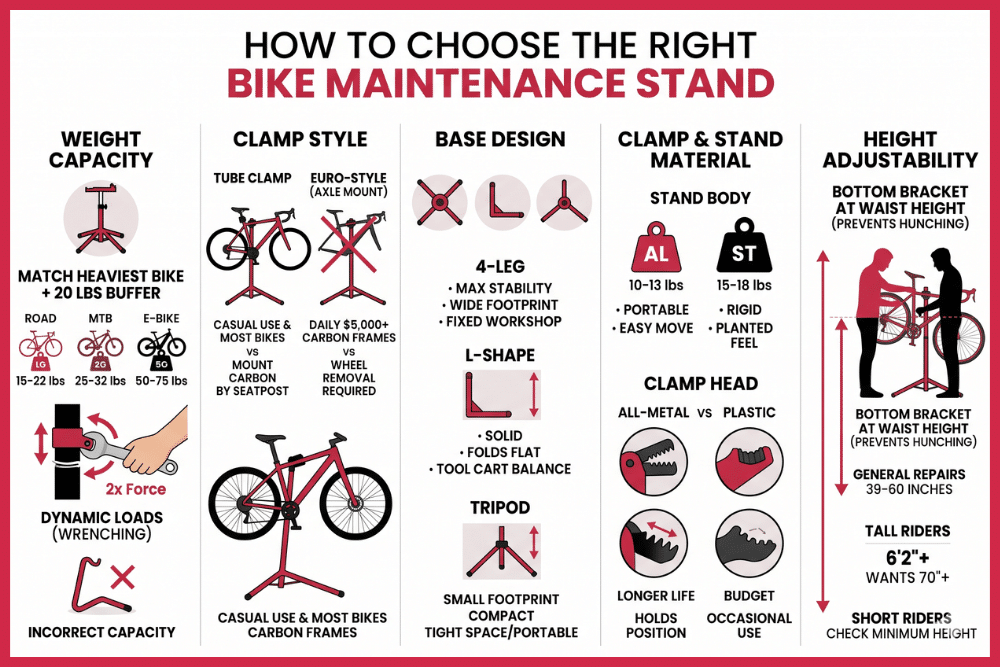
Match Weight Capacity to Your Heaviest Bike (Plus 20 lbs)
Start with what your bike weighs. Road bikes run 15 to 22 lbs. Mountain bikes hit 25 to 32 lbs. Touring bikes load up to 35 lbs. E-bikes are the outlier at 50 to 75 lbs, and full-power e-MTBs can push past 70 lbs alone.
Now add 20 lbs to your heaviest bike’s weight. That’s your minimum stand capacity.
Why the buffer? Static weight is only half the story. When you torque a stuck pedal, crank a seized bottom bracket, or yank a tight cassette lockring, you create dynamic loads that effectively double the force on the stand. A 55-lb stand holding a 40-lb e-bike feels fine, until you put your weight into a stuck part and it starts to flex.
Tube-Clamp vs Euro-Style (Axle Mount)
Most stands in this roundup use a tube clamp. You grip the seatpost or top tube, lift, tighten, done. Easy to use, works with every bike, and what you’ll find in 90% of home workshops.
Euro-style stands work differently. You remove one wheel and mount the bike by the front axle and bottom bracket. No clamp touches your frame, which matters for high-end carbon bikes with thin tube walls or unusual shapes. The trade-off is speed. Pulling a wheel every time you want to lube your chain gets old fast.
For casual home mechanics, go tube-clamp. Mount carbon bikes by the seatpost (never the top tube) and you’ll be fine. Euro-style makes sense if you’re servicing $5,000+ carbon frames daily.
Tripod, L-Shape, or 4-Leg Base?
Base design affects two things: stability and floor space.
4-leg bases (like the Yaheetech and Topeakmart) give you the most stable platform. The wider stance handles heavy wrenching without flex. Trade-off: they eat up the most floor space when set up.
L-shape bases (Park Tool, Bikehand) fold flat in one direction and offer solid stability for most repairs. Good balance of footprint and rigidity. You can position a tool cart alongside without bumping legs.
Tripod bases (CXWXC, Sportneer) use the smallest footprint and pack down the most compact. The three-leg setup is less stable under heavy torque but plenty solid for routine maintenance.
For a fixed home workshop, go 4-leg or L-shape. Tight on space or hauling the stand around? Tripod wins.
Aluminum vs Steel (and Where Plastic Goes Wrong)
Aluminum keeps stands light, around 10 to 13 lbs, which makes them easier to move and store. Steel adds weight (15 to 18 lbs) and rigidity. Either material works for the stand body. Match it to your priority: portability or planted-feel.
The real material question is what the clamp head is made of.
All-metal clamps last longer and hold position better under repeated use. Plastic clamp heads (common on budget stands) work fine for occasional home wrenching but wear down over time. The plastic teeth that lock the rotation angle are the usual failure point. They round off after 100+ heavy uses.
Translation: plastic clamp parts are fine for weekend mechanics. If you wrench daily or work on multiple bikes, pay up for metal.
Height Adjustability for Comfortable Wrenching
A good stand puts the bike’s bottom bracket roughly at your waist height. That’s where your hands work best without hunching or reaching up.
For most users, a height range of 39 to 60 inches covers every repair task comfortably. That’s the range on the Park Tool, Bikehand, CXWXC, and Sportneer.
Tall riders (6’2″+) want a stand that hits 70 inches or higher. The Yaheetech and Topeakmart both extend to nearly 75 inches, which is why they’re worth considering even if their other specs aren’t a perfect match.
One thing most reviews skip: minimum height matters too. If you’re 5’6″ or shorter, a stand with a 50+ inch minimum height (like the Yaheetech) is going to feel too tall to wrench comfortably. Check both ends of the range before buying.
Frequently Asked Questions (FAQs) About Bike Stands for Maintenance
How much should you spend on a bike maintenance stand?
Plan to spend between $80 and $300 on a quality bike maintenance stand. Budget stands in the $80 to $100 range (like the Bikehand or CXWXC RS100) handle weekly home wrenching just fine. Step up to $200 to $300 (like the Park Tool PCS-10.3) if you wrench daily, work on heavy e-bikes, or want one stand that lasts decades. Wall-mount options like the COTOUXKER drop as low as $25 to $40.
Will a clamp damage my carbon frame?
A bike repair stand clamp can damage your carbon frame if you grip it directly on a thin-walled tube. To avoid damage, always clamp the seatpost instead of the top tube or down tube, use a stand with soft rubber or foam jaws, and don’t overtighten the clamp. The Sportneer’s foam-padded jaws are gentler on carbon finishes than firmer rubber clamps.
If you’re servicing a high-end carbon bike daily, look into a Euro-style stand that grips the axle and bottom bracket instead. No clamp ever touches the frame.
Can I work on my bike without a stand?
You can work on your bike without a stand, but it makes most jobs frustrating. Flipping the bike upside down works for quick chain lube or tire swaps but blocks access to the drivetrain and stresses your shifters. Propping the rear wheel on a cinder block is another hack for cleaning, but it wobbles the second you push back on the bike.
For occasional five-minute fixes, hacks are fine. For anything beyond that, a stand pays for itself in saved time and fewer scraped knuckles.
Will these stands hold an e-bike?
Stands with 60+ lb capacity will hold most e-bikes. The Park Tool PCS-10.3 (80 lbs), CXWXC RS100 (60 lbs), Yaheetech (66 lbs), and Topeakmart (66 lbs) all handle commuter e-bikes and lighter e-MTBs without issue.
Heavy e-MTBs and fat-tire electrics that weigh over 70 lbs push past the limits of budget stands. For those, go with the Park Tool or upgrade to a dedicated heavy-duty stand rated for 100+ lbs. Don’t trust a 55-lb stand with a 65-lb e-bike, even if the math seems close. Dynamic torque loads will magnify the gap fast.