
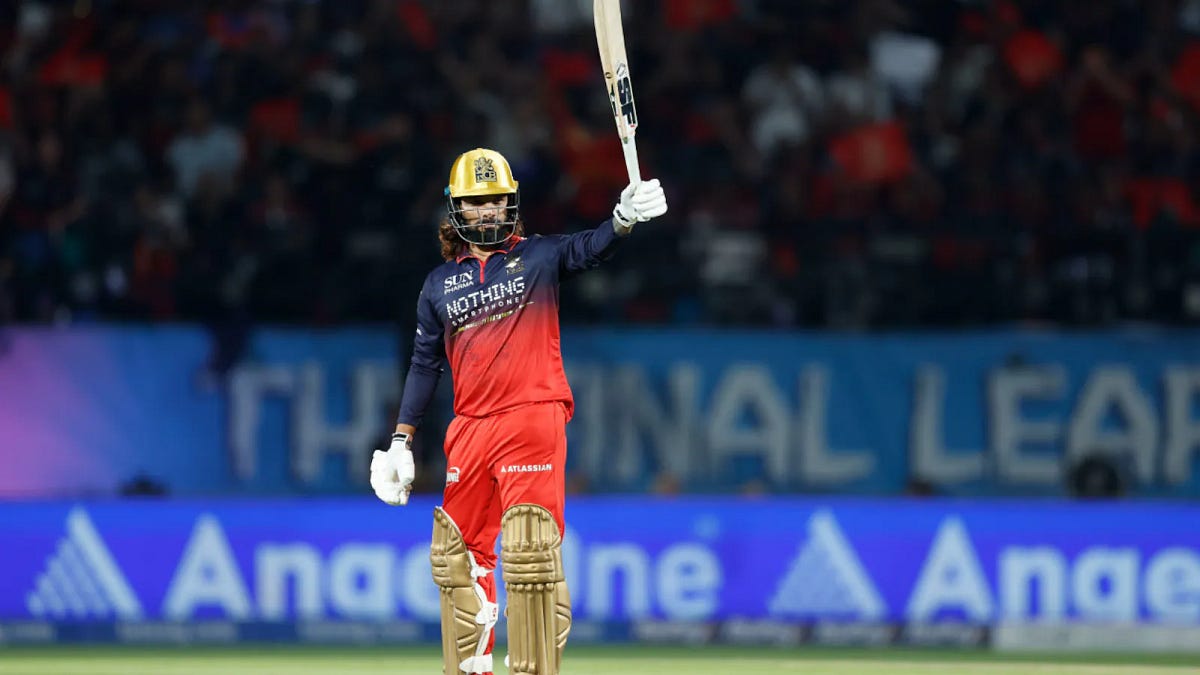
RCB beat GT by 92 runs, but frankly it should’ve been double that difference. After posting a playoff record 254, they reduced GT to 88-8 in 11.2…then played with their food for 8 overs before closing out an anti-climatic demolition.
But, what happened beyond the headlines?
-
💨 RCB Innings, Overs 1-6; RCB take down the IPL’s best powerplay pacers.
-
🐐 RCB Innings, Overs 9-20; Rajat Patidar’s timely knock, & GT’s untimely panic.
-
🔝 GT Innings, Overs 2-4; How Bhuvi ended GT’s hopes of a miracle.
🚨 If you’re an RCB fan, I’d love if you could fill out this 2-minute survey on how you feel about the franchise this year. I plan to create a graphic story of your answers soon! 🚨
RCB take down the IPL’s best powerplay pacers
✍️ Written by Ben Brettell, who runs Cricinspo.
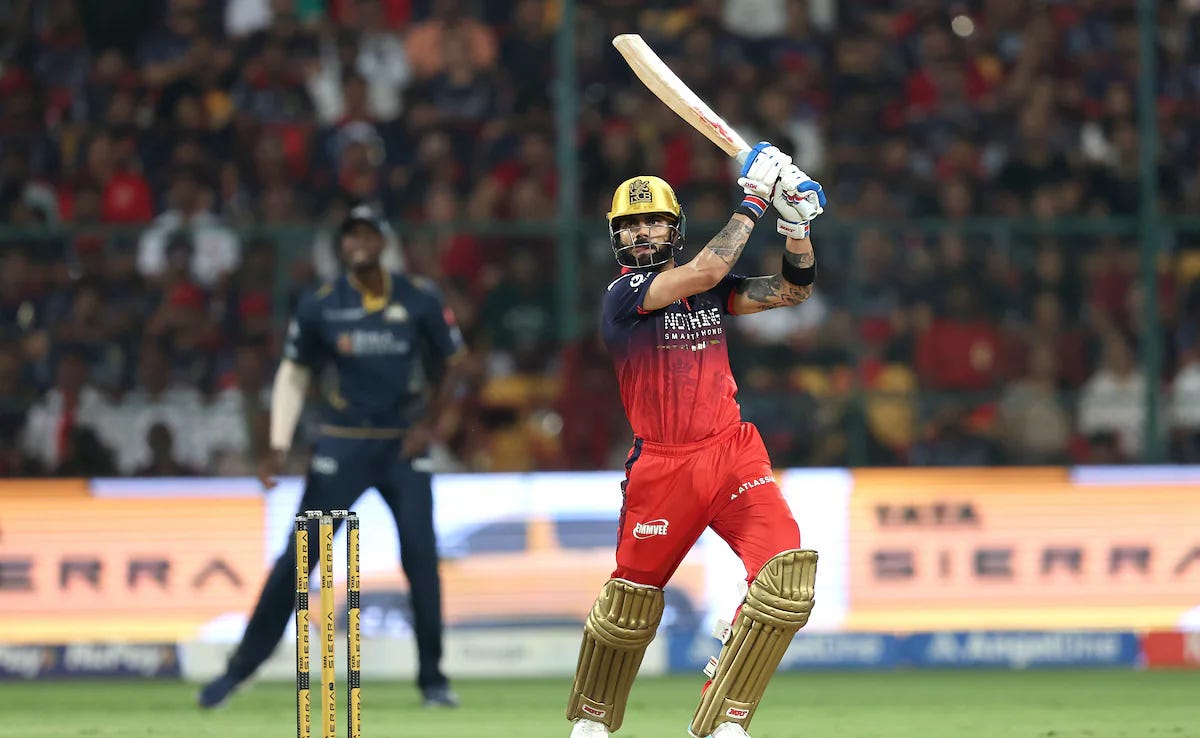
Before the game, the key battle was clear; GT’s elite powerplay bowling attack against RCB’s remarkably reliable top order. Irresistible force meets immovable object.
By the end of six overs in Dharamshala, it wasn’t close.
Coming into the qualifier, no side had played fewer dot balls than RCB’s 185 in the powerplay this season. GT, meanwhile, had been the standout bowling unit with the new ball. They led the competition for powerplay economy (8.76), dot balls (247), wickets (30), average (24.5) and strike rate, taking a wicket every 16.8 balls.
Remarkably, every one of those wickets had come from just two bowlers – Kagiso Rabada (17) and Mohammed Siraj (13).
This was an excellent batting surface, though. Unless the bowlers were absolutely precise, runs were going to flow.
Mohammed Siraj, facing his former side, never quite found the lengths that had brought him success this season. His first over set the tone. Twice he offered width back of a length, and twice Venkatesh Iyer — batting with superb intent and clarity — threaded boundaries through the off side. Siraj’s attempts to correct went too full rather than shorter and harder to access.
Rabada, by contrast, stuck rigidly to the hard-length approach that has underpinned GT’s powerplay success all season. His opening over was probably the best of the powerplay despite being scooped for six by Venkatesh. Three consecutive hard-length balls beat Kohli outside off stump, the extra bounce and pace clearly troubling him. It was high-class fast bowling – and a fascinating contest, because Kohli refused to retreat into survival mode.
It was the right choice. Since 2025, Kohli has the best average (no outs), the most boundaries (36) and the fourth-highest strike rate (178) against 140+ kph balls in the IPL. Rabada ignored the stats, and stuck to his plan. Across 12 powerplay balls to Kohli, the South African stayed within the 141-152 KPH range. He conceded 20 runs, including three 4s and a 6.
Beyond just punishing loose balls, RCB’s aggression was important tactically. They never let Rabada and Siraj settle into repeatable lengths.
Even when they lost Venkatesh to a miscue in the second over, RCB’s batters stuck to the strategy. Siraj’s second over drifted full again – Kohli clipped him off the pads, drove him straight, rotated strike. Padikkal looked immediately comfortable, twice driving on the up against over-pitched deliveries. Rabada kept asking difficult questions; Siraj looked like a bowler searching for something.
Despite Jason Holder restoring some control in the fifth over, a last ball run out attempt that turned into four overthrows summed up RCB’s dominance in the phase. After Kohli took apart Rabada’s predictable pace-on deliveries in the 6th, RCB closed the powerplay on 76/1. It is their highest score of the season, in their biggest match, against the best opening pair in the league.
GT’s process wasn’t fundamentally wrong. Rabada largely executed the plan that had made this attack so successful all tournament. But RCB’s batting quality – Kohli’s ability to rotate strike, Iyer’s willingness to attack length immediately, Padikkal’s timing – prevented GT from ever dictating terms.
GT’s powerplay bowling works best when both ends apply pressure simultaneously, building cumulative dots and hard lengths. But both quicks contributed to their own undoing. Siraj erred by bowling too full, giving RCB easy scoring options on one side. Rabada, for all his pace and aggression, never varied his speed to Kohli – repeatedly feeding a batter who feasts on exactly that.
Two different errors, pulling in the same direction. And on a surface this flat, GT couldn’t afford either of them.
Data from ESPN & the Jio broadcast.
Rajat Patidar’s timely knock, & GT’s untimely panic
✍️ Written by Aarush Adil Khan & Pri Gulati.
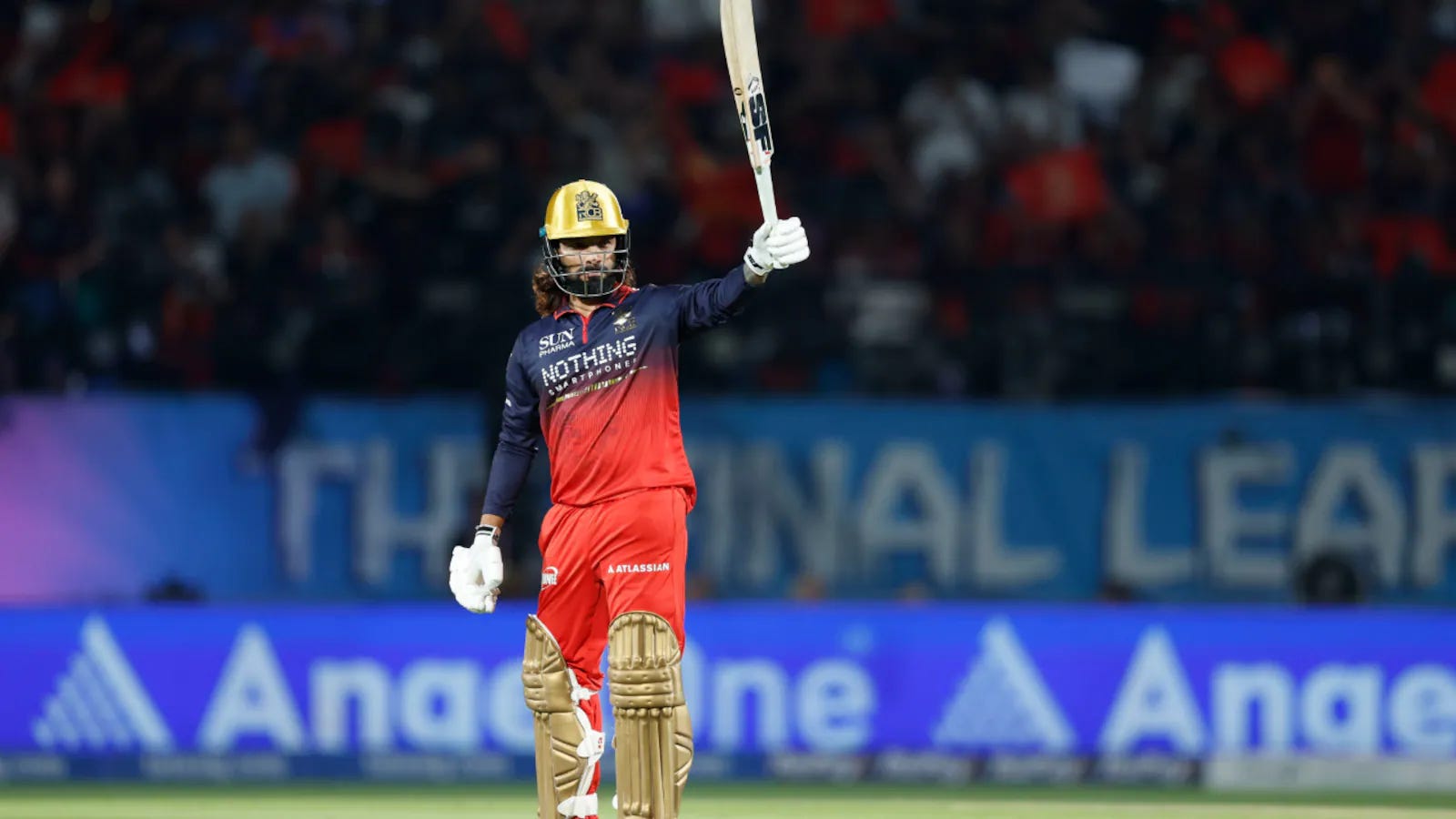
The stereotype is clear; Rajat Patidar prefers spin, and struggles against pace. He’s been dismissed 29 times against pace as opposed to 16 times against spin in the IPL. He’s been dismissed 6 times by pacers this season alone!
Except, he’s also been dismissed 5 times by spinners this season. He strikes at 158.5 at an average of 31.2 against the bowling type. Not as good as his numbers against spin (175.4 and 41.9), but no slouch. The reality is not that he is bad at pace, but that he is not comfortable against a very particular kind of pace delivery.
Of his 29 pace dismissals, 10 have been against short & back-of-a-length bowling. His boundary percentage drops against these balls when they target his stumps, and so does his strike-rate. The strategy against RCB’s captain is simple; attack his stumps, and bowl at a length or short of a length at him.
Initially, GT’s pacers understood this strategy. Kind of.
Holder, Rashid Khan & Prasidh Krishna all bowled at a good length to Patidar. When he first walked out to the crease, they targeted his stumps or just outside off. They gave away a few slot balls – an understandable risk with this strategy – but it was nothing egregious. By the end of the 13th over, RCB’s innings was at risk of stalling as Patidar was struggling on 14 (10).
Krishna’s 14th over started with a skied top edge that fell short of both Jos Buttler & Kulwant Khejroliya. The next ball – one of only 3 short balls that Patidar faced in the entire innings – was manoeuvred behind square for a boundary. The next ball was a poorer version of the shot, as he could only find Kagiso Rabada at the boundary.
Rabada dropped him on 20 (13). Patidar would use his second (third?) life to maximise his innings. GT’s bowlers would learn to…minimise their threat, for some reason.
The GT pacers have been incredibly consistent this season, sticking to good length, 130-140 KPH deliveries with few variations in speed or length. The results have been beneficial, helping to secure that number two spot. But, when Patidar whipped a “slower” 120 KPH delivery to fine leg – as he did the ball after he was dropped – GT backtracked on variable bowling.
Instead, they aimed for wide yorkers that could deny the RCB captain. They hoped to stretch his shape, and guide him towards the covered square boundaries instead of straight down the ground. But, a plan is only as good as its execution.
On a lucky day, a full and wide delivery might restrict Patidar by limiting his ability to play on the backfoot. But the margin of error is small. Khejroliya’s 15th over would miss that window of perfection by a few degrees. A low full toss caught an inside edge for a single, but helped Patidar zone in on the plan. A quick flurry of boundaries follows: an attempt at a yorker turns into a lofted drive 4, a maximum achieved by cutting across the angle, and another low full-toss hoisted over mid-on for 4.
Patidar is turning the screws, and GT is letting him. In their panic to overcorrect, they slip back into length balls, and the RCB skipper takes advantage of a series of panic-strewn mistakes. Over pitched deliveries and mistimed wide yorkers provide an extension that helps him angle his shots. Imperfect deliveries create low-risk hitting zones.
Patidar is flying.
He scores 7 off 3 in the 14th over. 14 off 4 in the 15th over. 13 off 3 in the 16th over. Rabada gets Krunal Pandya’s wicket in the 17th over – Patidar still scores another 13 off 3. He slows down in Prasidh’s smarter 18th over, with just 6 off 3. Siraj comes back for the 19th, and reminds us why he didn’t get a third powerplay over; another 11 off 3 for the RCB skipper.
Suddenly, it’s not a question of whether GT can win. The score is way beyond anything that’s been chased at Dharamshala this season (where PBKS – kings of the 200+ chase – played), beyond anything that GT have ever chased, beyond anything any IPL playoff game has ever seen overhauled.
No, the final over is about just one thing; can the 79 (29) batter get a century? First ball, 6. 15 in 5 needed. He takes the unselfish single. Jitesh Sharma returns the favour with a risky 3 to get him back on strike (via yet another GT misfield). Fourth ball, 6. Just 8 in 2 needed.
Patidar takes a single, and ends up with a measly 93 (33). As the broadcasters declare, this innings is far more important than just a personal milestone. It’s a captain’s knock to end all captain’s knocks. But, it should not be forgotten; for as brilliant as Patidar was, GT’s bowlers were terrible.
The strategy against RCB’s captain is simple; attack his stumps, and bowl at a length or short of a length at him. Instead, they repeatedly aimed for perfection with wide yorkers (which they missed a bunch), overcorrected to good length balls that Patidar feasts on, and overcorrected again with error-strewn yorkers that he could dig out with ease.
What began as a contest of lengths and an attempt at containment through targeted deliveries, crumbled under pressure. The mid-length, both a danger and blessing for batter and bowler alike, was abandoned in favour of the hope of a “gotcha” moment.
This version of Patidar – captain, leader, legend – was never going to give them the satisfaction.
Data from ESPNCricinfo, the IPL website, DeepCrease, Cricmetric, & the Jio broadcast.
How Bhuvi ended GT’s hopes of a miracle
✍️ Written by Karan Jain, who runs CricNuance. You can follow him on X.
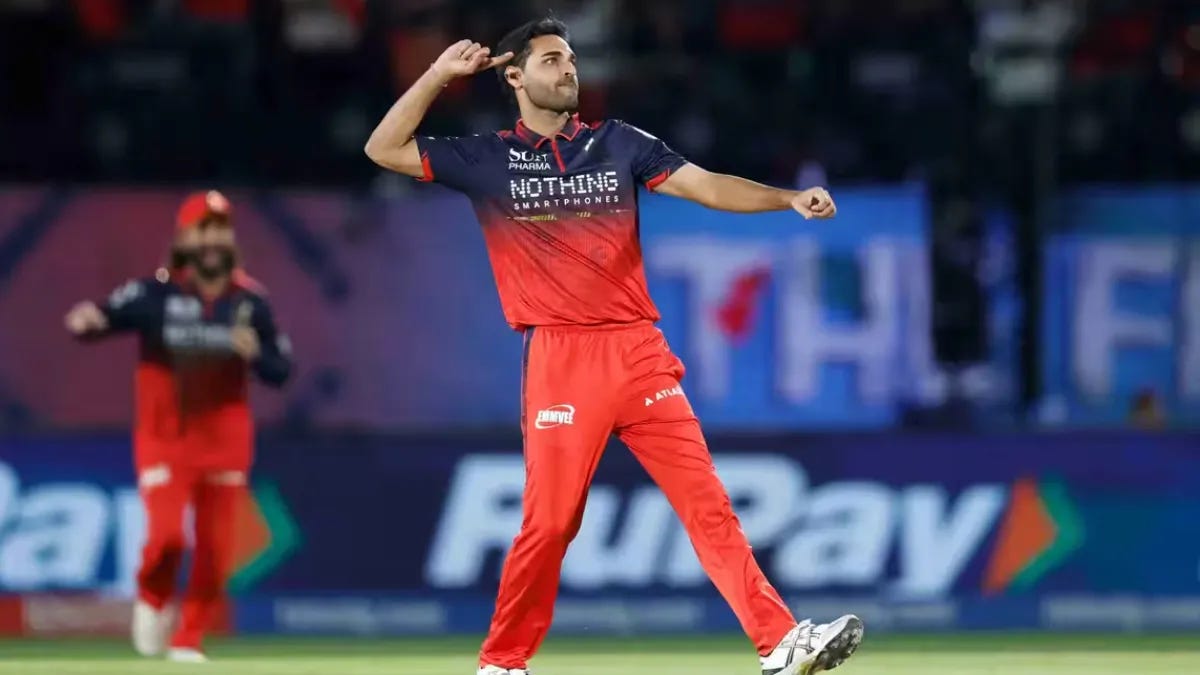
Heading into the second innings, RCB were well in front. All season long, GT’s highest successful chase of the season had been 181, and this pitch wasn’t nearly as flat as the first innings score of 254 made it look.
If GT had any hopes of chasing the unlikely target down, they would need their top three of Sai Sudharsan, Shubman Gill, and Jos Buttler to fire. The trio had scored 70.99% of GT’s total this season, with a collective 1,726 runs to their name.
Even with his conventional methods, Sudharsan showed glimpses of how he can generate boundaries in the powerplay. Counting his bizarre hit-wicket dismissal, which saw the ball go to the boundary, Sudharsan hit four balls to the boundary off six Jacob Duffy deliveries.
When Duffy slightly erred in line towards the leg stump, he was driven for four between mid-on and midwicket. When he went slightly too wide, he was punished with a cut shot, and when he went short, he was pulled for another boundary.
Despite this minimal margin of error, Bhuvneshwar Kumar showed off his immense control. His first ball to Sudharsan was at a good length to the stump line – a delivery which the batter struggles against (4 powerplay wickets, 139.36 SR). To add to the degree of difficulty, Kumar even got the ball to move away from the southpaw. Unsurprisingly, Sudharsan was beaten all ends up.
This forced Sudharsan to charge down the pitch on the following delivery, but Kumar saw this coming and marginally pushed his length back to force the batter into another dot. Once the southpaw got off strike, a masterclass would begin against Shubman Gill.
Gill has a powerplay strike rate of 165.14, and had taken RCB down with 42 (18) in GT’s last game against the defending champions. Most notably, he scored 24 runs in an over against Josh Hazlewood by preemptively charging down the pitch to turn good balls into fuller ones – a tactic the Australian has been susceptible to in the second half of the season.
Gill attempted a similar tactic against Kumar on his first delivery against the RCB pacer. He charged down to give himself room on the offside, but the bowler saw it coming. He switched to a last second, back of the length delivery that completely confounded Gill. The GT captain duly played out the over with two dots from his crease.
A 2-run over was barely what GT needed at the moment, and so – after Sudharsan’s bizarre wicket in the 3rd over – the pressure was on Gill to accelerate. He went for a wild swing on the first ball of the fourth over, and Kumar decoded it perfectly. His in-seaming ball beat the bat, and tore into Gill’s stumps.
On a pitch that rewarded his control and accuracy with variable movement, Kumar would then deliver a similar delivery to Jos Buttler – but with a dangerous out-swing instead. The GT keeper edged it, but it didn’t carry to the RCB keeper.
Unlike his opening partner, Kumar pitched the ball in the right areas, used a two-paced pitch (as Matthew Hayden described it) to disrupt GT’s prolific top three, and ended any hope of a miraculous comeback.
On a friendly pitch and a racy outfield – that contributed to Rahul Tewatia nearly doubling his season-long runs total just by not chasing after good balls – Kumar’s powerplay contribution was vital in ensuring RCB didn’t…”RCB up” this game.
Data from ESPNcricinfo & Cricmetric.