
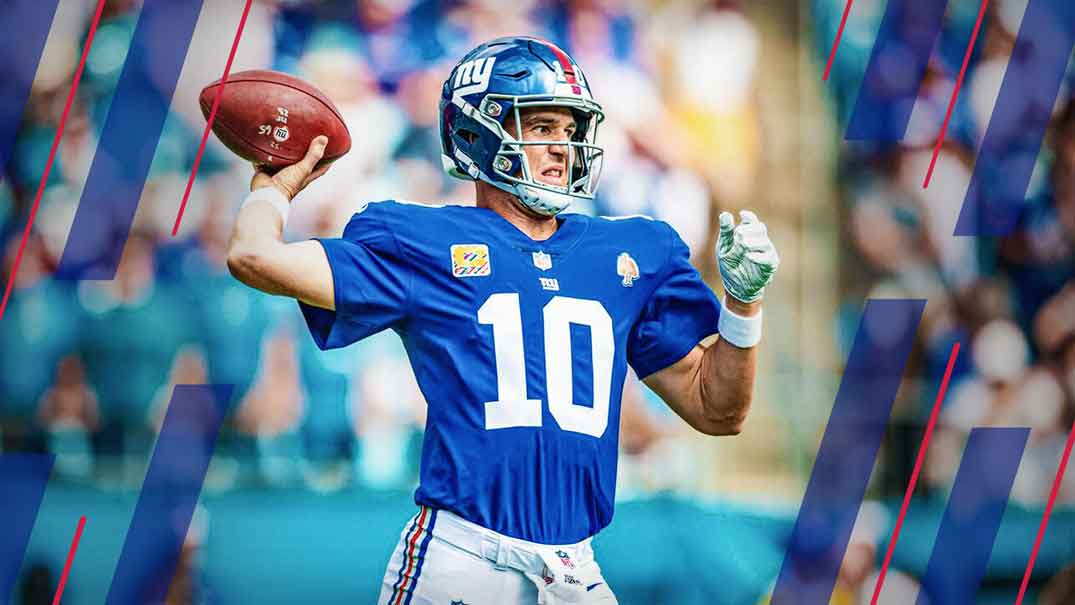
- Ahmad Bradshaw captures a surprising backfield nod: In a tightly contested committee debate, Bradshaw narrowly edged out Saquon Barkley for the starting running back spot due to his superior pass-blocking marks and high rate of converting carries into first downs or scores.
- The defensive front remains a legacy power unit: Highlighting the deep talent pool of the PFF era, every single edge defender and interior lineman considered for the team—including Dexter Lawrence II and Justin Tuck—recorded at least one historic 90.0-plus single-season grade.
- Landon Collins outpaces Xavier McKinney at safety: Despite McKinney displaying more refined traits on coverage snaps, Landon Collins secured the starting safety role due to his elite utility as a run-stopping box defender and an extra 900 career snaps in a Giants uniform.
As part of PFF’s celebration of 20 years of NFL data, we’re building an All-Star team for every franchise, highlighting the best players at each position from the PFF era. This installment turns to the New York Giants.
PFF’s database dates back to the 2006 NFL season, providing a unique lens for evaluating and comparing players across eras. More details on the methodology used to construct these teams are available at the bottom of the page.
Offense
The Giants’ offense is heavily shaped by the core of their Super Bowl teams from 2007 and 2011. Most of the unit’s selections played key roles in one or both championship runs, with wide receiver Odell Beckham Jr. and current left tackle Andrew Thomas standing as the most notable exceptions.
The toughest decision came at running back, where Ahmad Bradshaw narrowly edged out Saquon Barkley. Barkley reached a higher peak during his rookie season and produced more volume as both a runner and receiver. Bradshaw, however, was consistently more efficient. He averaged more yards per carry, generated a first down or touchdown on 24.0% of his rushing attempts compared to Barkley’s 19.6%, and posted a higher explosive-run rate. He also held an advantage as a receiver, averaging 1.33 yards per route run versus Barkley’s 1.15.
The deciding factor was pass protection. Bradshaw allowed pressure on just 3.7% of his pass-blocking snaps compared to 8.5% for Barkley despite being asked to stay in protection more frequently. Had Barkley remained healthy throughout his six seasons in New York, he likely would have claimed the spot. Bradshaw’s efficiency across multiple facets of the position ultimately gave him the edge.
The slot receiver spot produced a similarly close debate between Victor Cruz and Sterling Shepard. Cruz delivered the higher peak, highlighted by his standout 2011-13 stretch, while Shepard compiled a larger body of quality play across more seasons. In this case, Cruz’s peak performance was enough to earn the nod.
Defense
The Giants’ defensive front has been a franchise strength throughout the PFF era. Several accomplished players failed to make the final roster, including edge defenders Osi Umenyiora and Olivier Vernon and interior defenders Leonard Williams and Dalvin Tomlinson. Even Hall of Famer Michael Strahan, who appeared in only 25 games during the PFF era at ages 35 and 36, remained remarkably productive. All nine defensive linemen and edge defenders under consideration recorded at least one season with a PFF defensive grade above 90.0 during their time in New York.
While the Giants’ defense reached its peak during the 2007 championship season, the secondary has produced a number of standout performers over the past decade, albeit with relatively short peaks. The closest decision came at safety between Landon Collins and Xavier McKinney. McKinney was the stronger coverage player, while Collins provided more value against the run and as a pass rusher. Collins also logged more than 900 additional snaps in a Giants uniform, a slight advantage that proved decisive under this methodology.
Linebacker was the thinnest position group on the roster. Frequent turnover at the position prevented any one player from building the sustained résumé seen elsewhere on the team, as the Giants regularly cycled through starters every few seasons.
Methodology
Selections were based on normalized PFF grades adjusted by season. To balance peak performance and longevity, only a player’s five best seasons with a franchise from 2006-25 were considered. Any season with an overall PFF grade below 60.0 was excluded, ensuring that strong years helped a player’s case while weaker seasons were not held against him. Postseason play was included, though all seasons were capped at a 16-game equivalent to maintain consistency across eras. At each position, the player with the highest score under this methodology earned the spot.
Each team consists of 12 offensive and 12 defensive players. Because 11 personnel and nickel defense were the league’s most common alignments over the past two decades, those personnel groupings served as the foundation for every roster. Teams received either a second tight end or a fullback depending on whether they used more 12- or 21-personnel. Defensively, teams received either a third interior defender or a third linebacker depending on whether they primarily operated from a 3-4 or 4-3 front.
Players who logged significant snaps at multiple positions during their tenure with a franchise were eligible at either spot. In most cases, those players were assigned to the position where they provided the greatest value, though their versatility occasionally influenced the final roster construction.
Unlike some All-Pro teams that group offensive linemen by position type, these rosters were built according to where players actually lined up. If a team’s two best tackles both played exclusively on the left side, only the top left tackle was selected. One of the three wide receivers and one of the five defensive backs was also required to have significant slot experience. In a 4-3 defense, one linebacker needed experience at the Sam linebacker position, while in a 3-4 defense, one defensive tackle needed experience at nose tackle.
When multiple players are listed at the same position, the first name represents the top selection. Players designated as slot wide receiver, slot cornerback, nose tackle or Sam linebacker were selected specifically for those roles rather than as the third-best player within their broader position group.