
(You can find any explanations regarding our advanced metrics here.)
11 runs an over were needed when they started. It was more than 15 needed with nine overs still to bowl. This is a tough chase in any era, but this was Rajasthan Royals going after 213 in 2010.
At the crease was a batter who didn’t look the part. His athleticism didn’t match how we saw batting; he looked like a bowler who likes to slog. But this day, he was stuck, 15 from 14, and no timing at all.
Then Ali Murtaza bowls a full toss, his eyes light up, he flexes his lean muscular frame and swings, it goes in the air, a tough chance and the fielder only gets fingertips. It falls. At this point, it doesn’t feel like a big deal, it’s just a drop from a bowling team who are well on top.
In the end, it was one of the biggest mistakes a fielding team could make.
11 straight boundaries. He was 15 off 14, and 23 balls later he crossed a hundred. The then fastest IPL century.
It should have ended in glory. Instead, it was a run out. An impossible chase, ending on the edge of victory.
A week later, former Test player Mike Selvey from The Guardian called Yusuf a ‘mediocre cumbersome batsman’ whose only assets were ‘a good eye, considerable strength, and a decent blade.’ He concluded that ‘Presumably he just got lucky in that freakish way that sometimes happens.’ ‘An IPL natural’, he said. Not as a compliment.
Mike Selvey is describing a monster. Unfortunately, this is also how the public perceived him to be. Just a big strong freak who could hit it far. Nothing more.
And on the other side, Shane Warne called it the greatest innings he had ever seen.
Yusuf Pathan was too early for our meagre 2010 minds to understand. He looked like a slogger, and those had limited value. We knew this was something we didn’t have to take seriously. Warne was wrong that it was the greatest innings he’d seen; Selvey was wrong that this was luck.
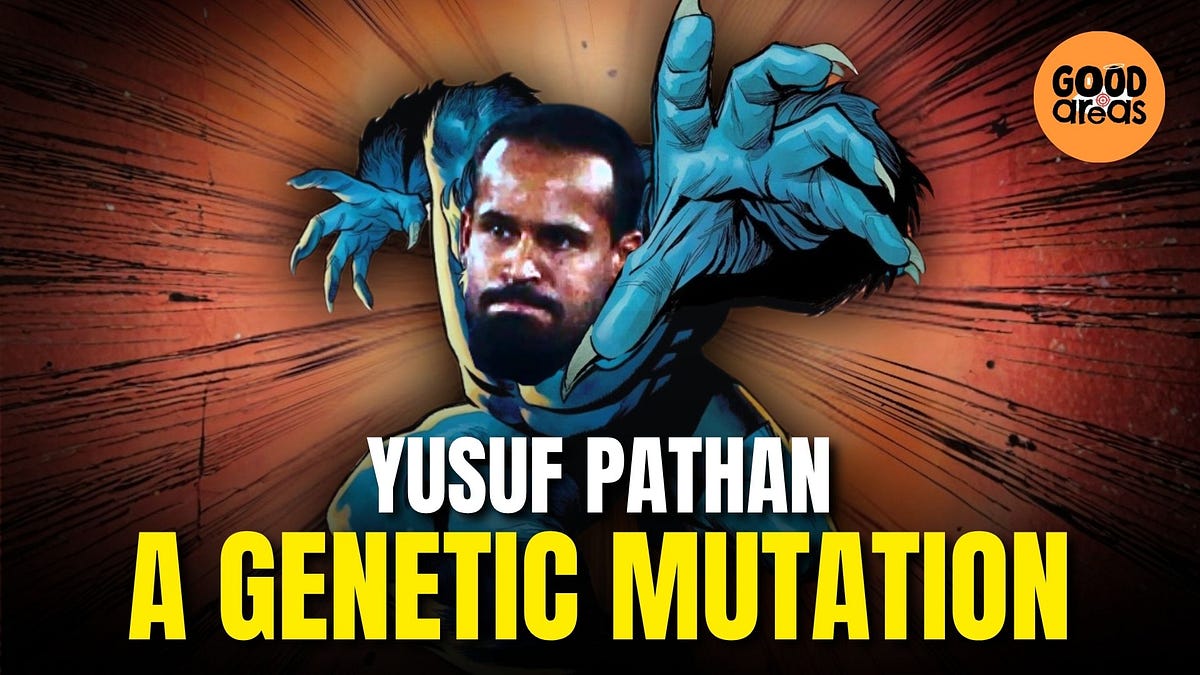
Yusuf Pathan was something we couldn’t really understand then. But now looking back, he wasn’t a slogger or a great. He was a genetic mutation of batting. Cricketers had been good against spin before, but he was the first one sent to destroy it.
***
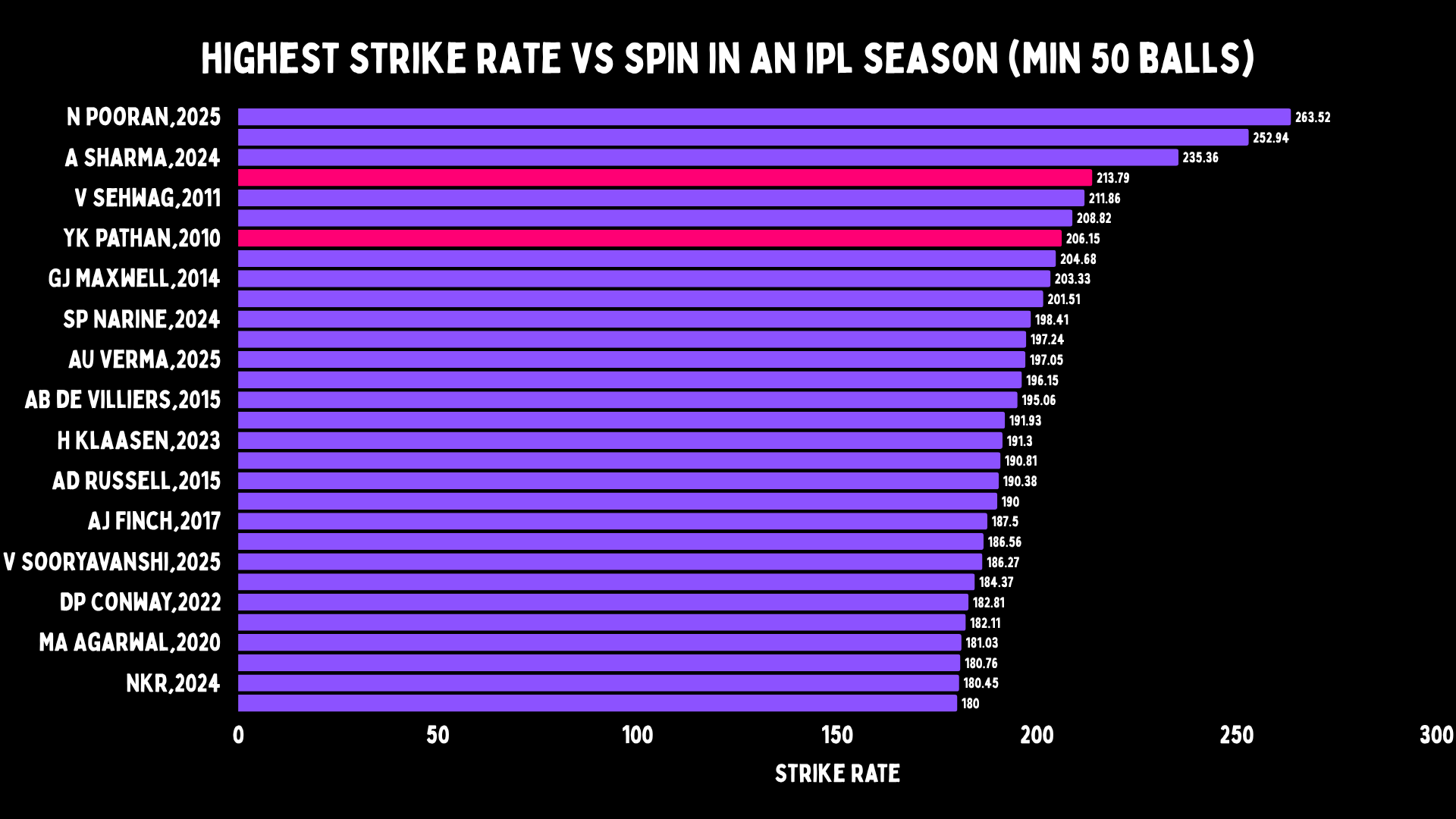
That day, Yusuf Pathan hit 46 off 14 against spin. He did it again in 2014, making 44 off 14 against Sunrisers Hyderabad spinners en route a 72 off 22. Even now, he has two of the fastest knocks ever against spin in an innings.
For a minimum of 1000 runs, Yusuf has the second-highest true strike rate versus spin in the IPL. Only behind Glenn Maxwell with 34, and ahead of Chris Gayle, David Warner and Shane Watson.
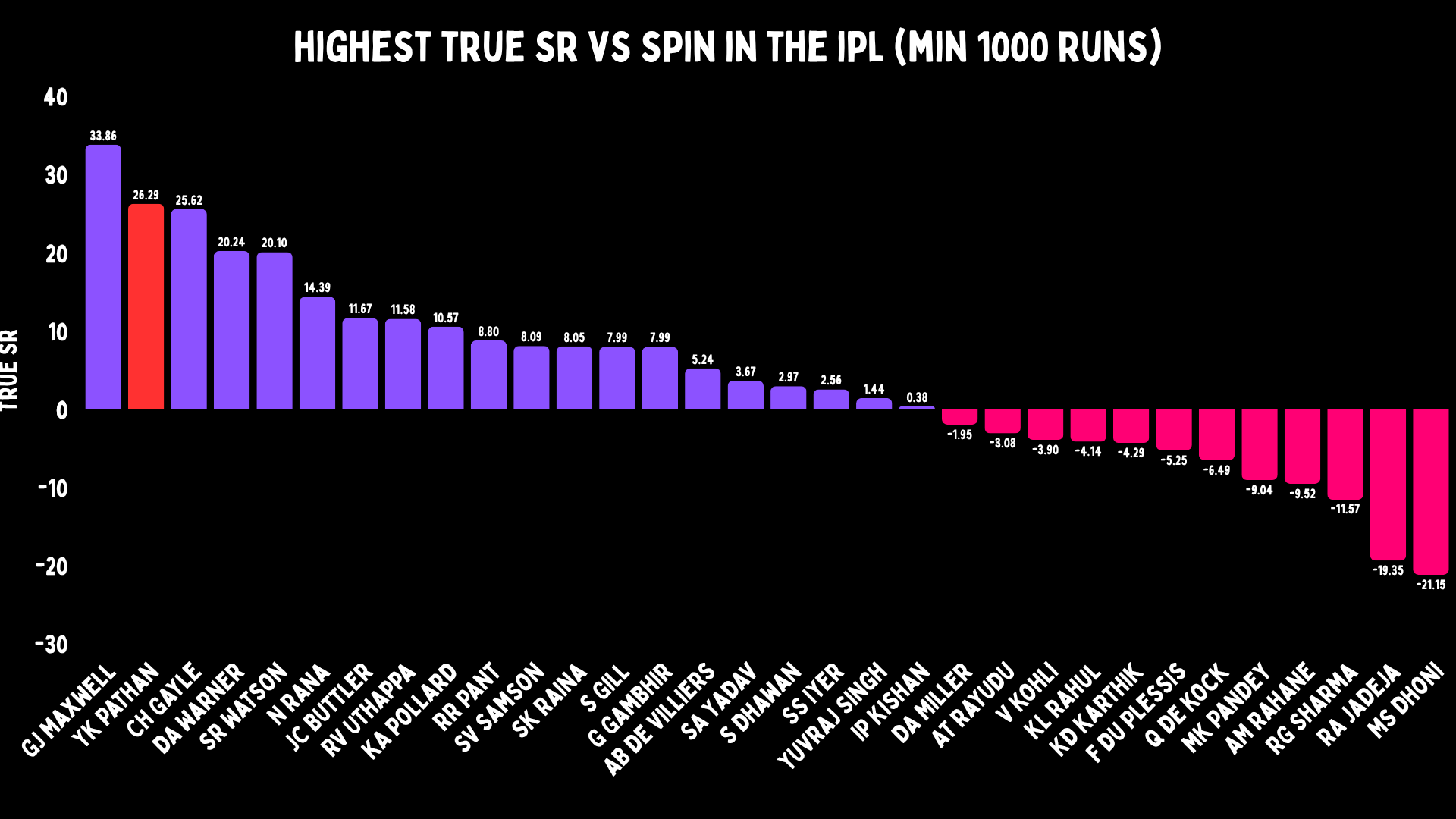
The 1000 run mark is important. This is not someone who got lucky, it is a player who is a great specialist. He wasn’t just good at playing spin, but destroying it. A grotesque killing machine.
Yusuf has two seasons where he’s averaging over 60 and striking at over 200 versus spin. Heinrich Klaasen, Rajat Patidar and Nicholas Pooran haven’t done that. But Yusuf also has four seasons with an average of more than 40 with 140 strike rate.
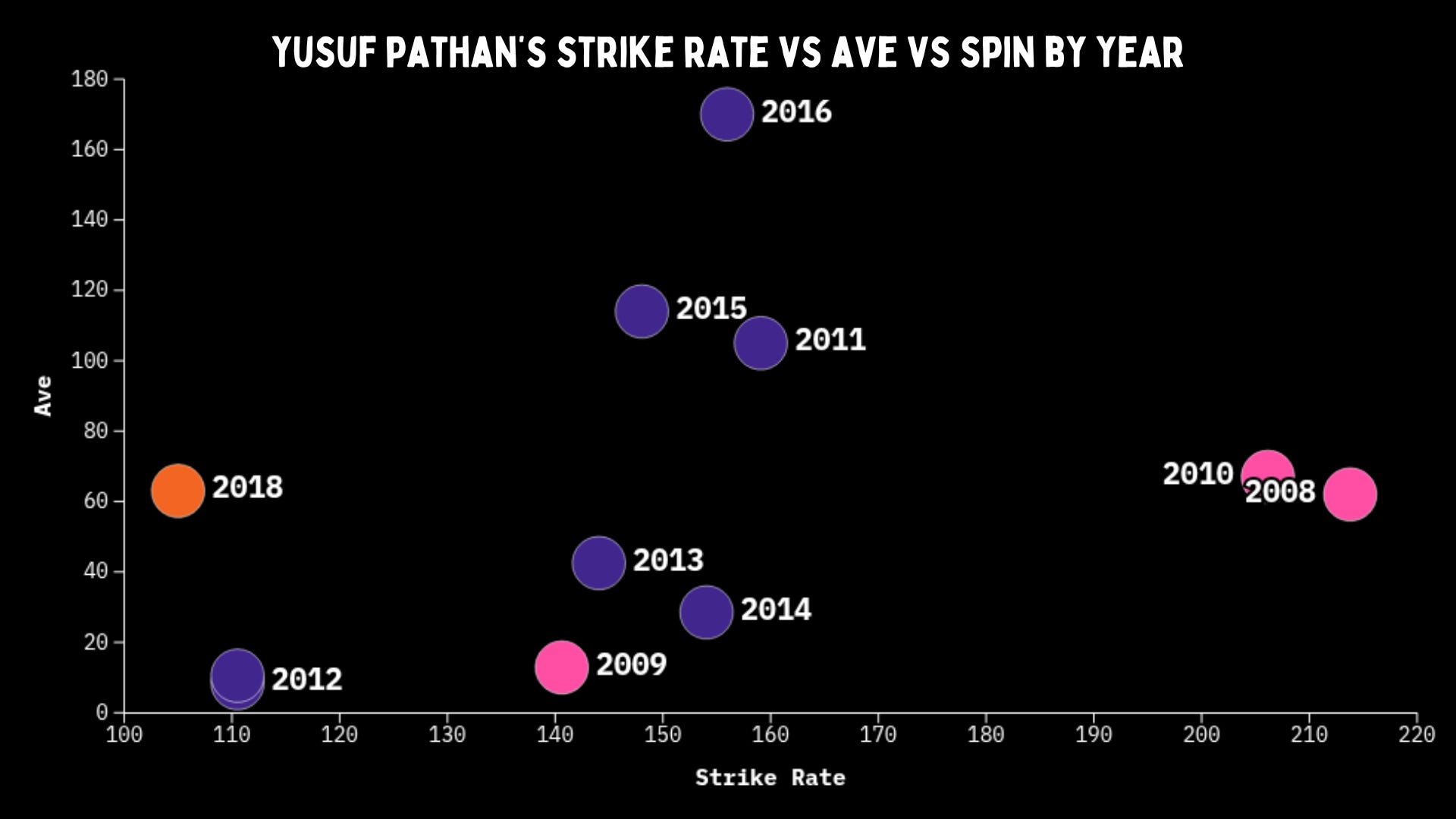
This isn’t Sunil Narine getting on a roll sometimes; Yusuf continually crushed and stayed in against the turning ball.
He has five seasons where his true strike rate is over 35. Two of those are near 80, which we thought was a typo. And if you’re into anchors, he also has five seasons where his true average is over 35.
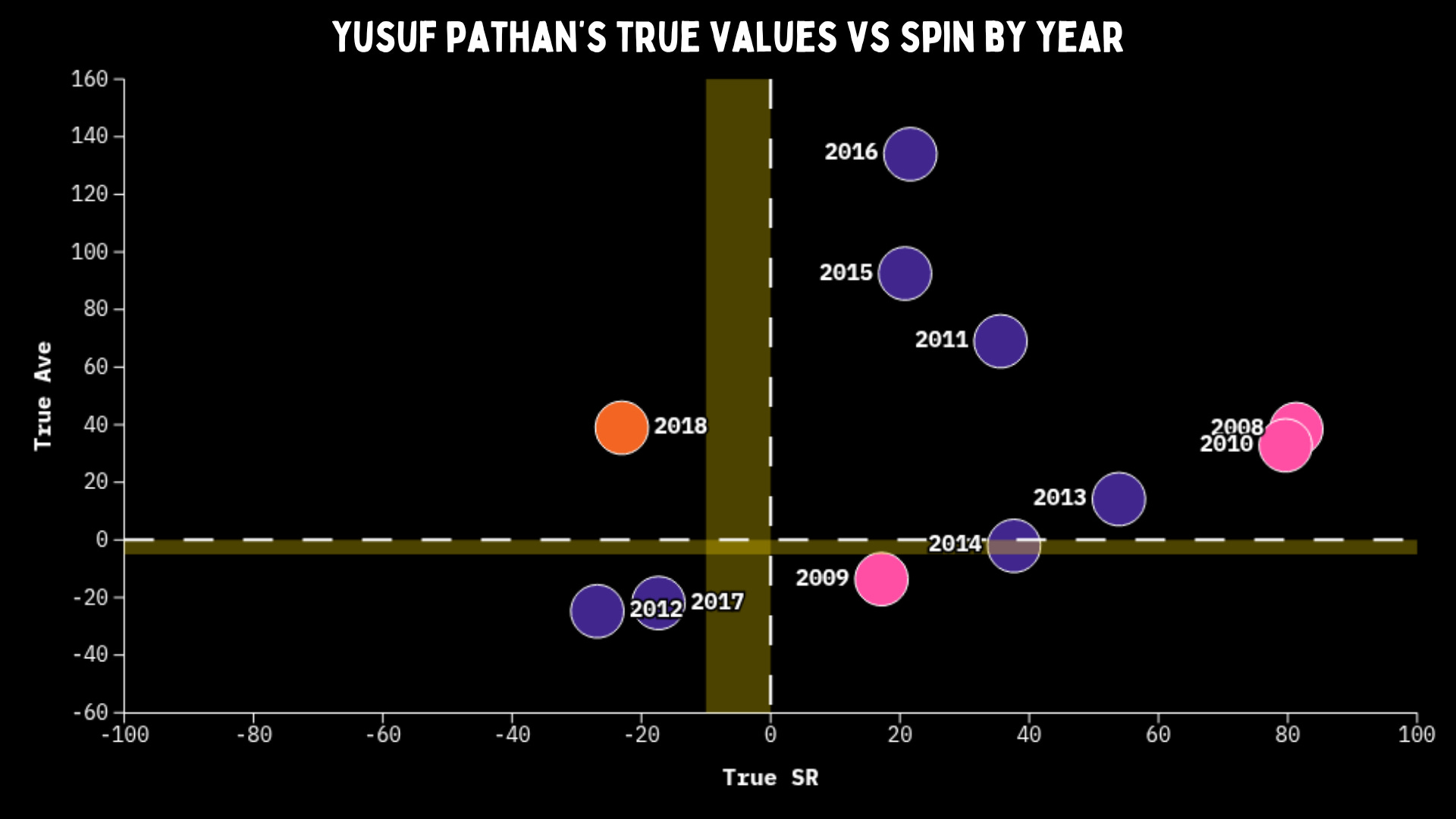
But, the good times stopped, and when they did, it was as if someone found an antidote to stop him.
Yusuf’s true strike rate versus the turning ball is 36 till 2016 and -24 afterwards. That’s a 60 point swing in true strike rate. He had a small drop in his pace batting. But it was normal.
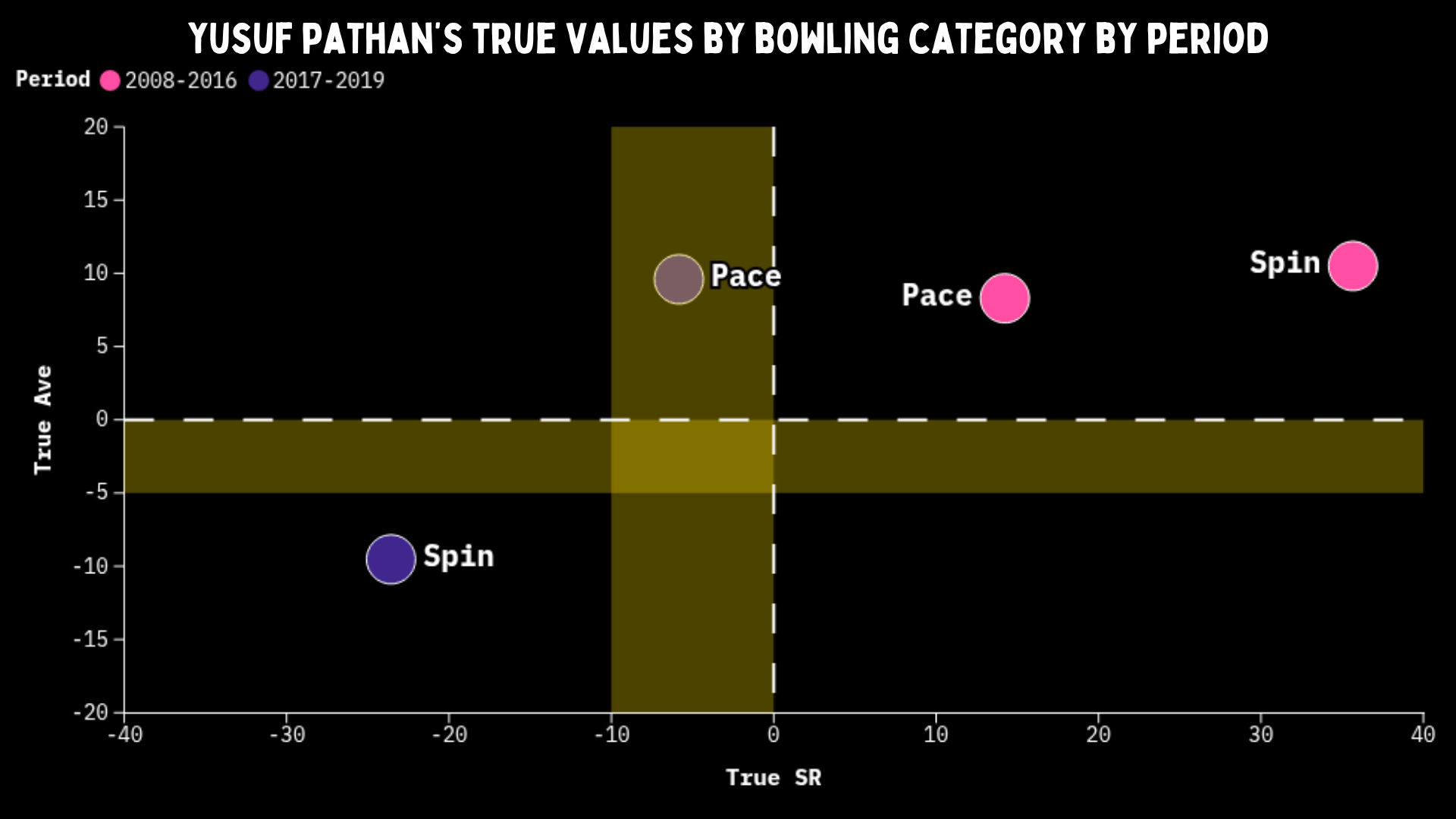
Yusuf went from the best hitter of spin ever, to a normal human.
It wasn’t just the turning ball though. Before 2017, he didn’t spare any kind of bowling. He had a true strike rate of over 25 versus all types of bowling barring right-arm pace. In fact, this makes him weirder. It is very rare to have your worst record against the thing you face the most.
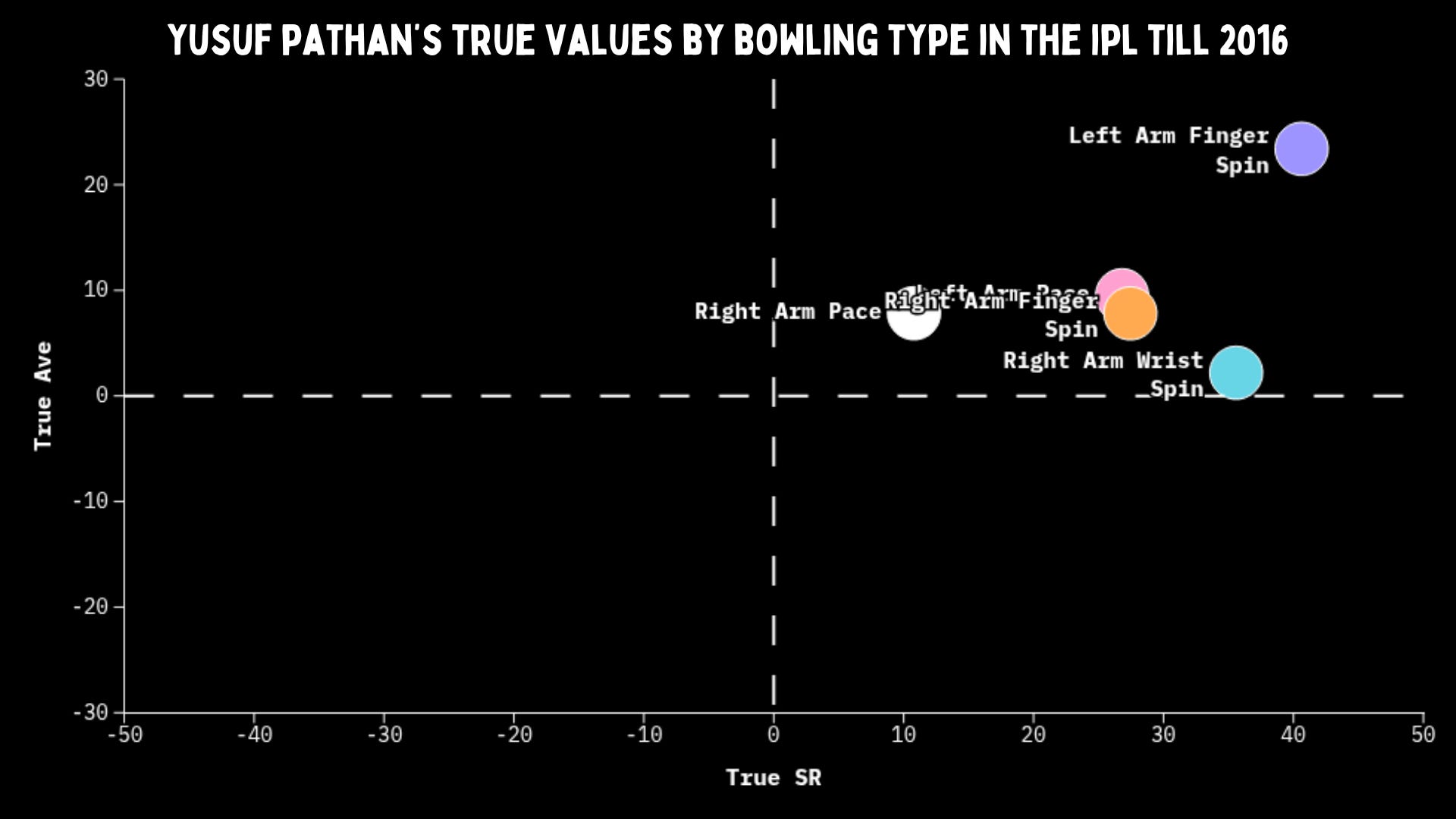
And as a right-hander, he was best against left-arm finger spin. Which is even more bizarre.
It was like he was a mutant that developed in the wrong way.
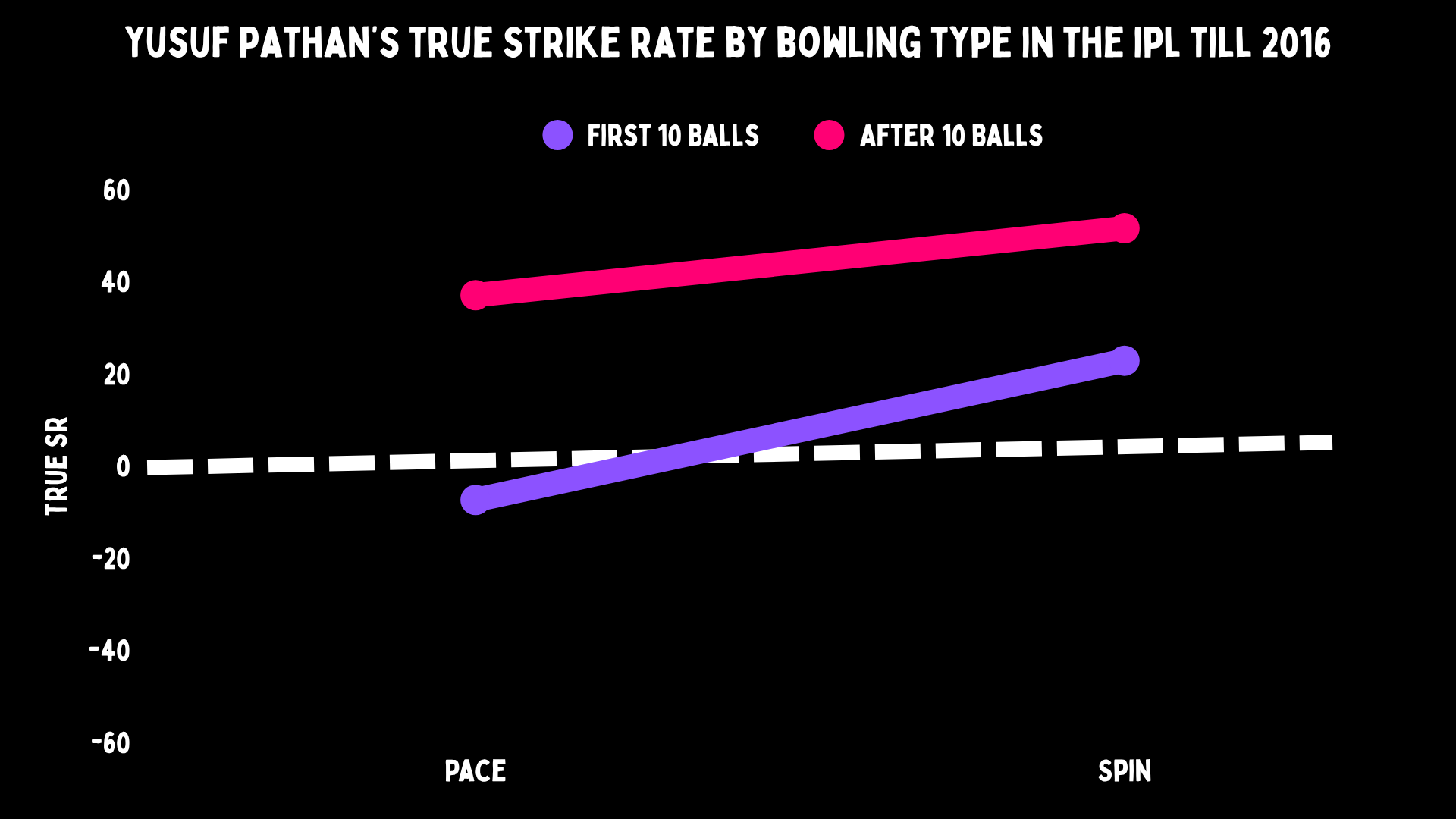
Yusuf didn’t need time to get going against spin, a rarity for batters. Only 10 players out of 48 have a positive true strike rate versus it in their first 10 balls. Yusuf with a true strike rate of 23 is only second to Glenn Maxwell’s 28. However, Yusuf’s true average in his first 10 balls is 20, whereas Maxwell’s is -11.
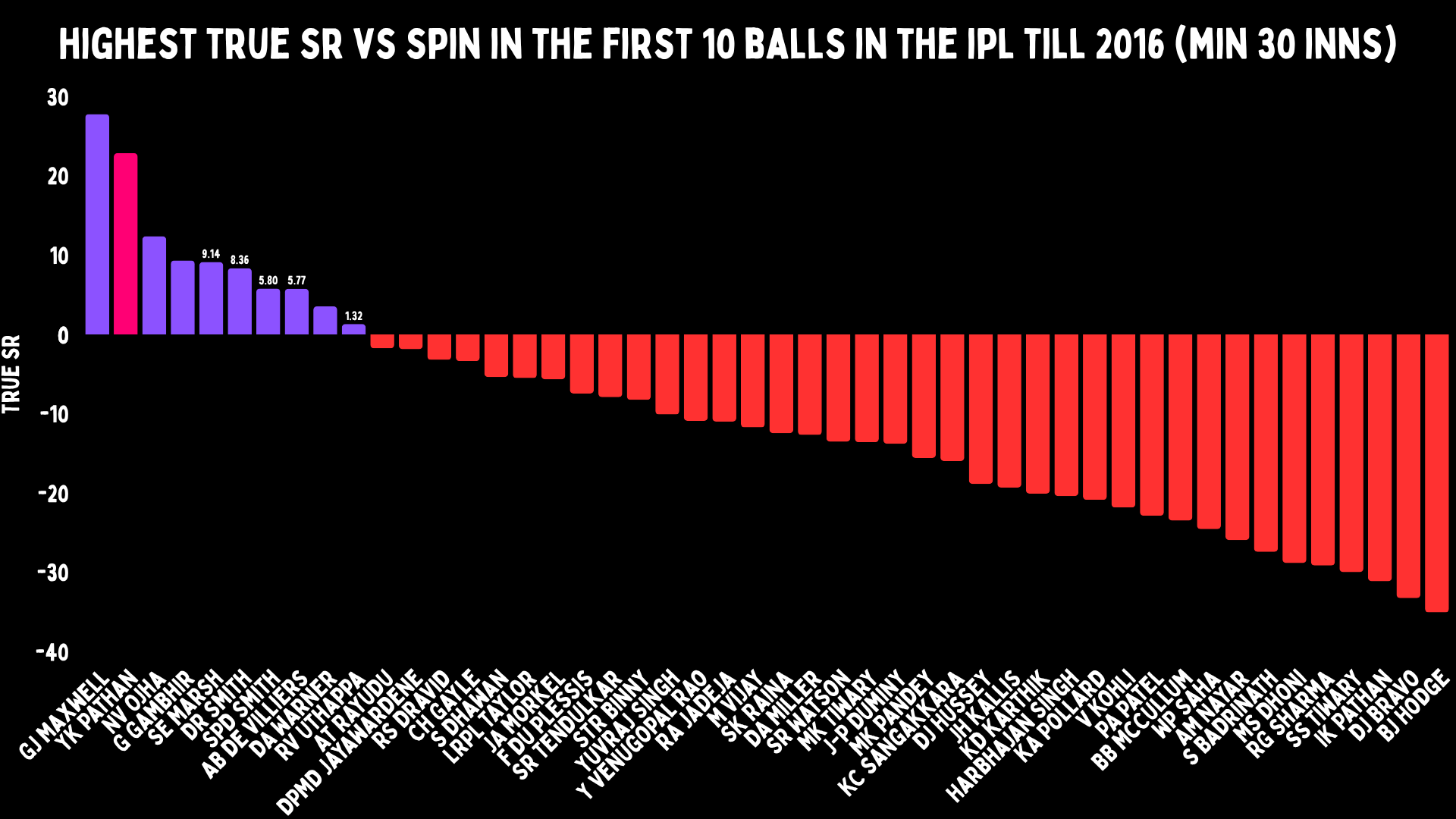
He could go from ball one, and not get out.
And once he’s set, that true strike rate jumps up to 51. Smashing spin from the get-go and crushing their soul when he’s set. However, Yusuf didn’t always like starting versus pace, he had a true strike rate of -7 in the first 10 balls. And that jumps to 37 when he’s set. He was a weapon; dangerous in the right hands, but could blow up in your face if you didn’t use him properly.
The way Shane Warne deployed Yusuf was almost perfect. 45% of his entry points for Rajasthan were in the 7 to 11 phase, when the spinners started to dominate.
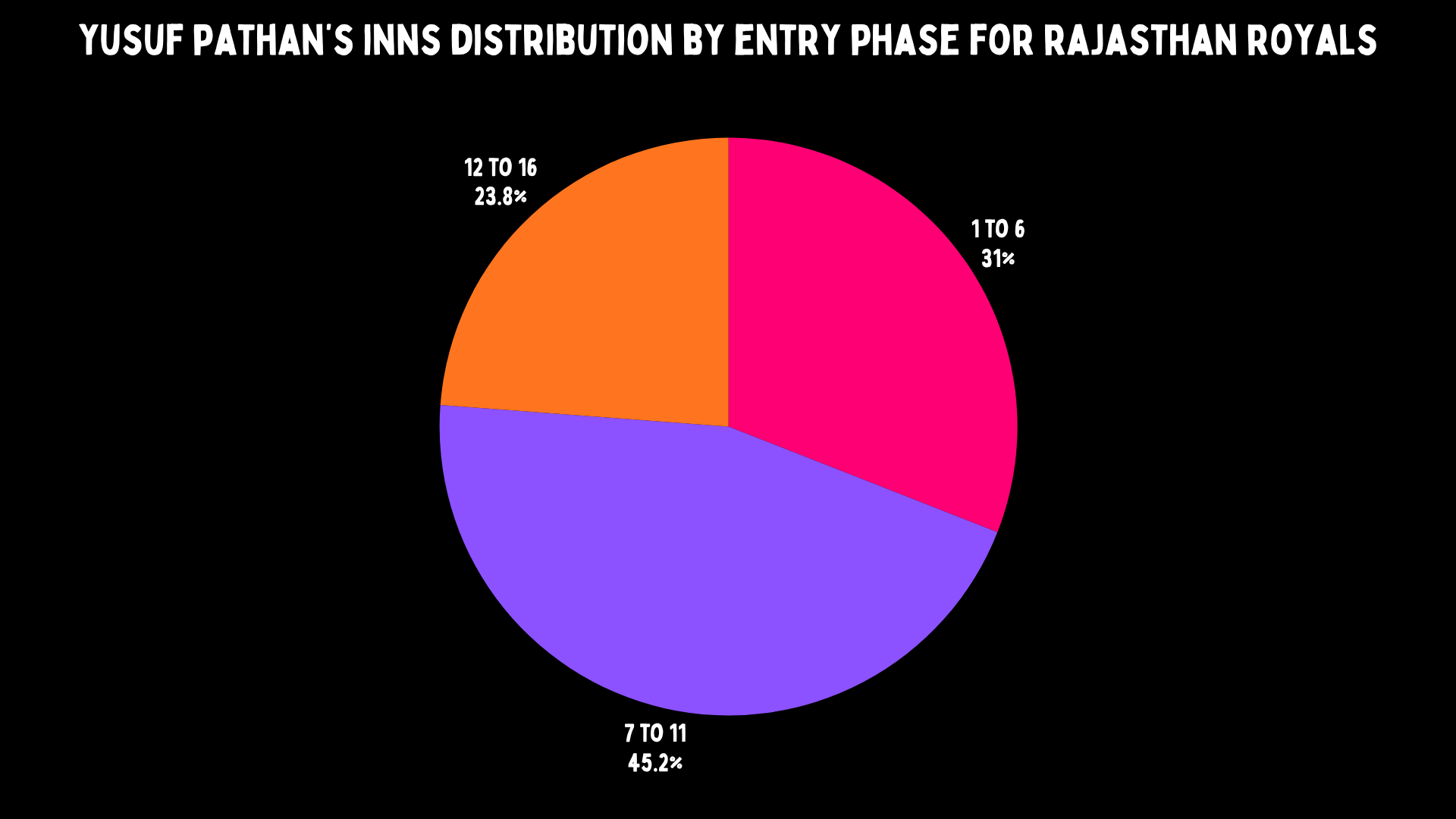
Yusuf had a true average of 15 and a true strike rate of 43 when he entered in that phase. He could face the matchup he loved from ball one, and as we’ve established, once set, nothing you bowl matters.
Warne knew exactly what he had. ‘He strikes the ball as cleanly as anyone I’ve ever seen,’ he said. Warne really backed and understood the talent that Yusuf was. Warne stated that ‘He’s not one of those guys who when he does badly, you just give him a size 10. You need to put your arm around him, make him feel good, and he will go out and perform the best for you.’ It’s one thing to understand the utility of a player; it’s another to understand their psychology.
Yusuf himself confirms it. ‘Before coming to the IPL, Warne studied my game and gave me the freedom to play as I wanted. He showed confidence in me right from the first game.’ The irony that one of the greatest spinners ever worked out how to destroy spin with a weapon he helped unleash.
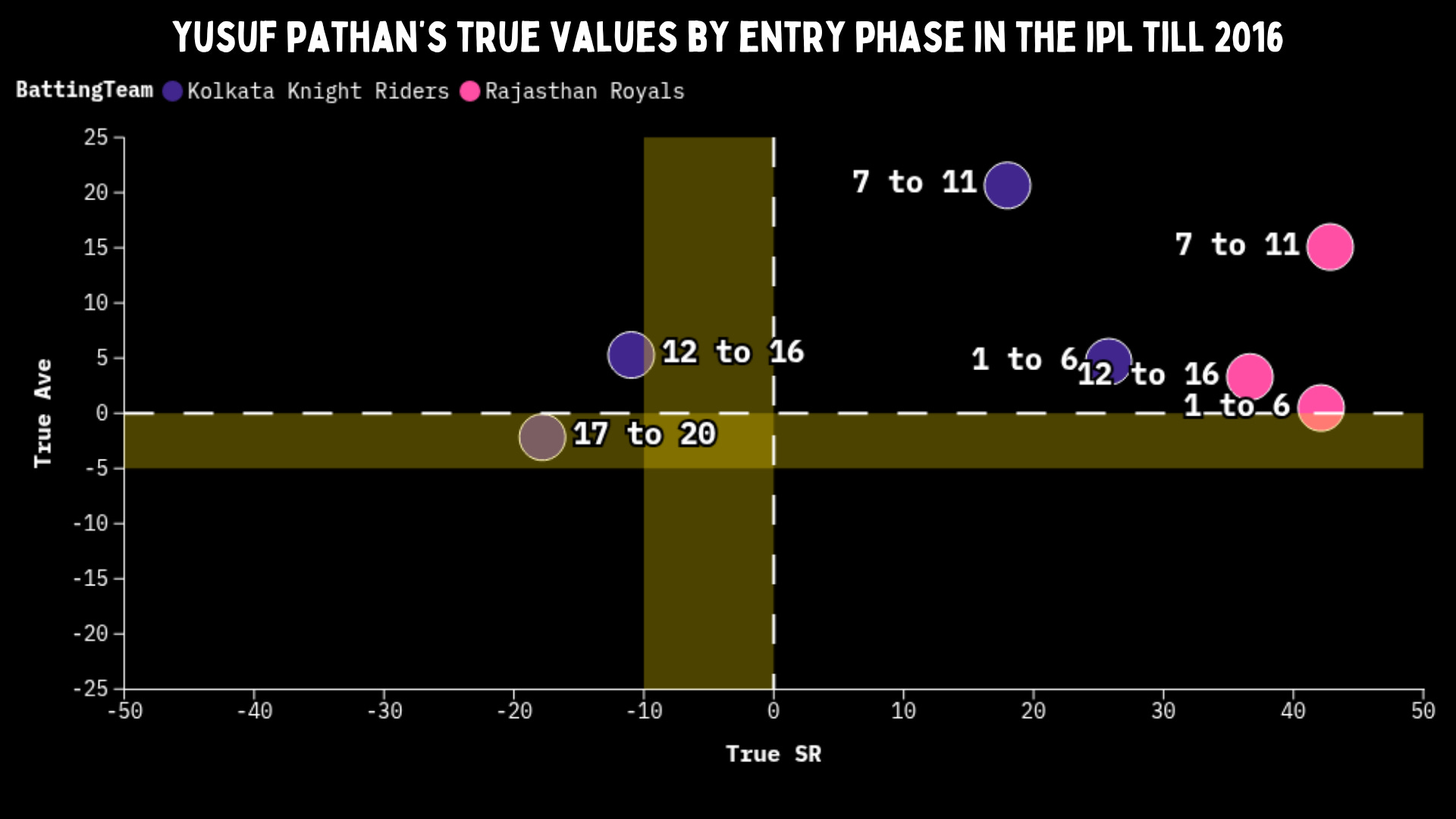
Changing sides muzzled him. The latest Yusuf ever entered for Rajasthan was the 15th over. For Kolkata, they didn’t see it that way. From 2011 to 2013, he was largely an afterthought, entering in his ideal phase just 23% of the time and frequently sent in at the death, where he was far less effective.
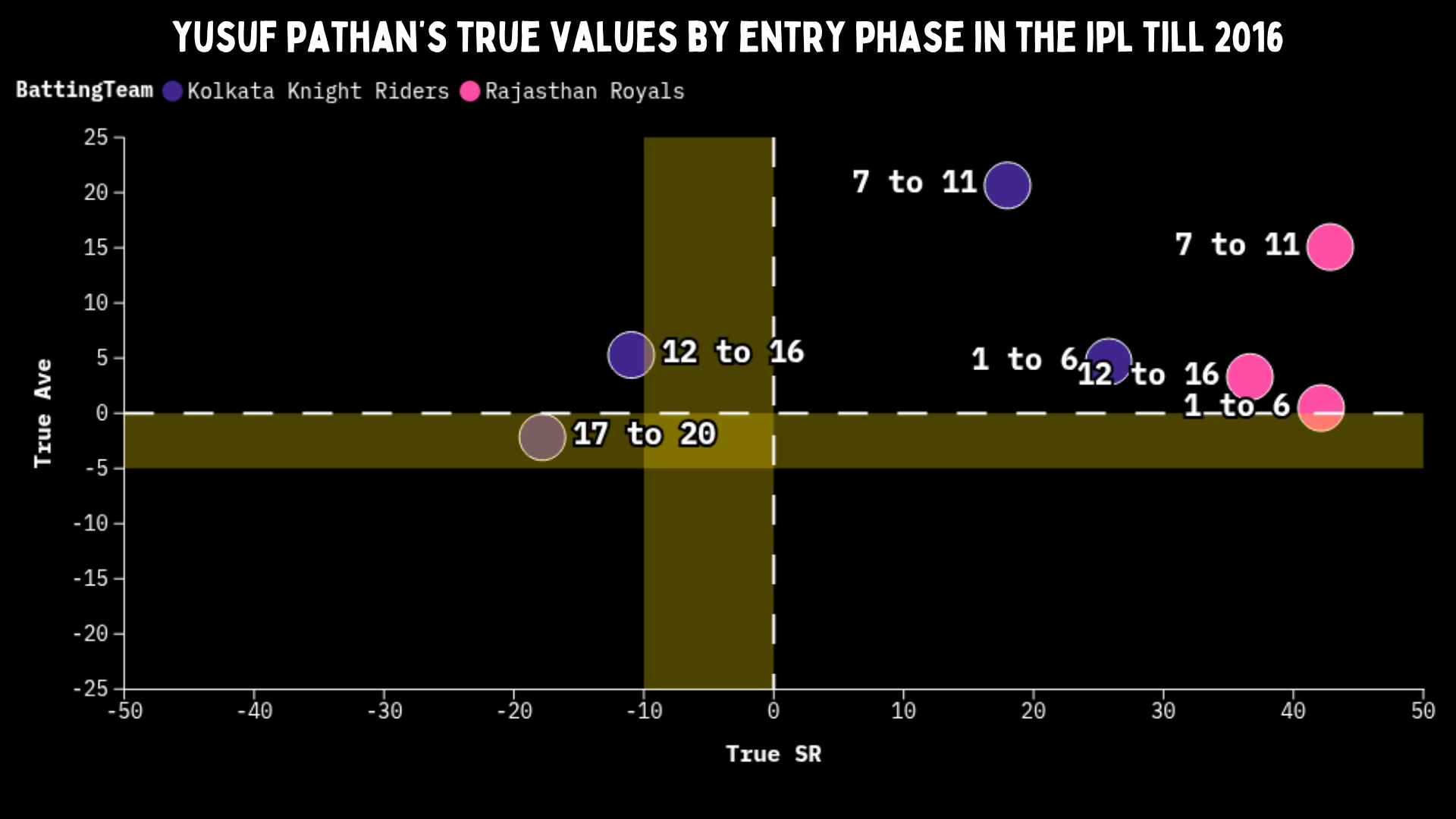
Kolkata bought Yusuf for $2.1 million, but they didn’t really know how and where to fit him in. Thankfully, Gautam Gambhir learned his lesson. From 2014 to 2016, that figure jumped to 46%.
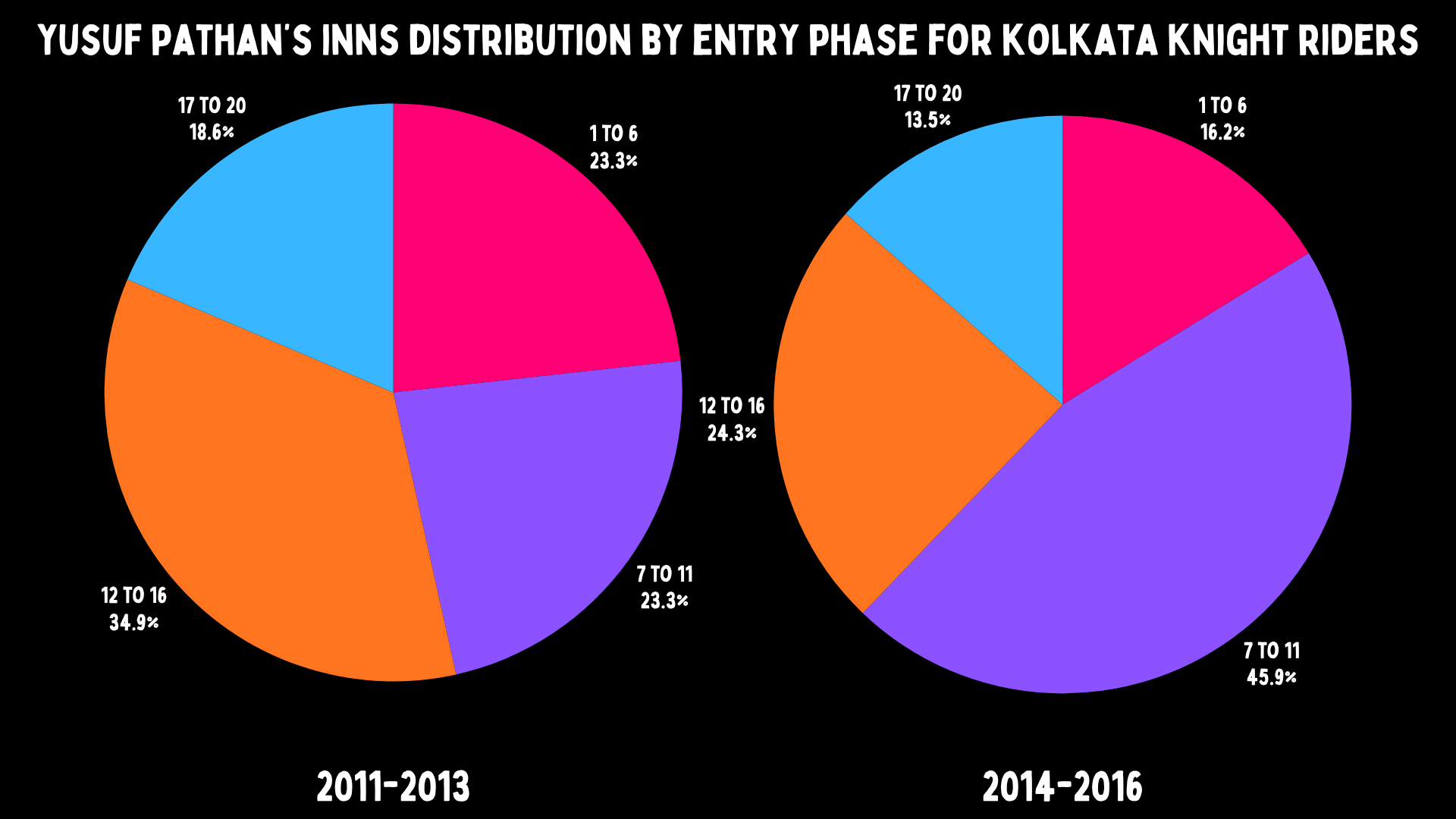
Overall, you have to say Gambhir did a solid job using Yusuf, though he didn’t always understand his utility as well as Warne did.
India, on the other hand, didn’t get the memo.
Yusuf’s median entry point was in the 8th over for Rajasthan, the 10th over for Kolkata and the 13th over for India.
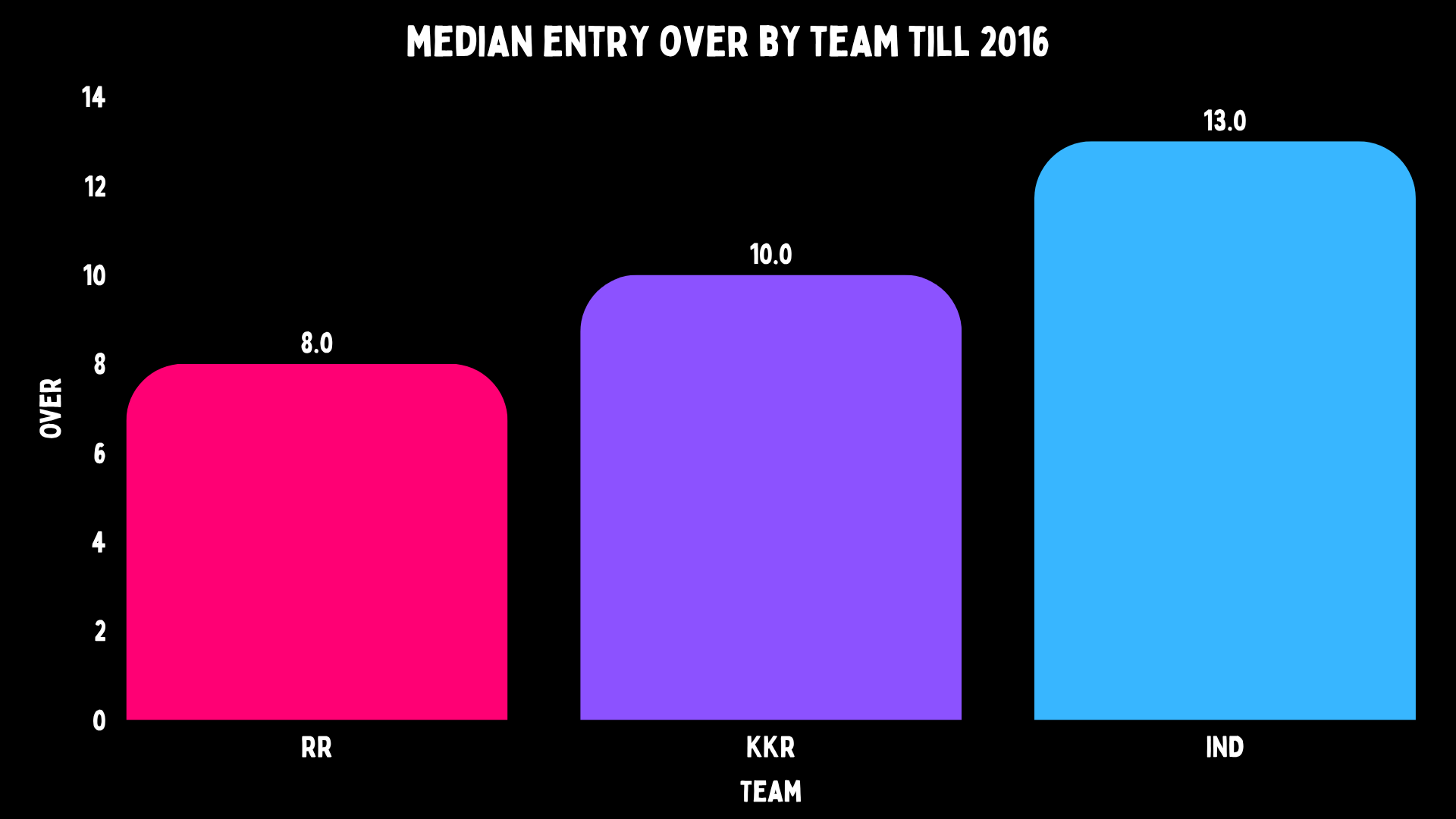
In that era, spinners often didn’t bowl after the 14th over. India had a weapon of mass destruction, and they misplaced their keys.
India used him in his ideal phase half as much as Rajasthan did.
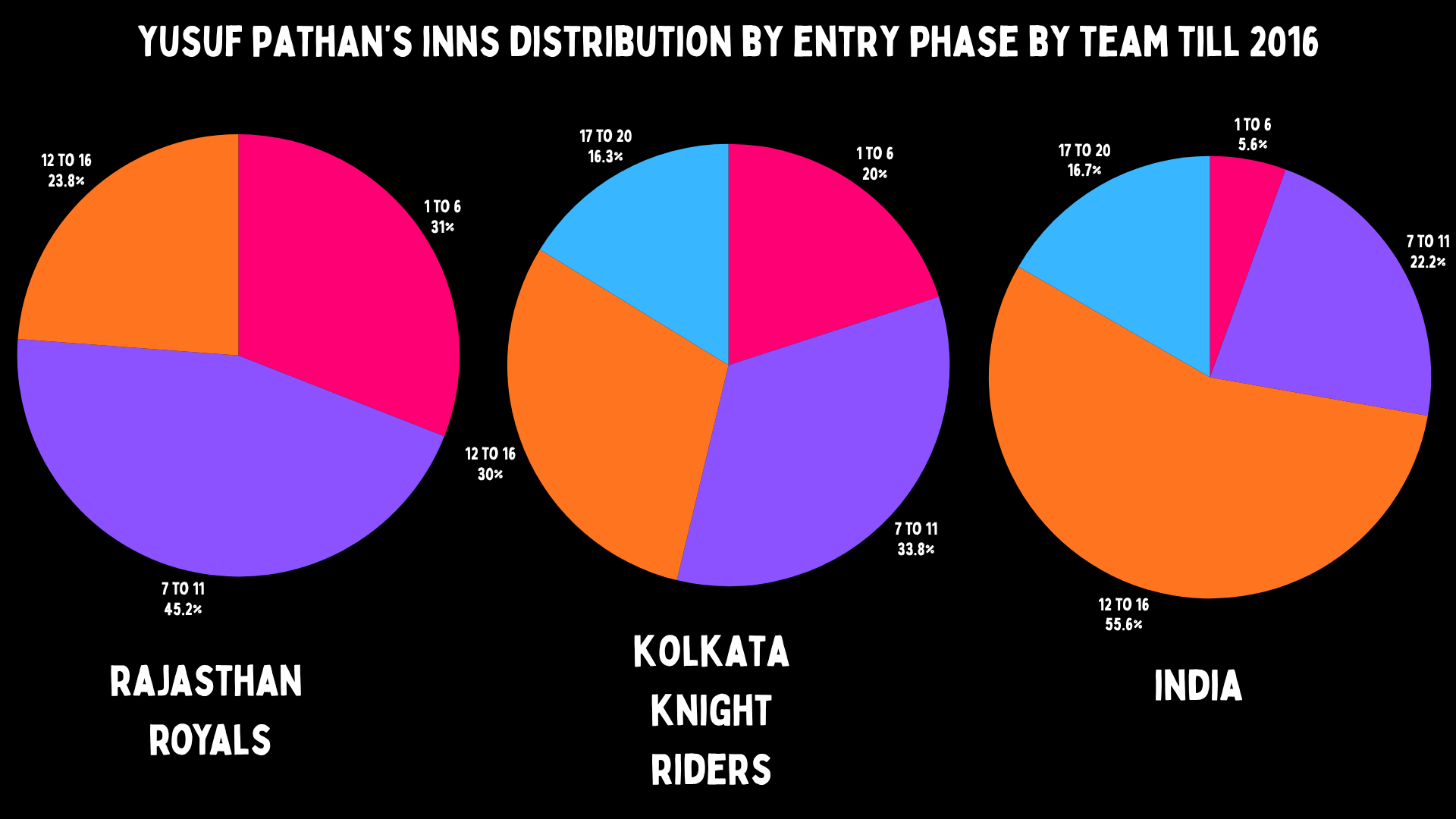
And on the rare occasions India did put him in earlier, the scores were 48/4, 61/5, 37/5 and 105/5. Even in his ideal phase, both arms were tied behind his back and he was set up to fail.
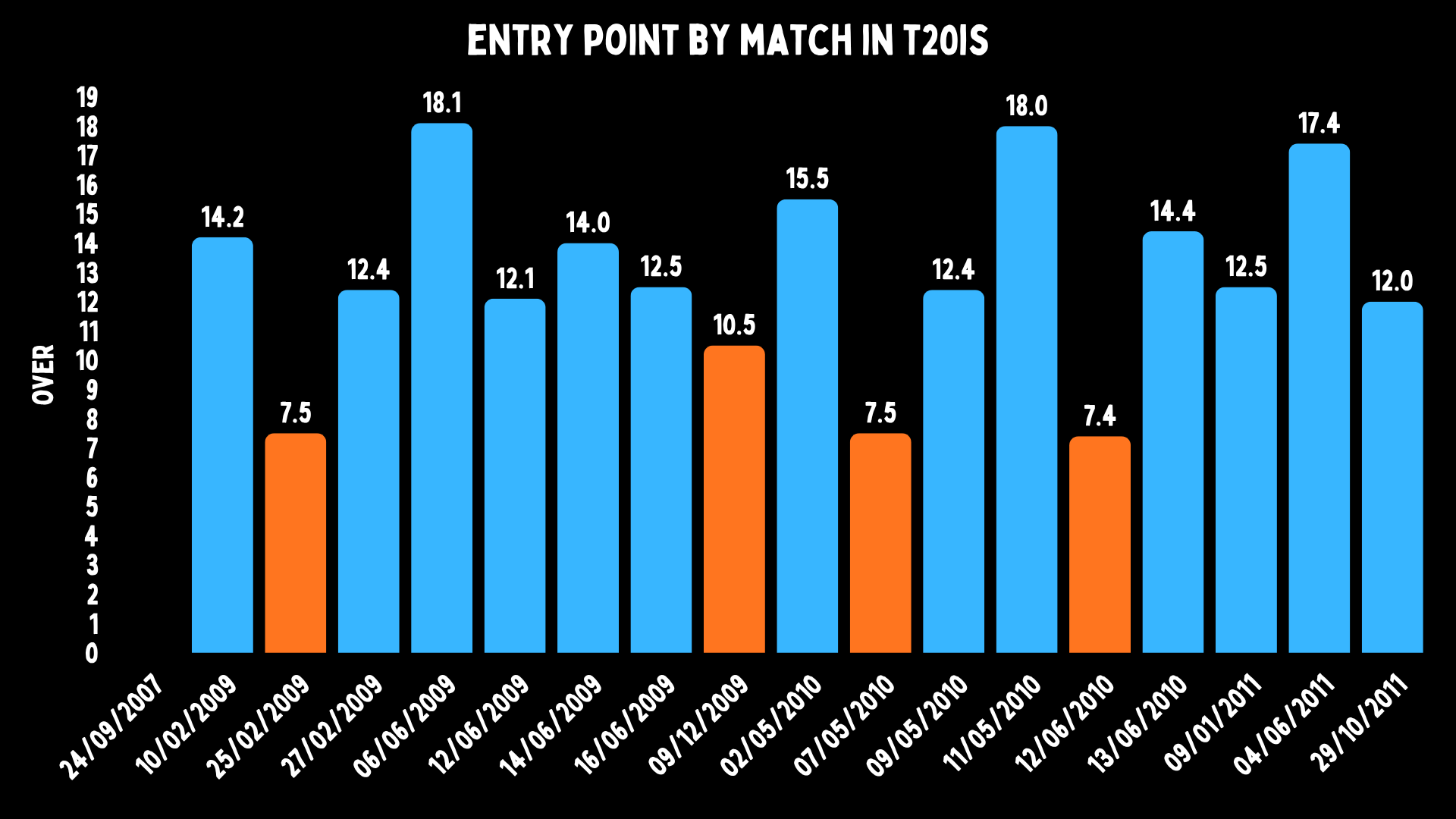
Both India and Kolkata early on miscast Yusuf. He was a big, strong man that hit the ball a long way, so naturally they assumed he’d be good at coming in at the end to finish. They weren’t alone in making this tactical error, Australia did this with Andrew Symonds, Mumbai Indians did this with Kieron Pollard and Chennai Super Kings did this with Albie Morkel. Lance Klusener and South Africa in the 90s, too. If you’re built like a refrigerator, teams will often push you further and further back. But in reality, your best usage might be up the order.
Yusuf wasn’t a finisher that could occasionally hit spin. He was a specialist middle overs spin destroyer that on occasions could finish a game. They are distinctly different roles. Unfortunately for Yusuf, this misreading haunted his international career.
And yet even in the wrong role, the T20I numbers tell you exactly what India were leaving on the table. If we look at Indian batters versus spin till 2016, Yusuf had a strike rate of 175. The next highest was Yuvraj Singh at 129. MS Dhoni had a strike rate of 91. So Yusuf is 45 points ahead of the next-best player, and nearly double his skipper.
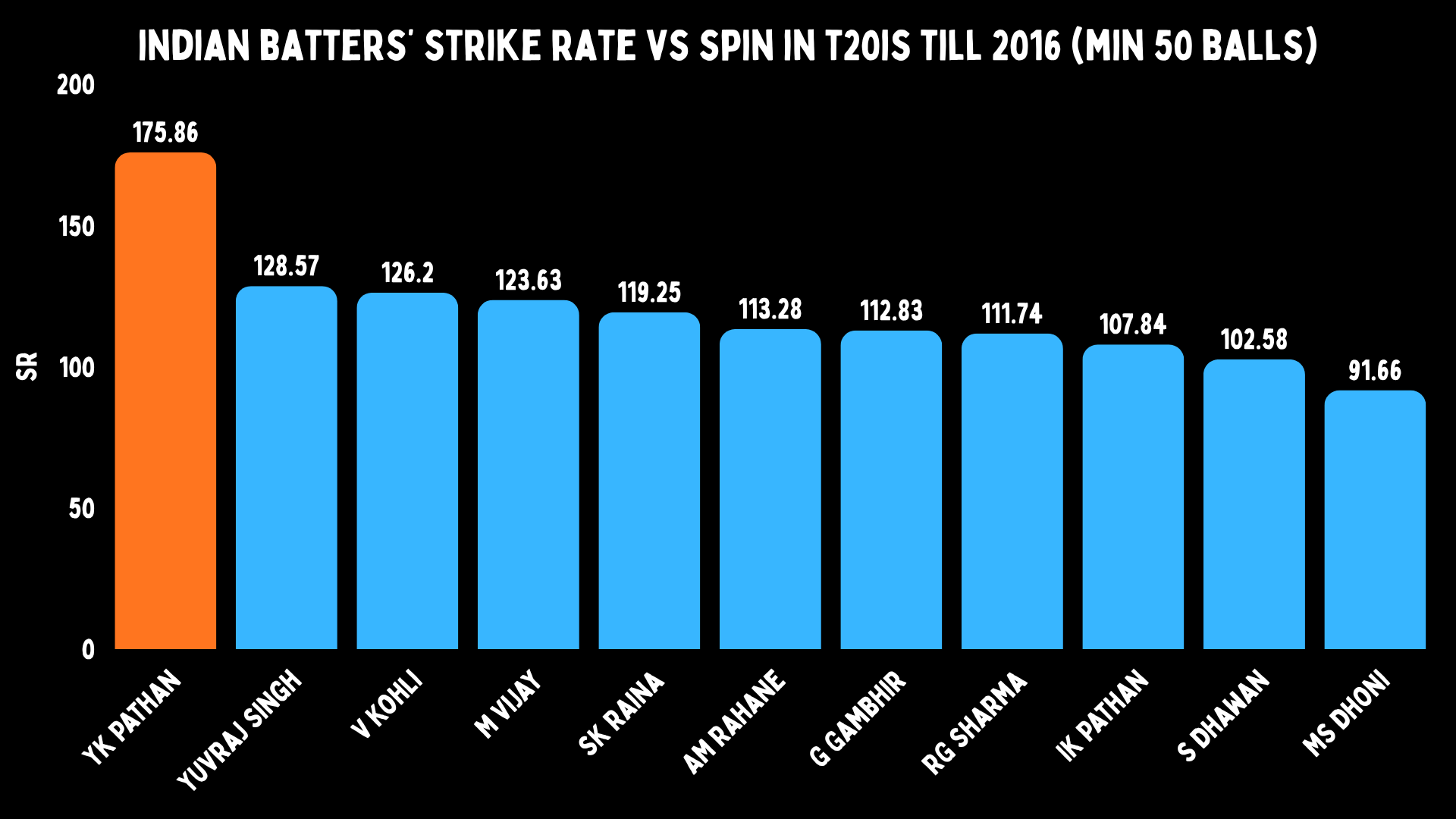
Even playing in the wrong role and coming in at the wrong time, he still managed to bash spin whenever he faced them.
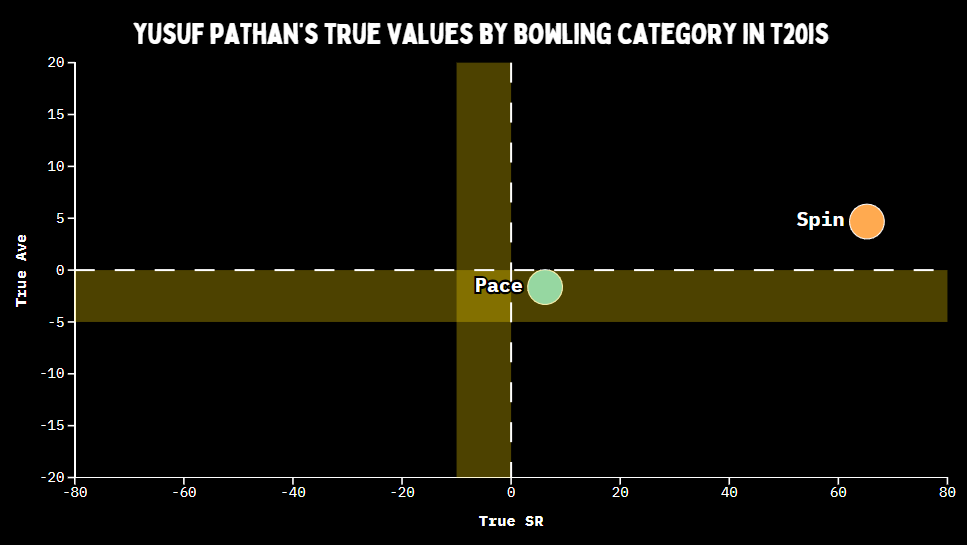
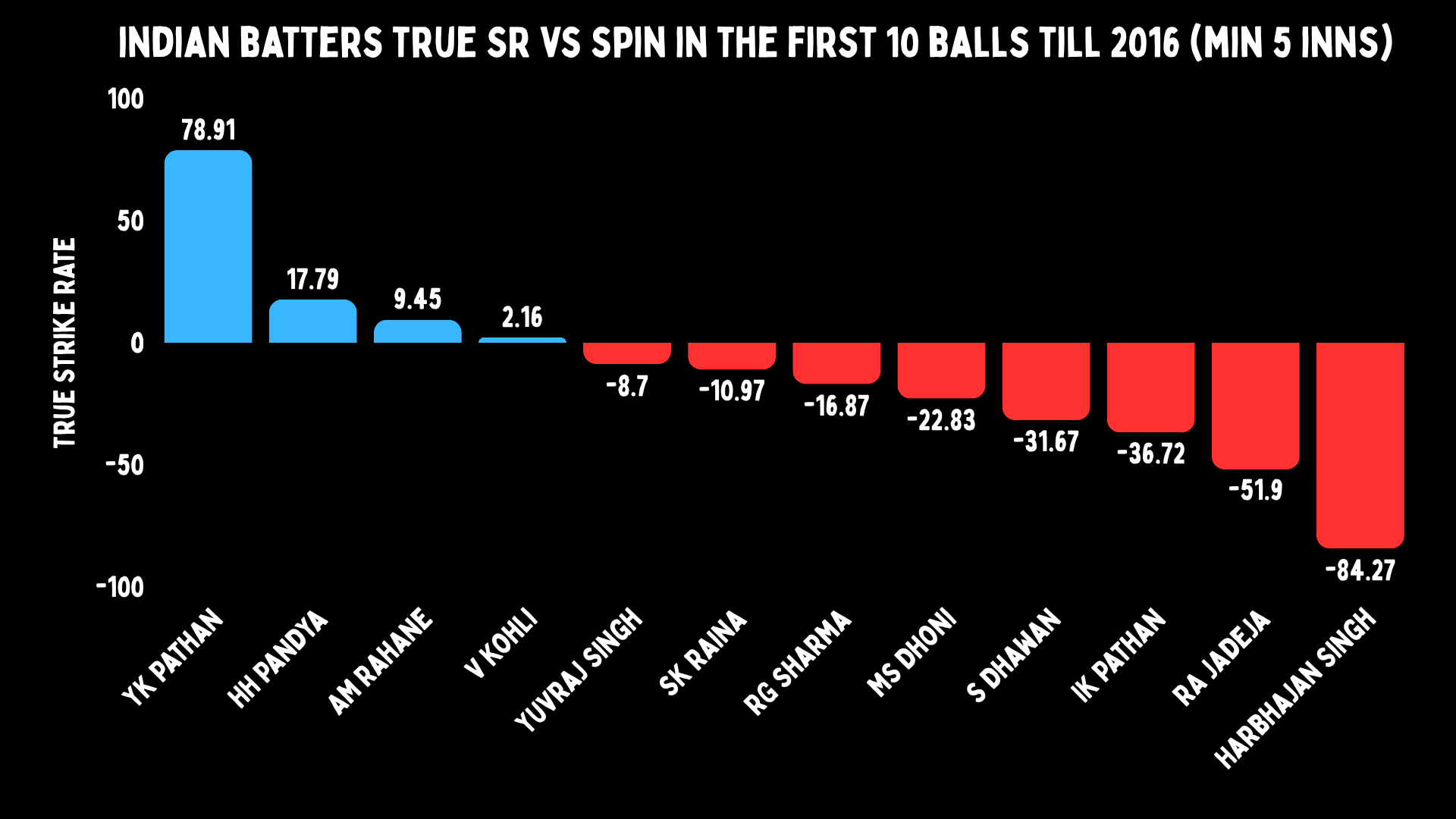
Naturally, his best utility would be as a middle order batter in Asia. However, in his entire T20I career, only 3 of his 18 innings came there. Twice he batted at number 8, and once at number 7. All three times, India were already in a crisis.
The first time he walked in, the score was 110/6 needing 53 to win. Hits 22 off 10, including 16 off 4 balls versus legspinner Malinga Bandara, who had taken three wickets and was barely going at a run a ball before Yusuf won the game.
You can tie his hands behind his back, put him in a hessian bag and chuck weights in with him, and he’ll still crack a six from spin.
Yusuf last played a T20I in March 2012, a rain-affected game in which he didn’t even get to bat. That was just before they headed into three T20 World Cups that took place in Sri Lanka, Bangladesh and India, respectively. India dropped their best spin-hitter on the back of failing against pace in a role he wasn’t designed for mainly outside Asia. They muted their mutant.
In these tournaments, where both playing and bowling spin would play a central part in determining your fate, India had strike rates of 111, 103 and 101. Barely over a run a ball in 2014 and 2016.
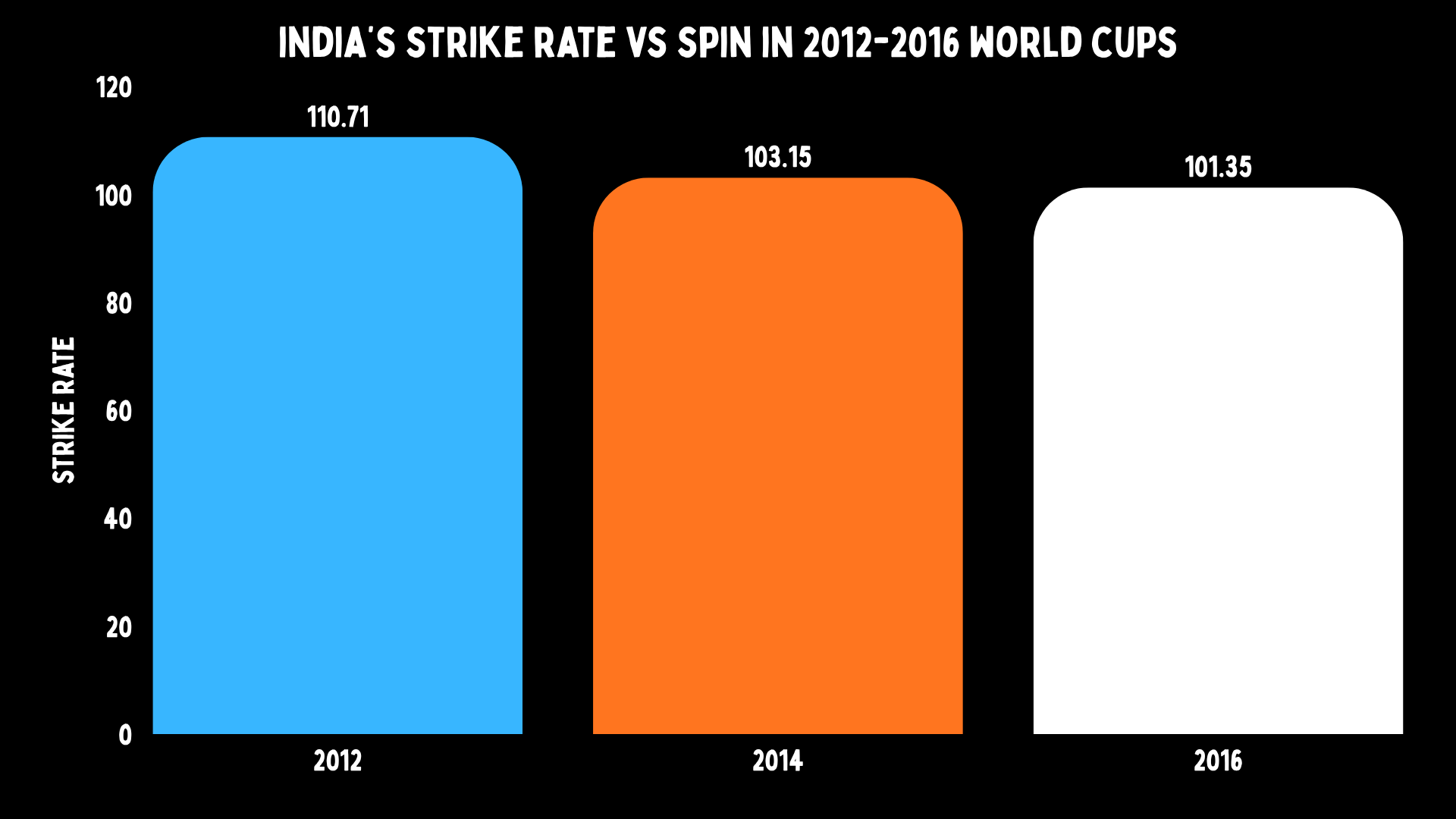
They were the seventh-worst team in terms of strike rate across these T20 World Cups.
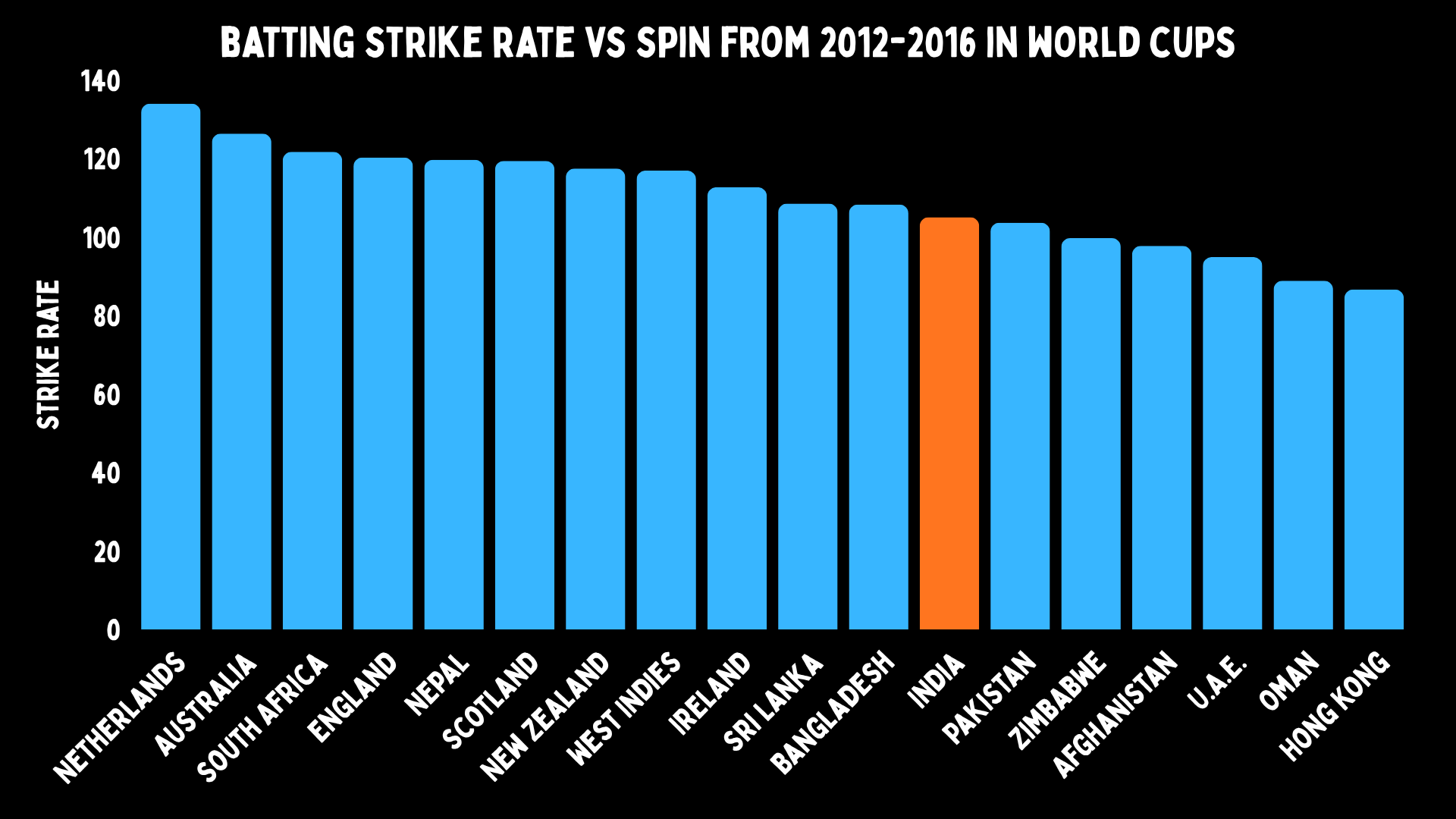
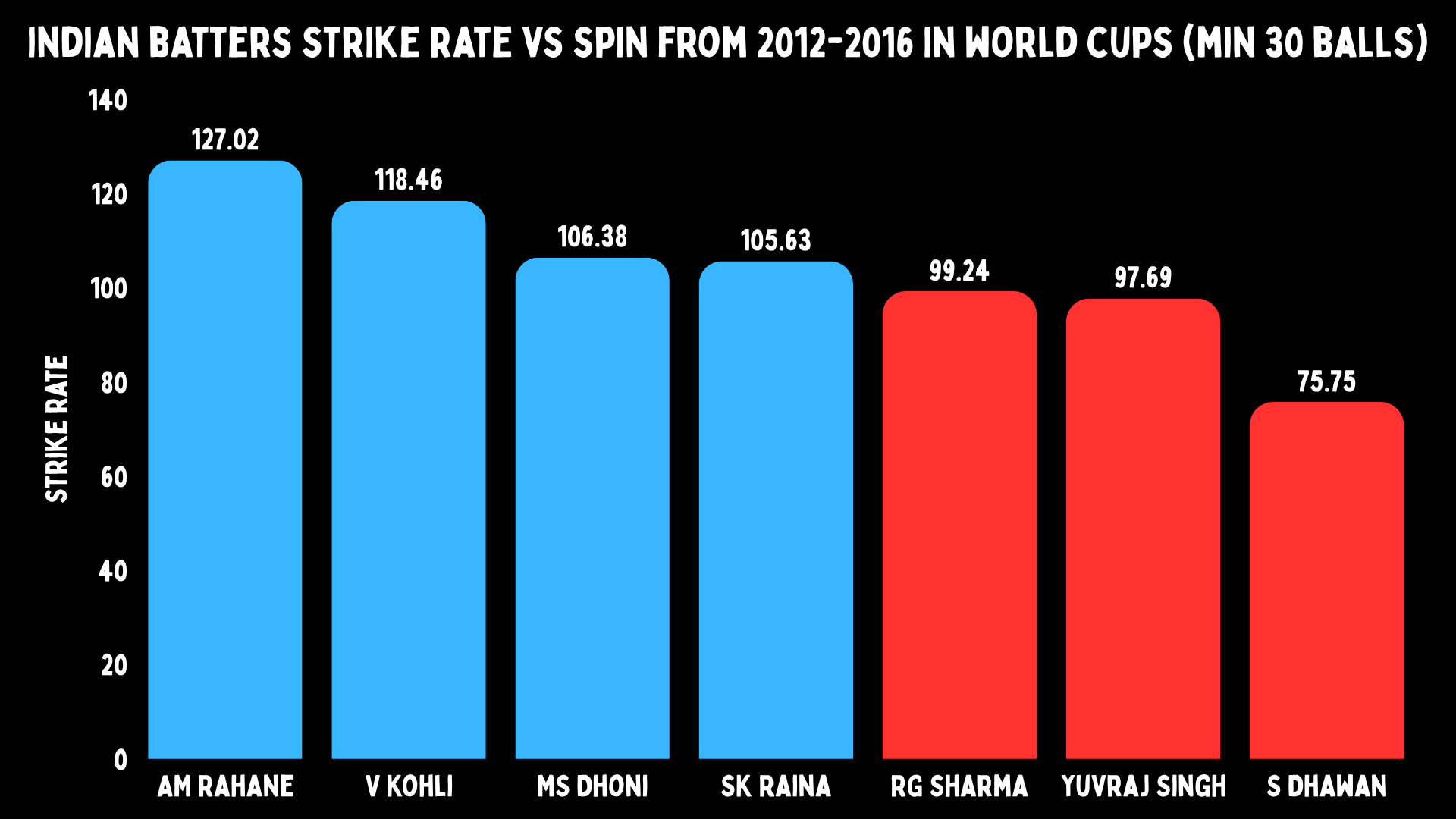
Three batters went at less than a run a ball in this timeframe. One would be a liability, three is a systemic issue.
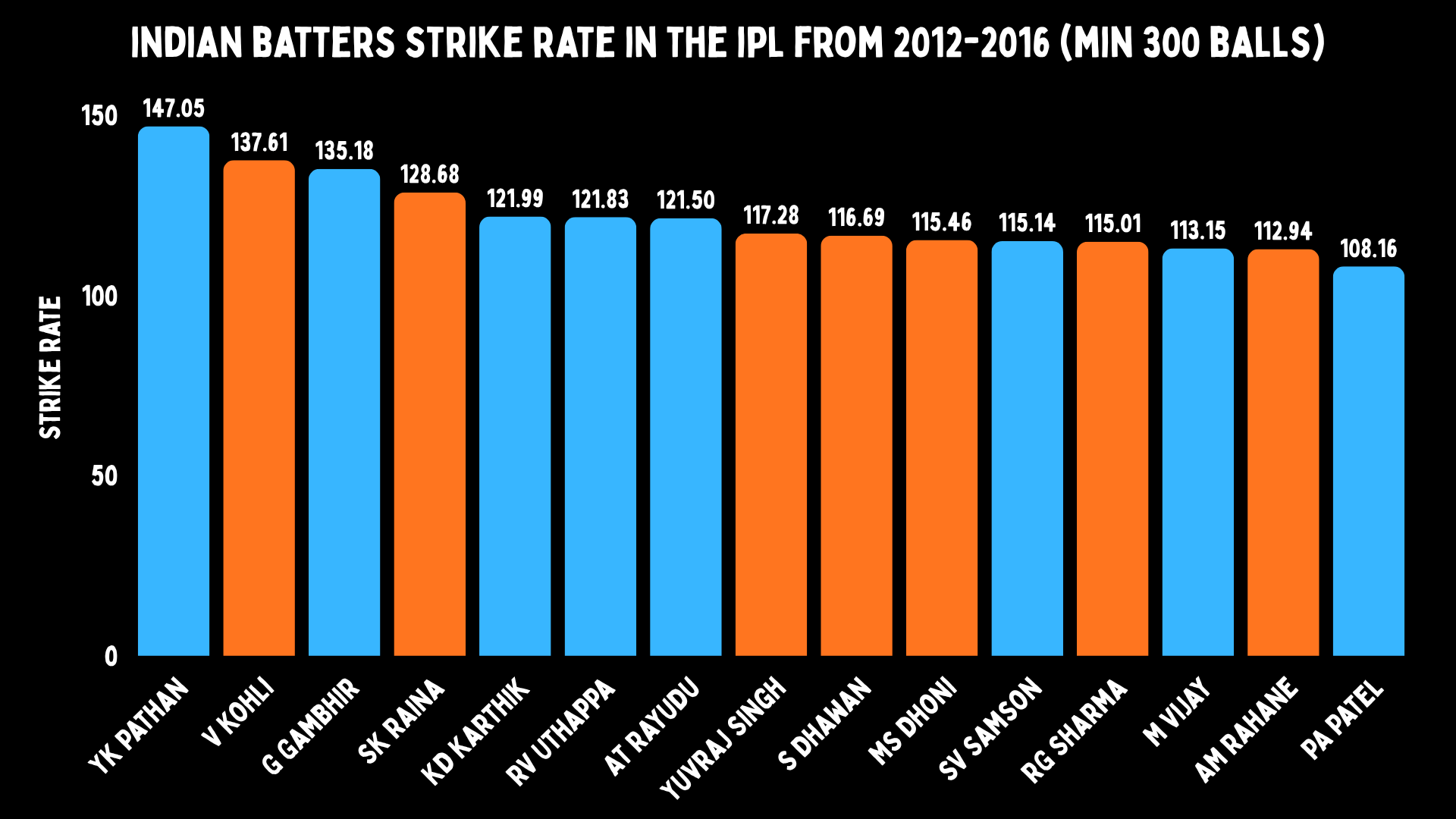
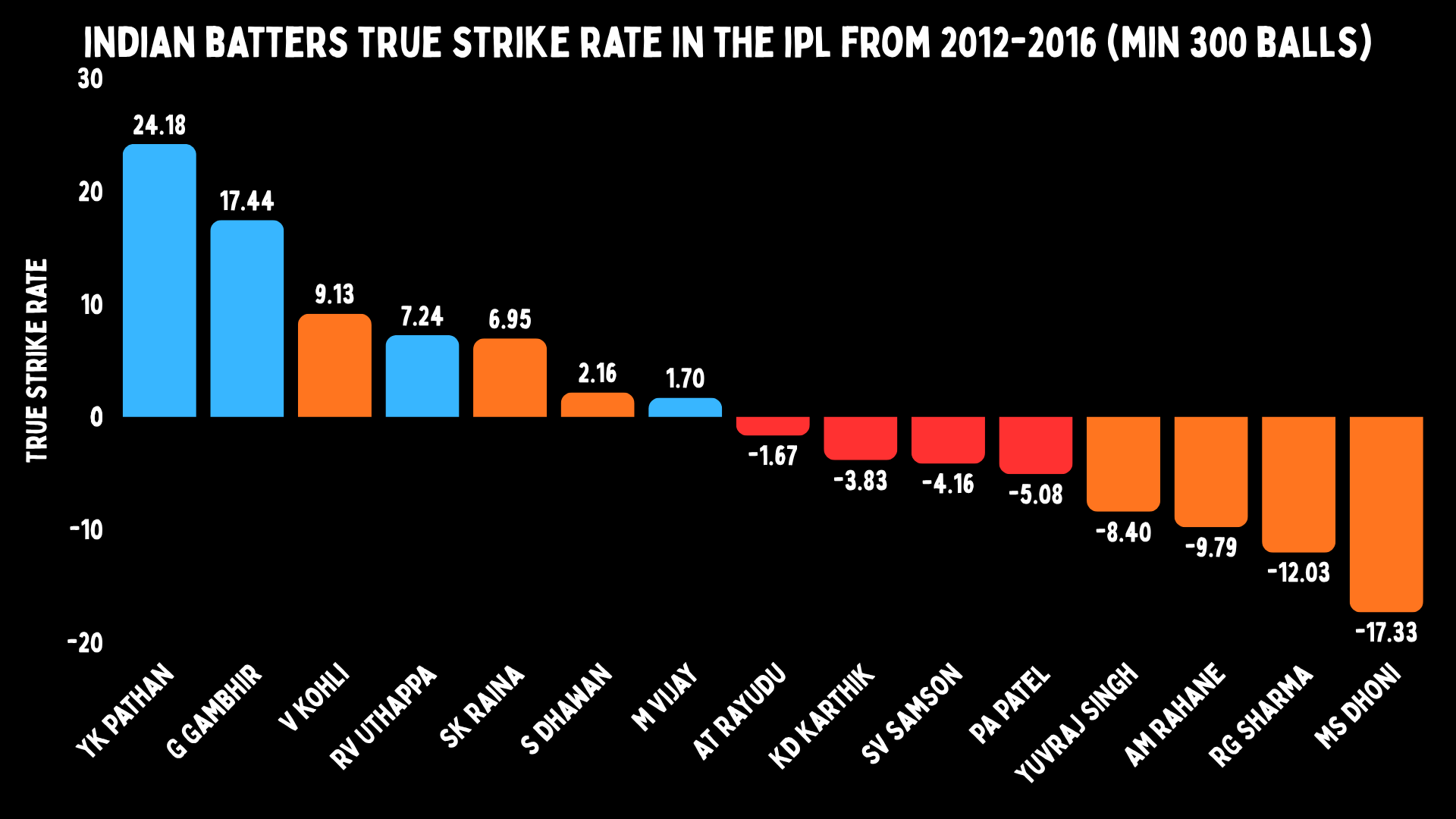
Meanwhile in the IPL in the same period, five of the players in the World Cup teams had a strike rate below 120 versus spin. The best of the lot was Virat Kohli with 137. Yusuf Pathan was 147.
In 2012, they needed a big fast win over South Africa, and they got stuck against spin.
In 2014, for the final the Indian batters got stuck versus the Sri Lankan spinners, who ended with figures of one for 45 in 8 overs.
In 2016, India made the semi-finals, put up 192 and still lost. In that, Samuel Badree bowled four overs, one for 26. The bowler with the next lowest economy was Sulieman Benn, who went for 36 runs with his left-arm spin. Something Yusuf would eat.
India had this incredible beast-man and three tournaments in which to unleash him, and they kept him in mothballs.
***
Yusuf Pathan was flawed, and weird. He didn’t fit in with the batting orthodoxy of his time. He was punk in the 60s. A tech genius from the 1800s. Shane Warne saw it, but few others did.
No one can tell what India might have been with Yusuf Pathan in the middle overs, feasting on the souls of the poor spinners who went up against him. Instead, he was miscast, then outcast. But you watch cricket today, and you see little parts of Yusuf in Shivam Dube, Rajat Patidar, Heinrich Klaasen, Nicholas Pooran and Abhishek Sharma.
And Yusuf Pathan was where that strain of batting first mutated.