
By Lou Melini — In September of 2025, Julie and I did a “hiker/biker” bike tour of Yellowstone National Park, a trip I had been planning for about a decade. Our tour was a shortened version of what I had originally envisioned, but it worked well with our time limitations.
Yellowstone NP was created in 1872, the first national park in the United States and in the world. It is 3,472 square miles, with 96% in Wyoming and the rest in Idaho and Montana. Only Death Valley NP is larger in the continental U.S., and three national parks in Alaska are larger. Because I have traveled through Yellowstone on at least eight occasions, backpacked into the backcountry on four occasions, and done numerous car camping trips, I can say that Yellowstone is my favorite national park.
Traveling by bicycle in Yellowstone has become immensely easier with the creation of hiker/biker campsites, which are found in every campground except Fishing Bridge and Slough Creek. If you roll in with your bike loaded with camping gear, you will have a place to stay. Hiker/biker campsites give traveling cyclists a true sense of “welcome to Yellowstone,” compared to my experience in 1975. My friend Jeff and I visited Yellowstone as the first national park either of us had ever visited. Our excitement was palpable until reality set in. Each day, we spent upwards of an hour trying to convince someone to allow us to share their campsite, a result of arriving late in the morning or early afternoon despite pedaling as fast as we could.
Hiker/biker campsites are usually small plots of land set aside for people entering the park on foot or by bike. In Grant Village, the sites are within group campsites that have not been reserved. Water and restrooms are a short distance from the tenting area. Some campgrounds also offer showers and laundry facilities within a reasonable distance. Picnic tables and bear storage bins are generously available in hiker/biker sites. The hiker/biker campsite in Madison is located behind the campground check-in building. As an added bonus, I have been able to get morning coffee at the employee office door there for the past 20 years when I need it.
The cost of a hiker/biker site is $10, or $5 with my senior pass. This compares to about $20–$50 for a regular campsite, depending on amenities. Regular campsite fees include showers, but hiker/biker sites do not, although employees have occasionally treated me to a shower. In 2025, showers cost $5.50. Do the math if you are traveling with three or more cyclists. For example, in Grant Village, three cyclists would be $1.50 ahead using a regular campsite instead of a hiker/biker site, with even more savings if you have a senior pass. However, campgrounds are generally booked up, and hiker/biker sites are worth the peace of mind of knowing you have a place to stay.
Julie and I had five days to complete our Yellowstone tour before going to our timeshare in Island Park. We left our car with friends in West Yellowstone, which borders the park. You can also leave a car at the West Yellowstone visitor center (check with the visitor center for details). In addition, you can take a Salt Lake Express bus to West Yellowstone and return via the bus at the end of your trip. I have used Salt Lake Express for a couple of my bike trips. Be sure to call ahead to let them know you are transporting a bike.
We arrived at our friends’ house early in the afternoon from our home in Millcreek, Utah (outside of Salt Lake City). We then rode 15 miles on a flat road with a shoulder bordering the Madison River to our first night’s destination, Madison Campground. This short ride is a favorite for Julie and me, as there is a chance of elk and bison sightings, but mostly because of the scenic ambiance of fly fishers in the Madison River. Be prepared with food, as Madison Campground does not have food amenities aside from a small snack shop. There are also no showers at Madison.
We awoke to temperatures in the mid-30s—a cold mid-30s—for this early September trip. Welcome to Yellowstone in September. It took us some time to get out of camp. Our destination was Canyon Campground, only 26 miles away, so we had plenty of time. Madison sits at 6,800 feet of elevation, while Canyon is at 7,900 feet, so we knew we had some climbing ahead over those 26 miles.
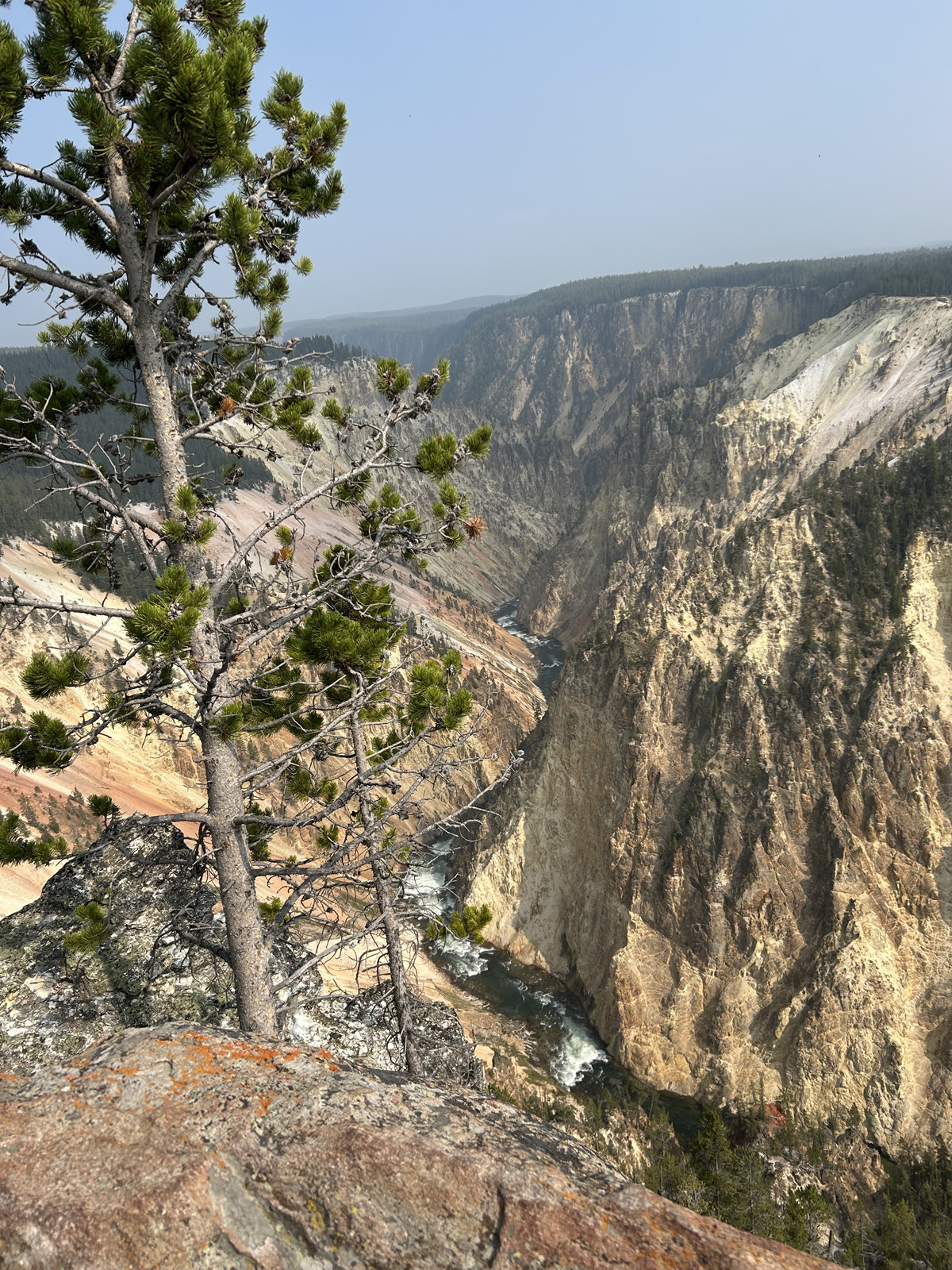
The ride to Canyon Campground was pleasant. The road is forested on both sides and has a shoulder. We detoured onto Virginia Cascade Road, a one-way road that parallels the main road. This route takes you along the Gibbon River and a small cascade (waterfall). Julie and I arrived at Canyon with plenty of time to hike along the Grand Canyon of the Yellowstone, perhaps the most beautiful feature of Yellowstone NP. Canyon has a small village that includes a grocery store, restaurants, gift shops, a post office, and a visitor center. Showers and a laundromat are also available.
We shared the hiker/biker site with five other cyclists, including a couple from Switzerland who were 3.5 years into their planned five-year global journey. I have rarely camped with more than two other cyclists in Yellowstone during my stays in the park. I happened to have a fistful of shower passes (a longer story), so I treated the group to showers.
Julie and I were traveling the “Grand Loop” of Yellowstone: Madison, Canyon, Grant Village, and back to Madison. Two of the cyclists at Canyon were from Billings, Montana. They were riding the upper loop of Yellowstone, which includes Mammoth, Tower Fall, and Canyon Campgrounds. Mammoth is the headquarters of Yellowstone and features several geological attractions, as well as a perennial herd of elk that reside near the campground. Once, at Mammoth Campground, an elk parked itself in front of my bear box shortly after I had emptied it of my food. I have had elk wander into campgrounds where I was staying on three or four occasions, including this trip.
The morning we left Canyon was again cold, but our new Swiss friends were in shorts. Julie and I bundled up for the 37-mile ride to Grant Village. The ride to Fishing Bridge does not have a shoulder, and the road is in disrepair in places. We started early and had little traffic as we rode along the Yellowstone River. At Fishing Bridge, a shoulder appears for the final 21 miles of the ride. We also rode through light rain for about an hour on this stretch to Grant Village.
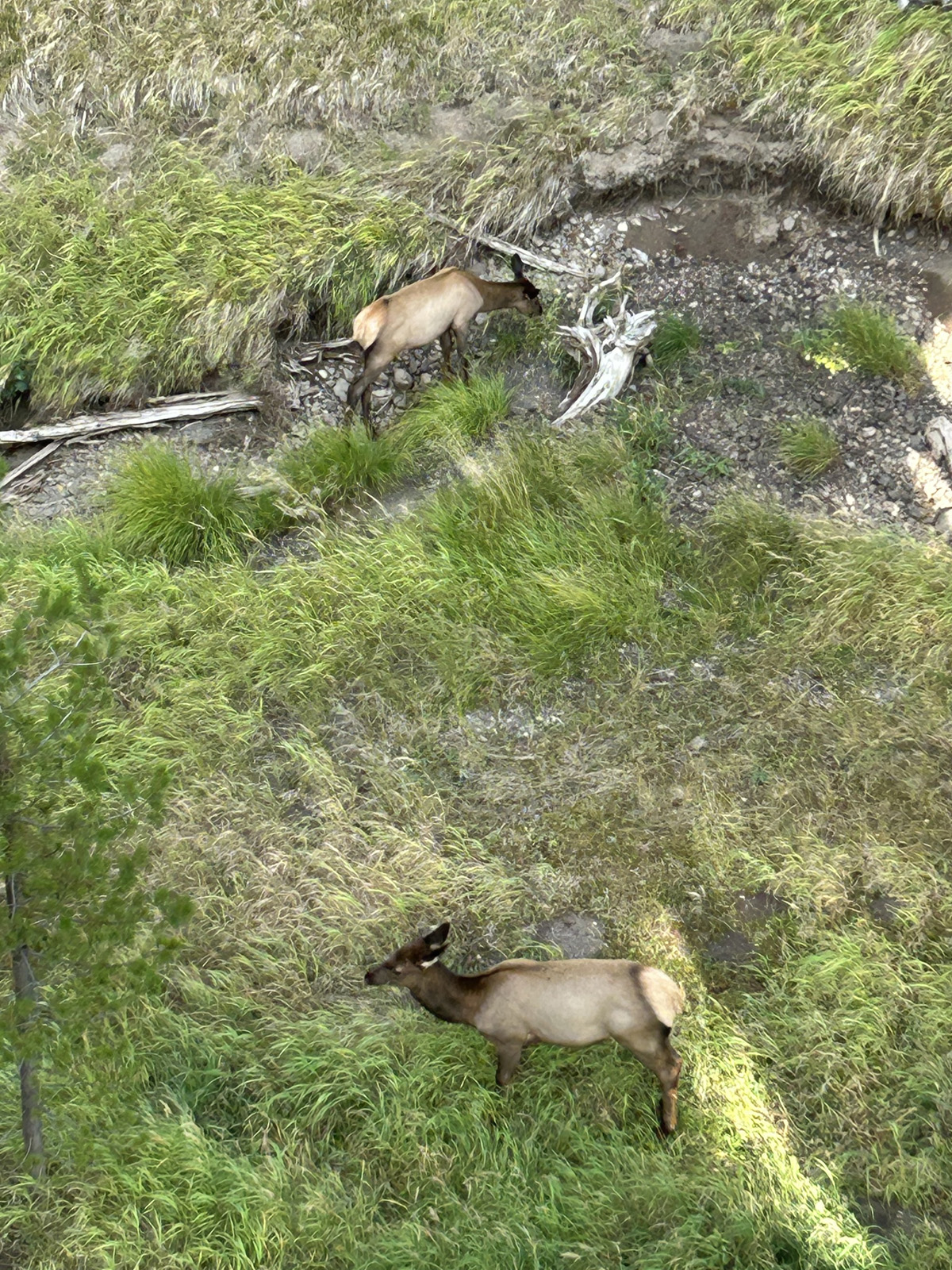
Grant Village is a small village, so we were able to acquire food to cook for dinner. From Fishing Bridge to a couple of miles before Grant, we rode along Yellowstone Lake. While setting up our tent, an elk walked along the boundary of the campground. Julie and I also saw several elk from a bridge over a ravine while walking to the grocery store.
We left Grant Village on day four of our trip, a morning that was warmer than the previous ones. Despite the cold mornings, we were able to ride later in the day in shorts and a thin long-sleeve top. By afternoon, we were in short sleeves. Madison Campground was 40 miles away, and we had three climbs, two of which crossed the Continental Divide above 8,300 feet and nearly to 8,400 feet.
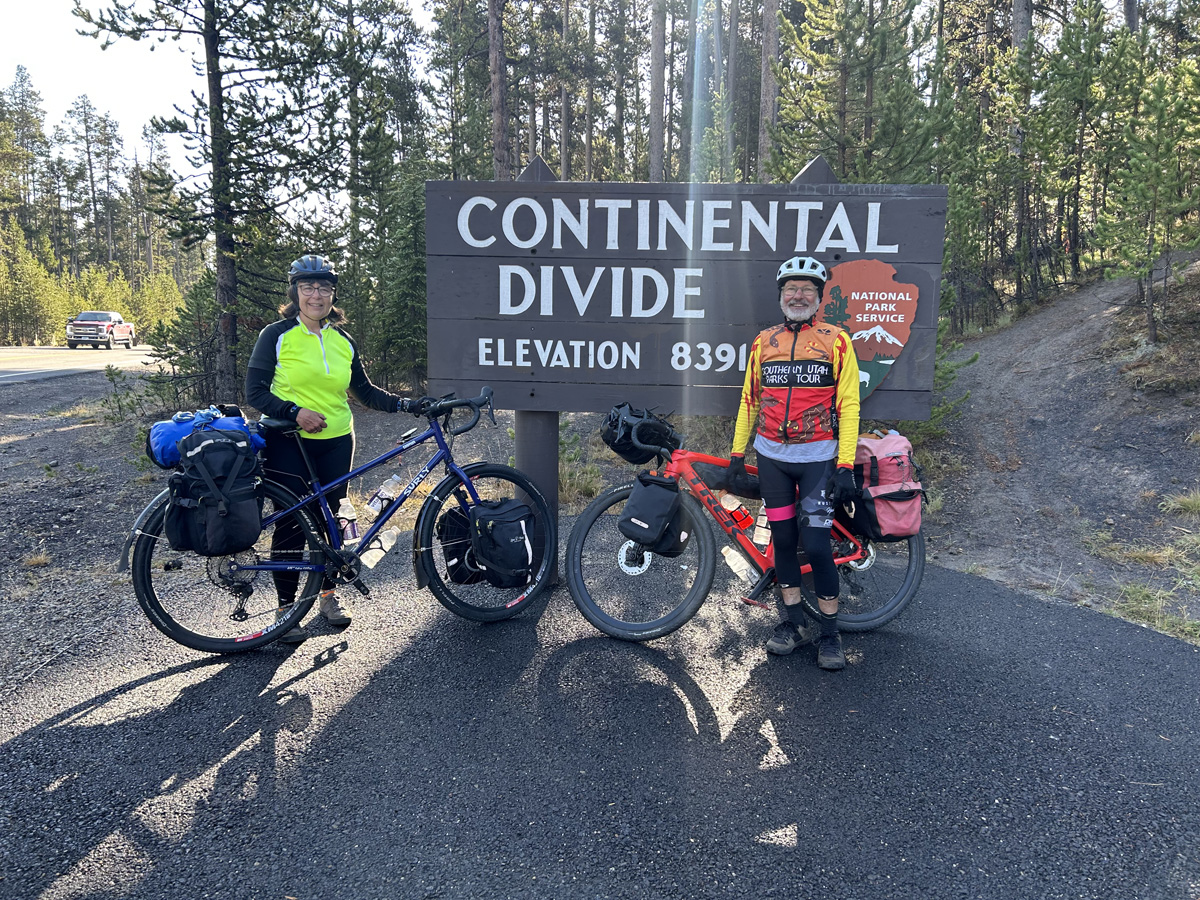
We began climbing about two miles out of camp as we headed to Old Faithful for lunch, to pick up dinner supplies, and, of course, to watch Old Faithful erupt. There is a good shoulder on the road from Grant Village except for about a quarter mile before and after Old Faithful. From Old Faithful to Madison Campground, traffic increased significantly. Despite “no parking” signs, we were forced onto the road numerous times. Julie and I tried to take bike paths to get off the road, but the first was inexplicably closed and the second was closed due to a “carcass on the trail.” In both cases, we had to backtrack a couple of miles. This section can be busy starting in late morning due to the Lower, Midway, and Upper Geyser Basins, including the Grand Prismatic Spring at Midway.
On our return to Madison, the same person checked us in at the hiker/biker site as on our first night. He is officially a resident of South Dakota, as the state allows people who live and travel in an RV to claim residency. He remembered Julie and me, so check-in was quick. We knew our neighbors from Millcreek had arrived at Madison Campground in their trailer, so we had dinner with them and played cribbage afterward. It was a nice evening. The next morning, day five, we rode the final 15 miles back to our car.
Nuts and Bolts:
Entrance fees: The entrance fee to Yellowstone by bicycle is $20, or free with a senior or annual pass (check current pricing; disabilities are free). Passes are good for seven days. If you are riding with a group, be aware that entrance station employees may not always know the regulations. For example, my senior pass allows the holder and three others to enter. I have had no issues getting Julie in on my pass, but she now has her own lifetime senior pass ($80). On one occasion, however, I brought a friend, and the attendant initially assumed he needed to pay until I clarified the rule. There is also a “car rule”: a $35 vehicle fee covers up to four occupants. In theory, a group of four cyclists should pay $35 under this rule—but good luck explaining that.
Traveling by bike in Yellowstone: Riding in Yellowstone presents unique challenges, but I consider it safe with appropriate precautions, as in any city. Speed limits range from 25 mph in tourist areas to 45 mph elsewhere, and rangers enforce them. Wildlife—especially bison—poses the greatest risk. Plan how you will handle encounters, as traffic can become erratic with sudden stops. On one occasion, I rode down the center line between stopped cars to avoid bison on both sides. Often, I ask a driver to use their car as a shield. Once, before the park officially opened, my family and I climbed onto a boulder while a herd of bison walked down the road.
Some cyclists worry about being hit by RV mirrors. That may have been true in 1975, but I no longer consider it a major concern. At one point, Adventure Cycling Association even rerouted the TransAmerica route to avoid Yellowstone, sending riders south on Route 20 and over Teton Pass to Jackson. That route includes high-speed traffic, though it now has shoulders along much of its length.
You can extend the route Julie and I rode by including the upper loop of Yellowstone. Be aware that the road from Norris to Mammoth lacks a shoulder. You can also extend south into Grand Teton National Park, where hiker/biker sites are available at Colter Bay and Jenny Lake. The road from Grant Village to the south entrance of Yellowstone also lacks a shoulder, but traffic is lighter early in the morning. Beyond the entrance, the road includes shoulders and eventually a bike path in Grand Teton NP.
Leave early from camp, stay aware of your surroundings, anticipate sudden movements from cars, and enjoy the ride.
Food and lodging: You do not need to carry large amounts of food unless you have specific dietary needs. Larger campgrounds and tourist areas—such as Canyon, Grant Village, and Old Faithful—offer food. Grocery options are limited, and restaurants are priced accordingly.
Bike shops: Bike shops are available in Jackson, Wyoming, as well as Freeheel and Wheel in West Yellowstone.
Lou Melini is a lifelong bicycle commuter, tourer, and the former Commuter Column editor for Cycling West.
(Visited 14 times, 14 visits today)