
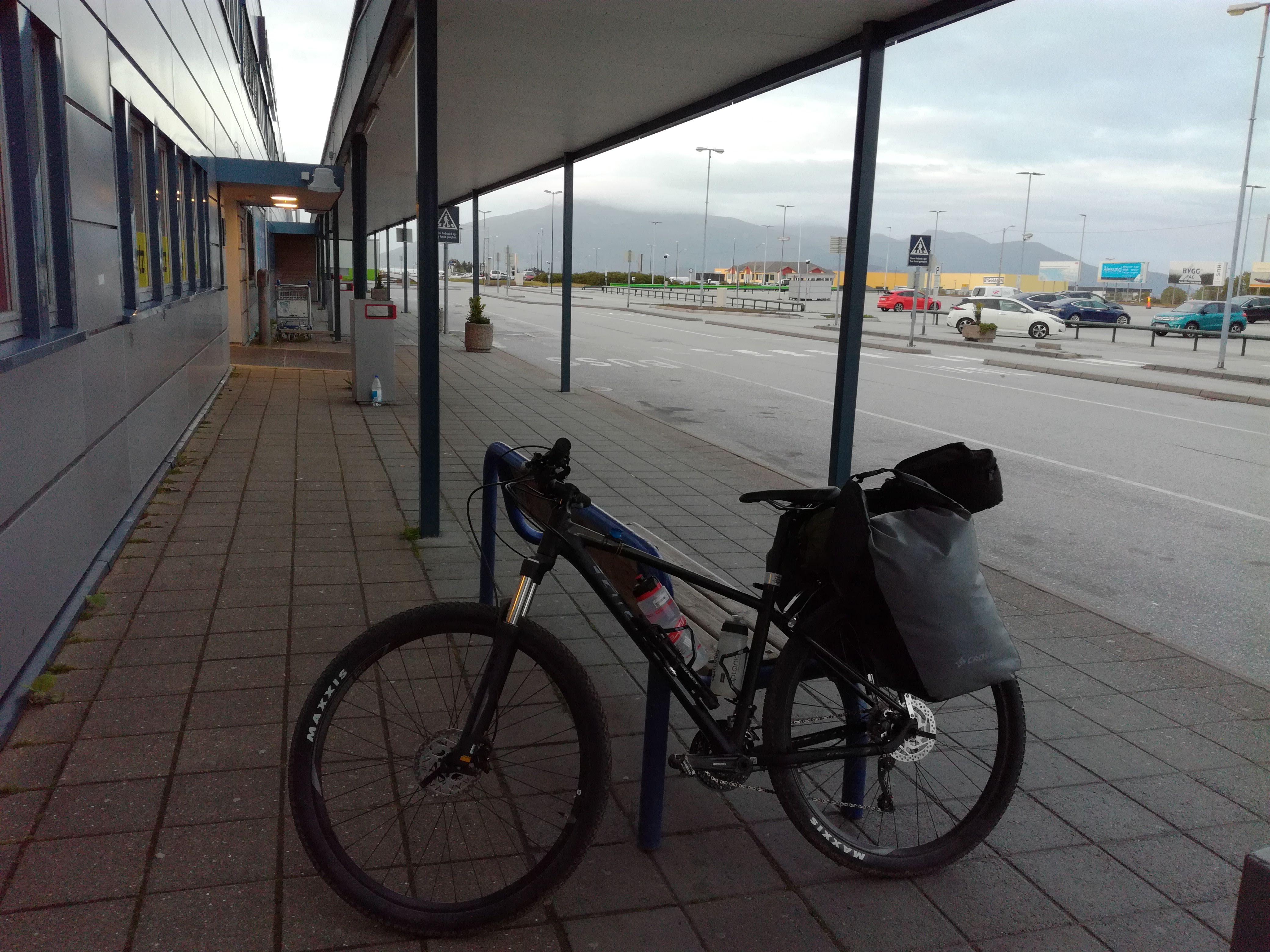
When I started dreaming of travelling by bike back in 2018, one of the big questions that stressed me was: how do I get my bicycle on a plane? I knew I wanted to start my big adventure in Switzerland, but how the hell would I get there with my bike?
Flying with your bike for the first time can be quite intimidating and overwhelming. How do I pack it? How to make sure my bike doesn’t get damaged? Where do I find a bike box for the return flight? How do I get to the airport with my packed bike?
To help you plan your first bikepacking adventure that involves flying, I’ll share my experiences and some tips and tricks to make the packing easier and ensure that your bike arrives safe and sound at the destination airport.
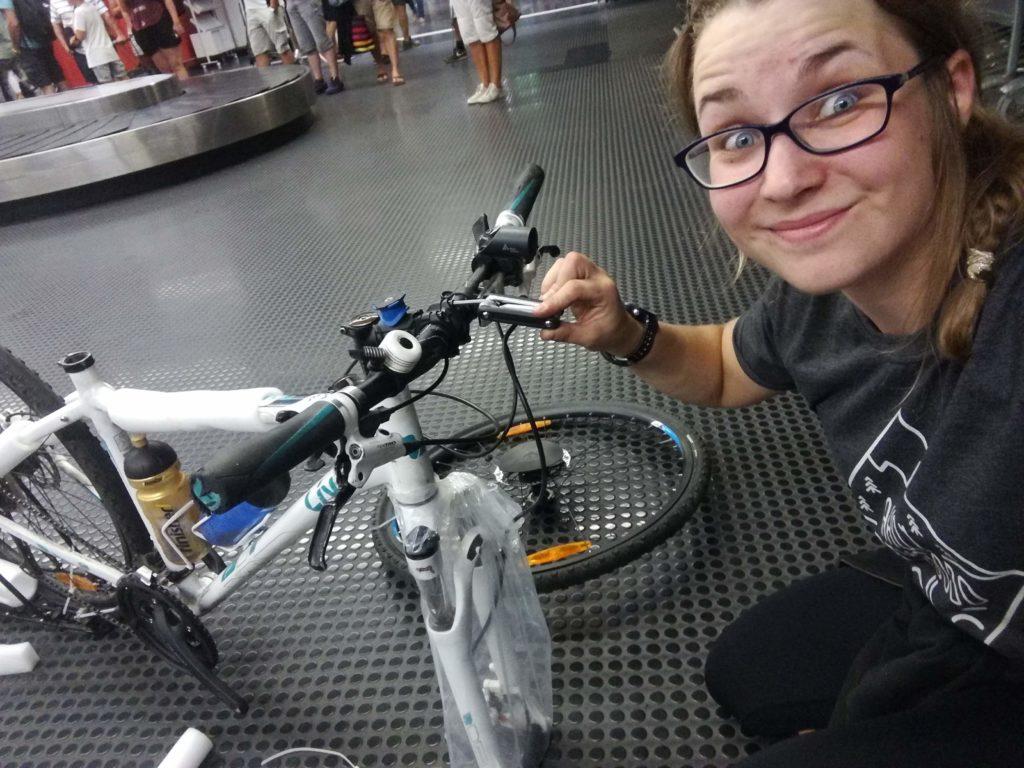
Before booking, check the airline’s policy for flying with a bike.
Flying with your bike can be confusing because every airline has its own policy regarding sports equipment. Different weight limits, different dimensions allowed, different requirements for how to report that you’ll be travelling with a bike.
Before buying any plane tickets for your bike trip, study the airline’s bike policy carefully to avoid potential issues when checking in at the airport.
Here is a brief overview of the bike policy of some of the most popular airlines, including my experience if I have flown with them. Use it only as a reference point and double-check it on the airline’s official website before booking your flight.
| Airline | Bicycle fee | Maximal dimensions | Weight limit | Reservation necessary? | Notes | Packaging |
|---|---|---|---|---|---|---|
| Turkish Airlines | Depending on the route, from 70 to 220 EUR | Not specified but they recommend contacting the staff to consult acceptable dimensions | 23 kg | Yes, can be done during the booking on the website | Flew with them in 2019, no issues with extra stuff in the box or anything else | sturdy paperboard/cardboard boxes or special bags |
| WizzAir | 63,25 EUR | 149x119x171 cm | 32 kg | Yes, can be done during the booking on the website | I flew with them many times, never had a problem with extra gear packed in the box or anything else | Travel case or cardboard |
| RyanAir | 60 EUR | Not specified | 30 kg | Yes, can be done during the booking on the website | I flew with them many times, never had any problem with my bike and gear packed in a cardboard box | Protective case or bag |
| Delta Airlines | Standard checked baggage fee for bikes under 50 ibs (22,6 kg) | < 292 cm total | 45 kg (for additional fee) | Yes, you need to mark your baggage as the sports equipment during the booking on the website | Soft travel bag will not be accepted. You might have to sign a limited liability release form if you don’t have a bike case | Durable protective container designed specifically for bicycles |
| Air France | Depending on the zone, from 40 to 125 EUR | < 300 cm total | 23 kg or 32 kg in Business or La Premiere cabins | Yes. You need to make a reservation after you book your ticket. Contact customer service at least 48 hours before the departure | Bike boxes (175 x 21.5 x 86 cm / 68 x 8 x 33 in) are available for purchase at most Air France airport check-in counters. | Protective container (cardboard, hard plastic, etc.) |
| Lufthansa | Depending on the route and size/weight | <280 cm total | 32 kg | Yes, you need to add the bicycleafter buying the tickets, at least 72 hours before the flight. Payment at the airport. | robust protective cover or appropriate bag (e.g. cardboard box, hard plastic) | |
| LOT | Free if it’s within the luggage limit on your ticket. Otherwise: 90 EUR |
For free: 130x30x70 cm. For extra fee: up to 200 cm the longest side |
For free: 23 kg For additional fee: 32 kg |
Yes, you can add sports luggage during your reservation online. | I flew with LOT in 2024, everything went smooth and with no issues. | Cardboard, bike case or wrapped in a stretch foil |
| KLM | Depends on the route | <300 cm total | 32 kg | Yes, you need to reserve space for your bicycle after you booked your tickets, here. | Bike box or other | |
| Qatar Airways | Free if it meets the standard baggage requirements (depending on the route). Otherwise, from 150 to 250 USD. |
<158 cm total for flights to/from Africa and the Americas. <300 cm total for other routes. |
32 kg | No, if it fits within the standard luggage allowance. Otherwise, yes, you can add it to your reservation later. | ||
| British Airways | Free within your checked baggage allowance. | 190x95x65 cm | 23 kg or 32 kg (depending on the ticket type. | Yes, you have to inform the airlineafter you’ve booked your flight, as soon as possible. | Don’t accept clothes and other items packed together with the bike | hard-shell box or padded bike bag |
| Air Baltic | 45 EUR | Not specified | 25 kg (or 32 kg for additional 60 EUR) |
Yes, you can add the bike during your online reservation (the airline will have to confirm if there’s space) | hard protective case or box | |
| Edelweiss Air | Free | <275 cm total | 23 kg | No, the sport baggage will automatically be added to your booking | hard-shell container or cardboard box (available for CHF 25 at Check-in in Switzerland) | |
| Eurowings | From 50 EUR | Not specified | 32 kg | Yes, you can add it during your online booking. | Hard bike case or a cardboard box if insulated with enough padding inside | |
| EasyJet | 55,00 £ | Not specified | 32 kg | Yes, you can add it during your online booking. | No other items can be packed in the bicycle box | bicycle box or bicycle bag |
| United | Included in your checked bag allowance | Not specified | 23 kg | Yes, you need to confirm with the airline if there is space for your bicycle. | case designed to transport bikes or a sealed box with plastic foam or other protective material inside |
A bike box or a bike case? (Or maybe a soft bike bag)
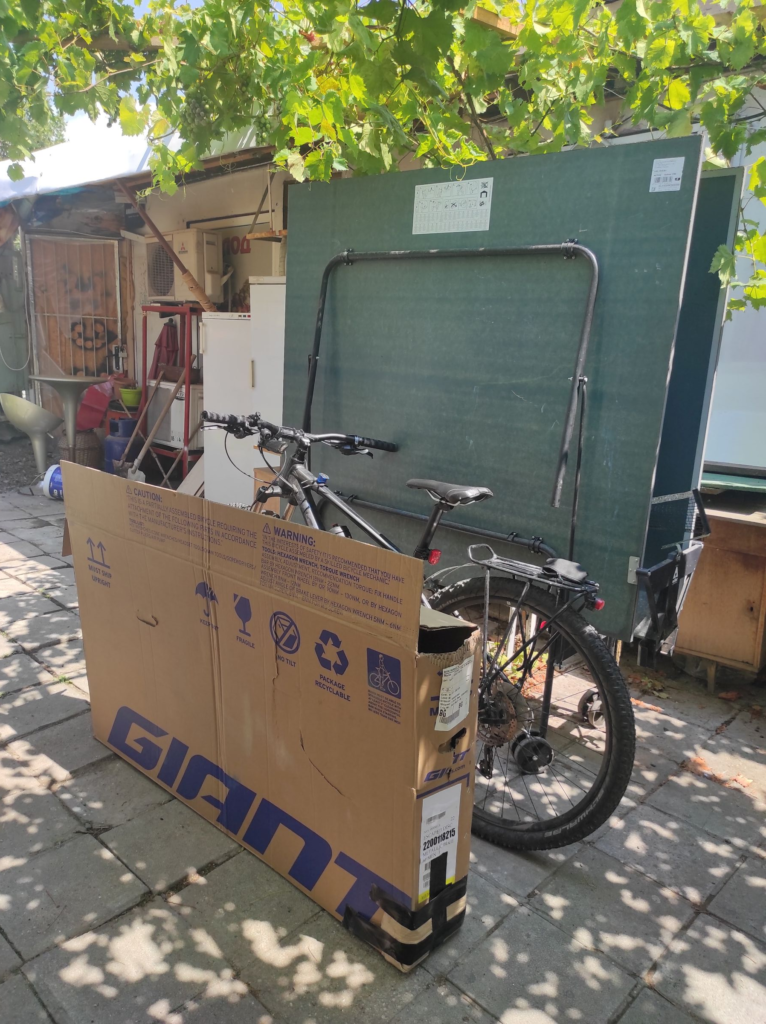
Cardboard box
Pros
- It’s cheap. Most of the time, a local bike shop is going to give you a cardboard box for free. They usually would throw them away after they unpacked the bikes delivered from the producers, so they’ll likely be happy that you can take one off their hands. You can also buy them at some airports (for example, the Amsterdam Schiphol Airport sells them for 30 EUR).
- Usually, there is extra space in the box for your camping gear or clothes. I use the sleeping bag, tent, clothes, and other stuff as extra padding, which helps keep my bike safe and sometimes allows me to reduce the costs of extra luggage. Not all airlines allow it, though.
- It’s the most convenient method if you’re travelling with your bike from point A to B, so it’s most often used by people doing bikepacking or bike touring. You don’t need to find a place to store your bike case for the duration of your trip. You simply discard the cardboard box at the airport after arrival and get a new one before flying back home.
Cons
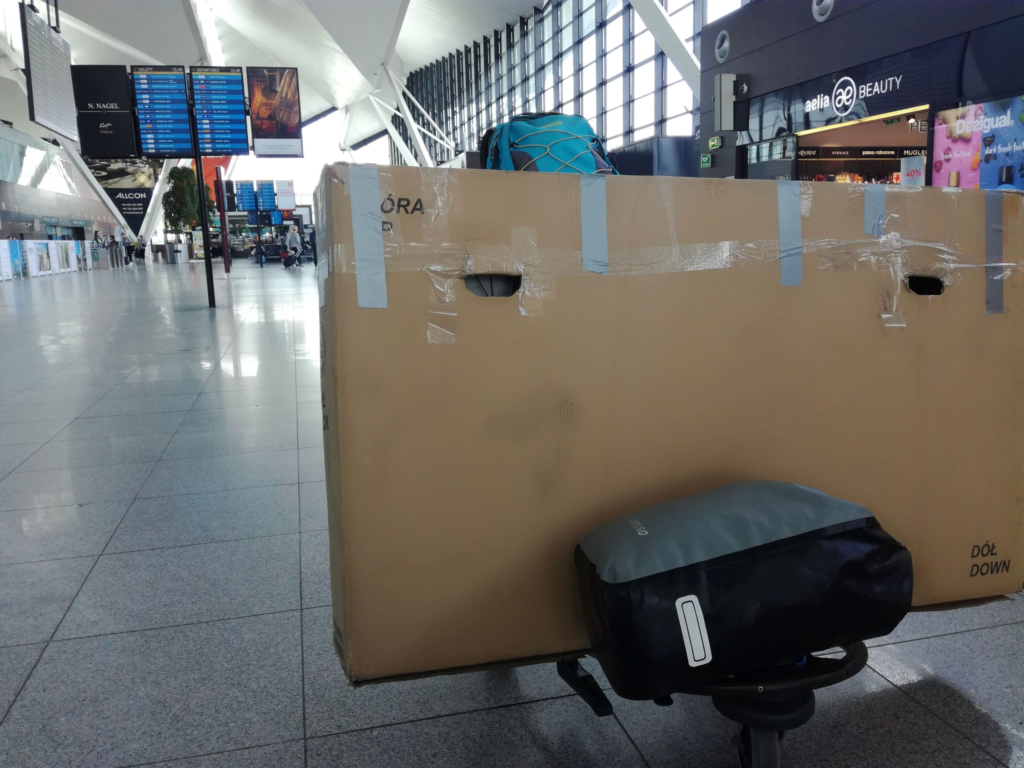
- Getting to the airport with the bike packed in a cardboard box is a real pain. It’s inconvenient to carry, bulky, and annoying.
- Before flying back home, you need to spend time looking for a new cardboard box. I’ve never had a bigger issue with that, but sometimes it’s better to contact a bike shop beforehand to make sure they’ll keep a box for you.
- A cardboard box is not very durable and can be torn or punctured if mishandled by the airport staff. That makes your bike more vulnerable to damage. Always use plenty of tape to strengthen the weak spots of the box and make sure no small items are loose (otherwise, they’ll fall out if there’s a hole).
Best for:
- Bike touring and bikepacking from point A to B, or when your trip doesn’t start and end at the same point
- Budget travels
Bike case
Pros
- Hard bike cases give your bike good protection. The airport staff also tends to handle them with more care.
- Usually, they have some compartments or systems to make packing easier.
- They are more compact and easier to carry around, especially if they have wheels. Getting to an airport is much easier than with a cardboard box – the bike case fits in a taxi or public transport.
Cons
- They are expensive. It’s hard to find a quality bike case for under 400-500 euros.
- They are heavy.
- It’s practically impossible to bring them along when you’re travelling from point A to B (unless you take a soft bike bag, but they aren’t the safest choice for plane journeys). If you cycle a loop, you need to find a place to store them (and they aren’t the smallest, so it might be a challenge).
Best for:
- Cycling vacations, when you stay in a hotel and only do day rides.
- Cycle tours that start and end at the same place, but only if it’s easy to find storage.
How to pack a bicycle for a flight (in a cardboard box)
Before my first big trip, packing my bike for the plane kept me up at night. What if my bike arrives damaged? Or if I forget to part some parts? What if I mess something up?
To help me figure things out, I asked my bike mechanic to show me how to disassemble the bike and how to put it back together. If you’re unsure about anything, I highly recommend doing it too – it gives you much more confidence if you can do a trial packing with someone who knows what they’re doing and can show you the tricks. There are also some YouTube tutorials that can be helpful.
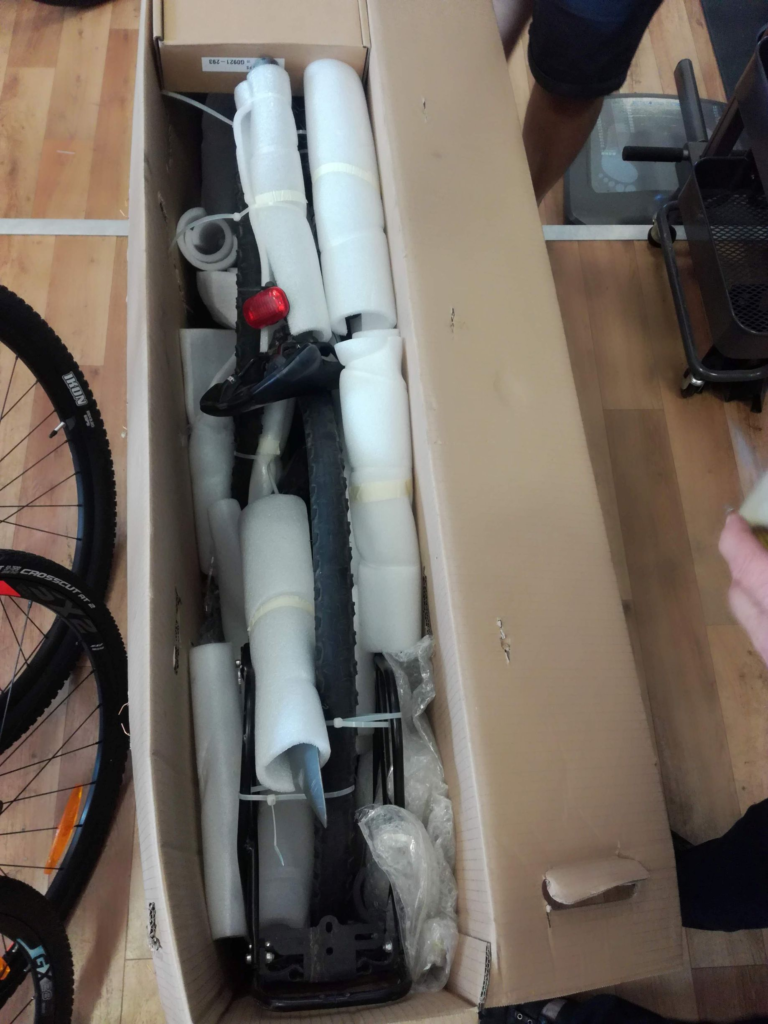
The process is quite simple.
- Before you start packing, take a few photos of your bike. This will help you if your bike gets damaged during the flight and you have to claim it to the airline. Having photos of your bike before the trip will help you prove that the damage occurred during the trip.
- If you don’t have a bike stand at home (and you certainly won’t have one on your trip, when you’ll be packing your bike for the trip back home), put some old blankets or a cloth on the floor to prevent scratches and flip the bike upside-down.
- Remove the pedals (for some pedals, you need an Allen key, for others a 15 mm wrench). To remove the left pedal, turn the wrench clockwise. For the right pedal, turn it anti-clockwise.
- Take the wheels off (if you don’t have quick-release skewers, you’ll need an Allen key). If the bike box is big enough, you might be able to leave the back wheel on. Pack the skewers in a small bag. If you have disc brakes, use disc brake spacers or bubble wrap, foam, or other padding to secure the discs. Deflate the tires. You can also use a fork mount to protect the dropouts.
- Turn the handlebars. You need to unscrew the screws on the stem. Then, turn the handlebars parallel to the frame. I usually add some padding between them and around, and tape them both together.
- Secure the derailleur with a lot of padding. Some people recommend removing it and attaching it to the frame with zip-ties.
- If necessary, remove the saddle and the luggage rack.
- Use foam, bubble wrap, or cardboard to secure all other sensitive parts of the bike.
- Pack all the smaller parts in a separate bag or a box.
- Put everything in the box, and fill the gaps with your gear, bags, etc., for extra padding.
- Double-check if everything you need is in the box. Generously tape the box to close all the openings. You can use duct tape to strengthen any potentially sensitive spots.
Flying with the bicycle – at the airport
When flying with my bike, I always give myself extra time in case something goes wrong. Arrive at the airport earlier than usual (even 3 hours before your flight). Especially if your bike is travelling in a cardboard box, you’ll most likely be slower.
The first thing I do is grab a trolley and put my box on it. Sometimes, when the box is extra long, going through some doors and maneuvering among them can be quite tricky.
Depending on the airport, most likely you’ll be sent to drop off your bike with bulky luggage. If something gets flagged during the security screening, you might have to open the box. For that reason, I always carry with me some extra tape in my carry-on bag.
Flying with the bicycle – what happens after landing?
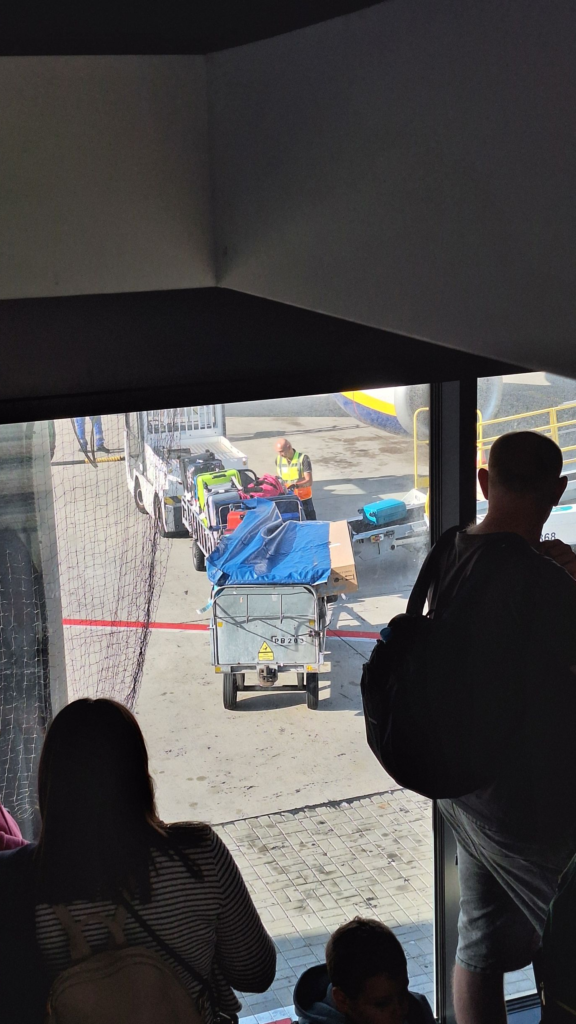
At your destination, you’ll likely have to pick up your bike at the oversized luggage point. Once it arrives, inspect the bike to check if there’s any damage. Most airlines don’t accept liability claims after you’ve left the baggage claim area. If your bike suffered during the flight, report this to the airline immediately.
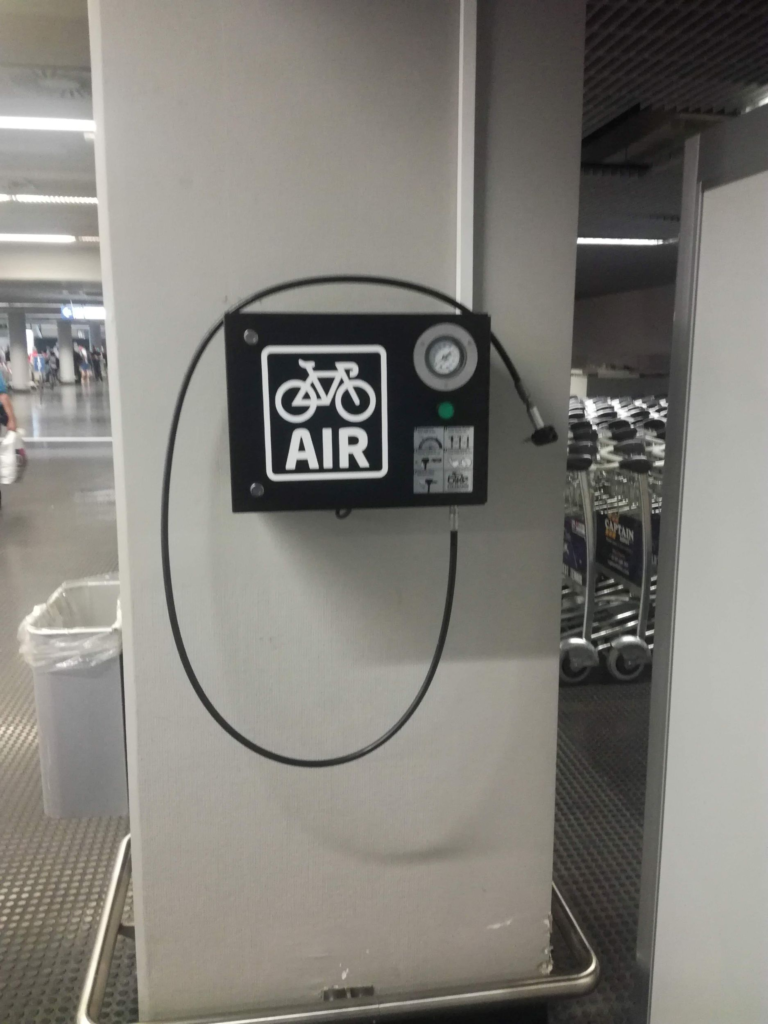
Put your bike box on a trolley and find a quiet spot to reassemble your bike. At some airports, there are even designated places for that, where you’ll even find a compressor to inflate your tires.
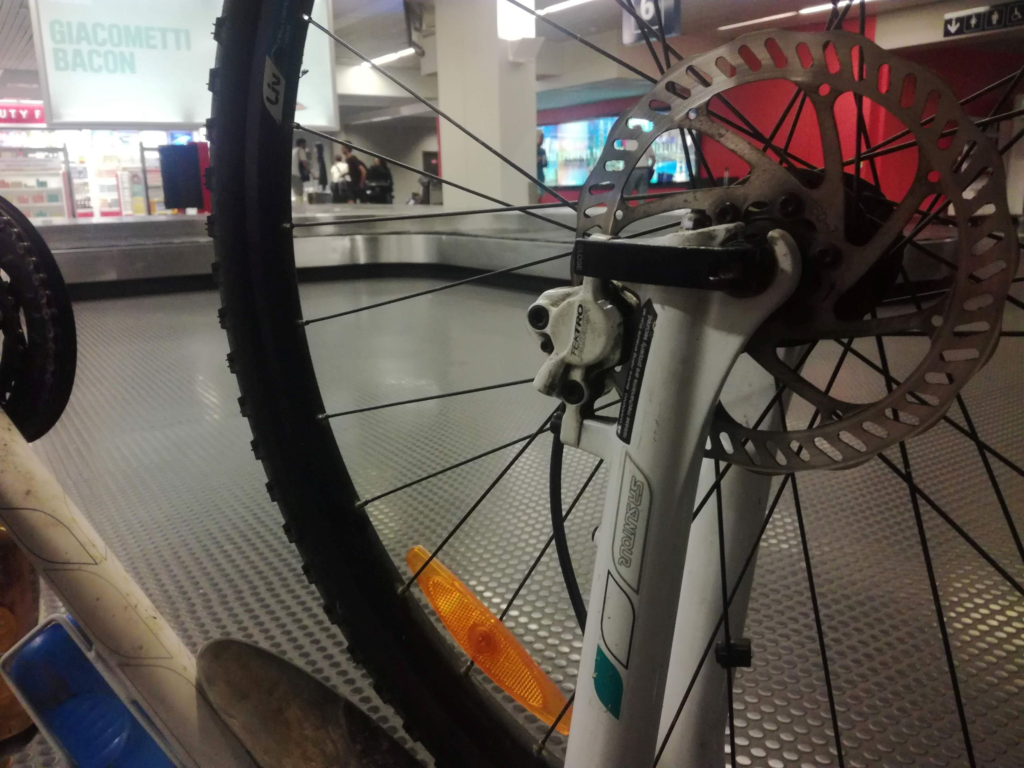
Do a quick safety check: Do the brakes work? Are the pedals attached properly? Are the skewers properly secured? Are all the bolts and screws tightened properly? Is the handlebar straight? Check if nothing is wobbly, makes a suspicious noise, or feels off.
What to do with a bicycle box after arriving at the airport?
Don’t just drop your cardboard box next to the trash cans at the airport. It might alert the security and cause unnecessary trouble for the whole airport (that you might be held liable for!).
Instead, ask someone from the airport security or cleaning staff what you should do with the box.
Flying with your bicycle after a trip – planning ahead
The trickiest part of most of my bike journeys that involve flying is to plan the trip back home. I usually plan one or two extra days at the final destination (which I use to explore the city and enjoy the place beyond cycling), to have enough buffer to find a bike box and pack the bike.
Before your trip, make a list of bike shops in the city you’ll be travelling back from. Contact them a few days before arriving there to ask if they could keep a bike box for you. Sometimes, they’ll even offer to pack the bike for you.
What to do if I cannot find a bike box?
Sometimes finding a bike box is not easy. What to do if there’s no bike shop in the area or if all of them are out of the boxes? You can collect multiple smaller boxes (for example, from a hardware store) and use wrapping foil and tape to put it all together.
Or use the “big plastic bag” method, as described by Tom on his blog.
Getting to the airport with your bike
You also need to plan how to get your packed bike to the airport. Some people fold the box and bike with it to the airport, and pack the bicycle there.
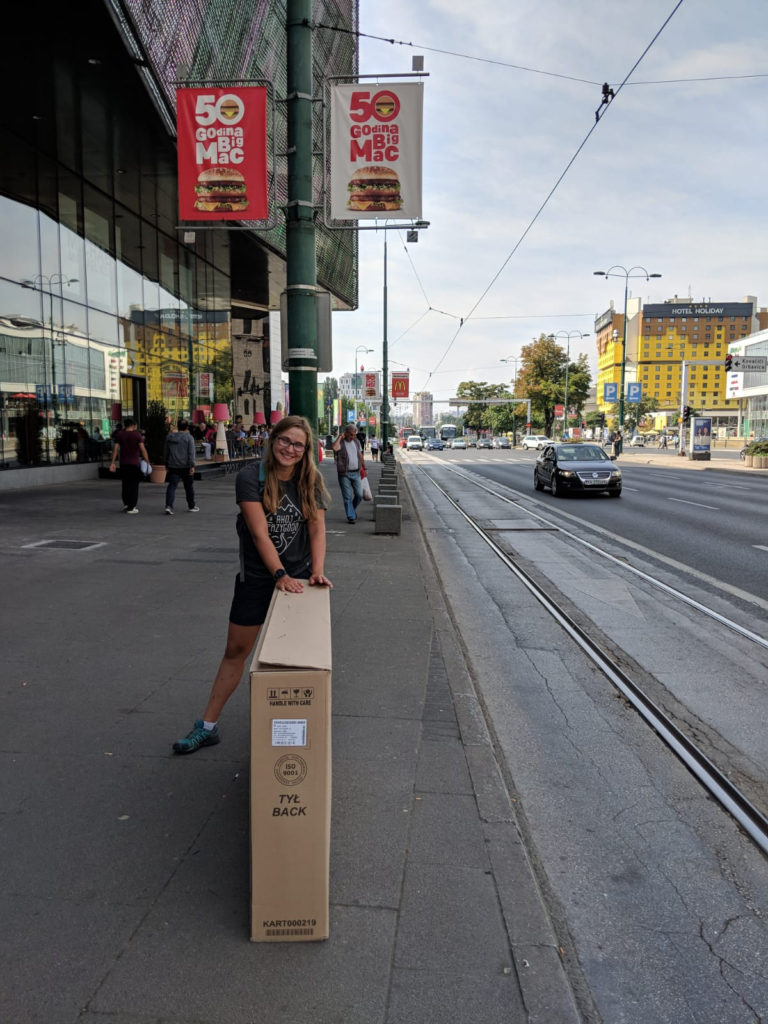
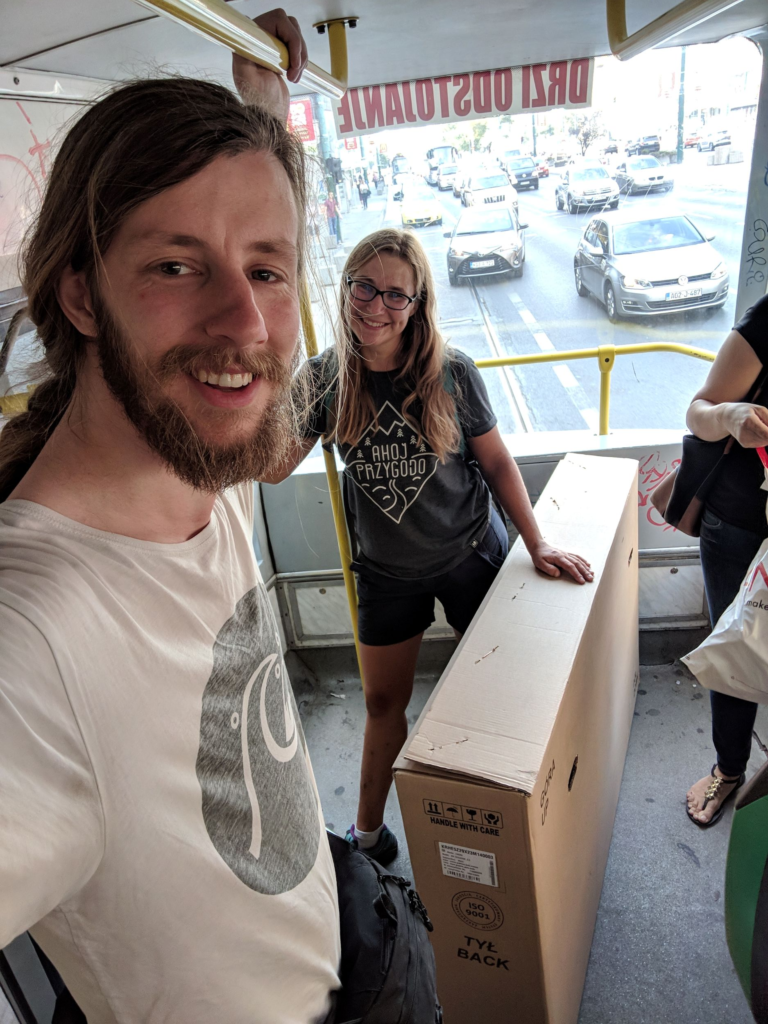
Another option is taking public transit. With a heavy and bulky bike box, it’s not the most enjoyable process, but it definitely allows you to save some money.
Taking a taxi is definitely the most comfortable and convenient option. It can be tricky to find a big enough car, though, especially when travelling as a group. Research the options beforehand and make sure that the cab company is aware of the dimensions of the box.
Flying with your bike – FAQ
Can I fly with a bike without a bike bag?
Yes! You don’t need a hard bike case or a bike bag to fly with your bike. All you need is a cardboard box from your bike shop. It’s less handy than a bike case with wheels, but it’s way cheaper.
Should I remove air from my tires before the flight?
Yes, most airlines request that you deflate the tires before the flight, to prevent them from exploding when the air pressure suddenly changes in the compartment.
How much does it cost to fly with a bike?
It depends on the airline. Some include sports luggage in their standard luggage allowance, while others charge an additional fee. It ranges from 40 to 250 euros.
Can I pack my panniers, camping gear, and clothes in the bike bag?
It depends on the airline. Some airlines, like British Airways, specifically forbid adding any other gear or clothes to your bike bag or box. Others don’t mind. Always check the rules for bicycle transport on the airline’s website.
Is a hard bike case worth it?
It depends. If you’re a passionate cyclist with a bike worth over 10K, who flies for cycling holidays or training camps multiple times a year, a hard case is definitely worth the money: it makes travelling with your bike safer, easier, and less stressful.
If you’re more of a bike traveller who doesn’t want to worry about finding a place to store your bike case, you’ll be way better off simply using a cardboard box.