
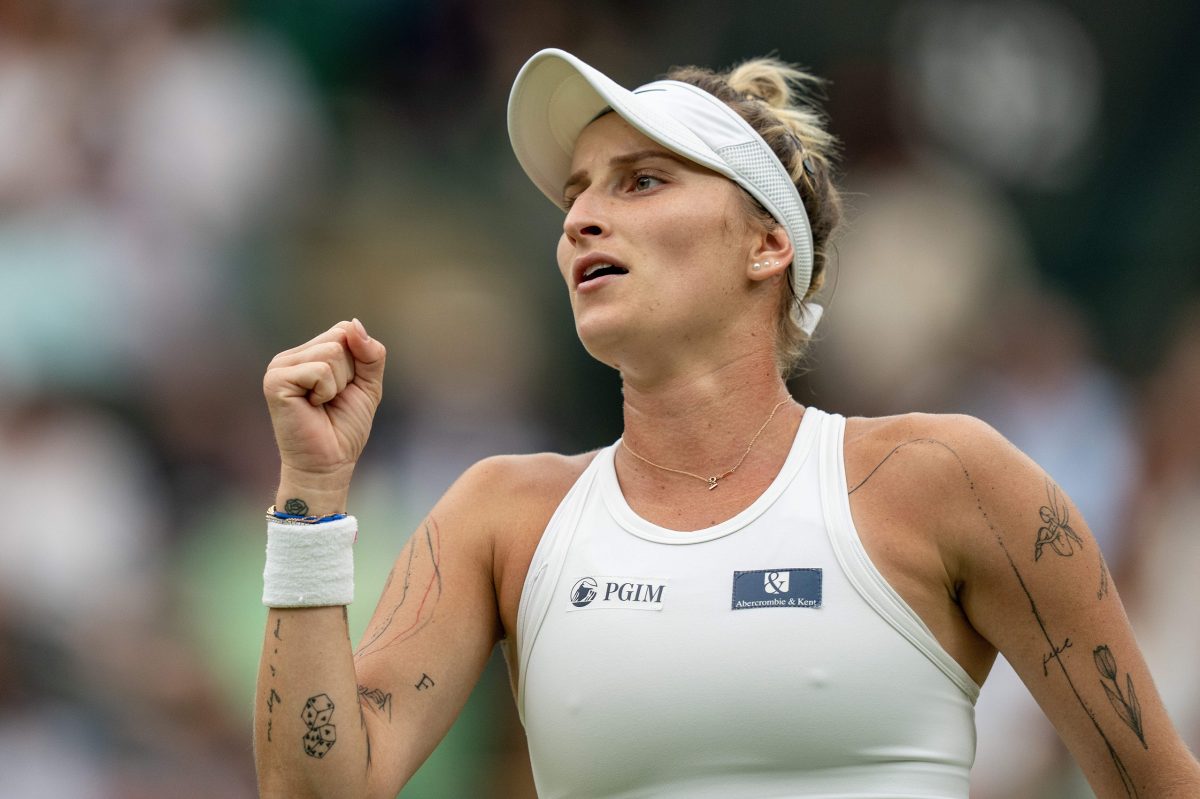
On a December evening in 2025, someone rang the doorbell at Marketa Vondrousova’s apartment in Prague. It was after 8 PM. The person on the other side of the door said they were a doping control officer and demanded an immediate urine sample. Vondrousova did not open the door. That decision, made in a matter of seconds by a frightened woman alone in her home, has now set in motion a case that could end the career of a former Wimbledon champion.
The facts are not in serious dispute. The International Tennis Integrity Agency has charged Vondrousova with refusing or failing to submit to sample collection without compelling justification after notification by a duly authorized person. Under the Tennis Anti-Doping Programme, refusing or evading sample collection can bring a ban of up to four years if the charge is upheld. Unlike some anti-doping matters, the allegation does not automatically trigger a provisional suspension, leaving Vondrousova free to compete while the process continues. A hearing is expected by the summer.
What Vondrousova Says Happened
On April 17, 2026, Vondrousova went public with her account. According to Vondrousova, the officer rang her doorbell after 8 PM, refused to identify himself, and demanded an immediate urine test. In an Instagram Story at the time, a shaken Vondrousova said she refused to let him in and called it a “serious intrusion of my privacy.”
Her lawyer, Jan Exner, added a layer to the procedural complaint. He called out the official’s behavior as “inappropriate” and stated that the officer, after repeated requests by the player, did not authenticate their identity. Vondrousova herself told the Czech sport daily Sport that it was “stressful to see someone I didn’t know asking to enter my living room without showing authorization.” Notably, she also said the check was not standard as the officer was from a German agency.
Her defense goes beyond procedure, however. In her Instagram statement, Vondrousova invoked the shadow of one of Czech tennis’s most disturbing recent memories. She said the unexpected late-night visitor triggered memories of her countrywoman Petra Kvitova’s 2016 stabbing, when a man posing as an electrician gained access to the two-time Wimbledon winner’s apartment and attacked her with a knife, severely injuring her playing hand. In Vondrousova’s own words: “After what happened to Petra, we don’t take strangers at our door lightly.”
The Kvitova incident is not a vague reference. Kvitova suffered lacerations to four fingers and had a knife held to her throat after she allowed the intruder access. She underwent surgery to help repair the ligaments and tendons in her left hand. That event, nearly a decade ago, left a mark on Czech tennis culture that has never fully faded, and Vondrousova’s lawyers argue it forms part of the legitimate psychological context for her reaction.
A Player Already on the Edge
The incident did not occur in a vacuum. By December 2025, Vondrousova was already a player carrying considerable physical and mental weight. She revealed that medical professionals had confirmed she was suffering from an acute stress reaction as well as generalized anxiety disorder, conditions she said had gradually intensified over time, affecting her ability to cope with stressful situations.
She also revealed that she has been affected by negative experiences off the court, including receiving hateful messages and threats over the years, which have contributed to a heightened sense of vulnerability, making her more cautious and protective of her personal space.
Her competitive record in the period surrounding the incident tells its own story. Her last full competitive stretch came at the 2025 US Open, where she reached the quarterfinals, including victories over Top 10 players Elena Rybakina and Jasmine Paolini, before withdrawing ahead of a match against World #1 Aryna Sabalenka. Since then, a shoulder injury forced her to miss the Australian Open, and she has not played a WTA Tour singles match since January 2026.
The Charge Itself and Its Uncomfortable Comparisons
The charge Vondrousova faces is Article 2.3 of the anti-doping code. It is one of the most serious categories in the rulebook precisely because the entire anti-doping system depends on athletes being accessible and compliant when testing officials arrive. The logic is clean: if a refusal could be excused on the basis of fear or inconvenience, the system would collapse. Authorities therefore treat refusal almost as seriously as a positive test, regardless of the athlete’s stated reason.
What makes the case feel particularly uncomfortable is the comparison it invites with other recent anti-doping outcomes. Jannik Sinner tested positive not once but twice for clostebol, an illegal substance, and was banned for less than three months, not missing a single Grand Slam during his suspension. Vondrousova, who has not tested positive for anything, faces a potential ban of four years for not opening her front door.
Her legal team appears confident. They stated: “We are certain that once the full context is understood, her name will be cleared.” Exner said proceedings are underway and there will either be a formal hearing or an attempt to reach agreement with international bodies, with more clarity expected by the summer.
Where Things Stand
Vondrousova has indicated that her immediate priority is stabilization rather than a rapid return to competition, acknowledging the need to address both her disciplinary case and her physical recovery in parallel. She recently appeared in doubles during a Billie Jean King Cup tie, her first competitive action in months.
The central question the tribunal will have to answer is whether what happened on a December evening in Prague constitutes a genuine and compelling justification for non-compliance, or whether the rules must be applied uniformly regardless of circumstance. Mental health diagnoses, the cultural memory of a knife attack on a fellow Czech player, a late-night unannounced visit from an officer from a foreign agency who reportedly failed to properly identify themselves: taken together, these form either a compelling human story or an insufficient legal defence. Perhaps both.
The bizarre conclusion to draw from this case is that Vondrousova may be in more danger of losing her career for being scared than any player currently active in the sport is for having actually failed a drug test. Whether that says something about the rigidity of anti-doping rules, the inconsistency of how those rules are applied across different cases, or simply the cruel randomness of circumstance, is a question the sport may find harder to answer than the tribunal will.
Main Photo Credit: Susan Mullane-USA TODAY Sports