
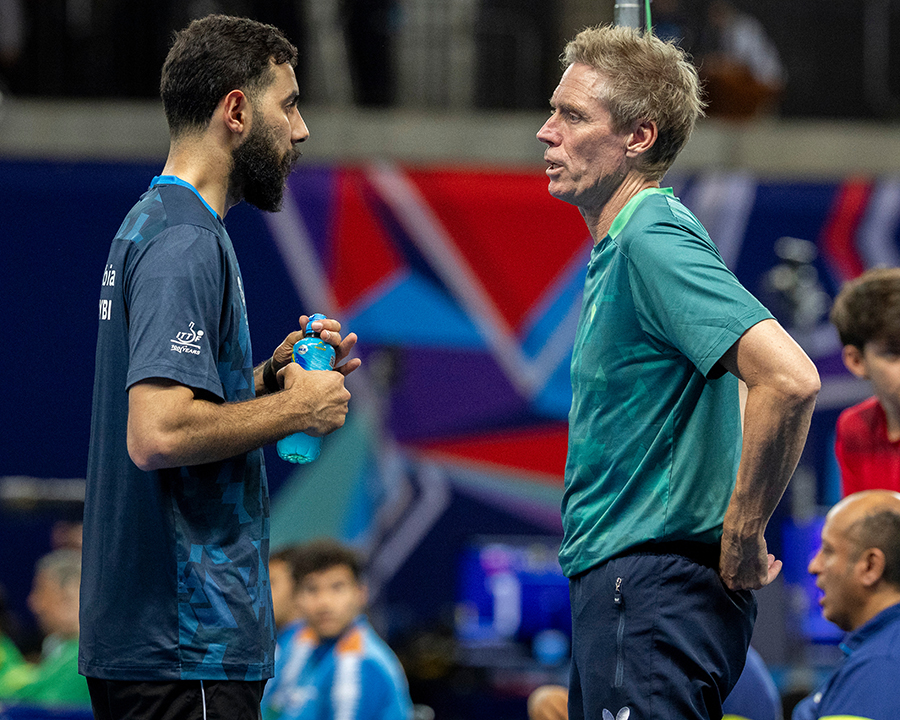
The players were not the only elite individuals showcasing their skills at the ITTF World Team Table Tennis Championships Finals 2026 Presented by ACN – they had world-class support in their corners as well.
The calm advice of coaches can make all the difference on many levels – tactically, technically, physically and psychologically.
Whether it is in preparing for the match or tweaking things at a change of ends or with a well-called timeout, their input helps to bring out the best from the players in their charge.
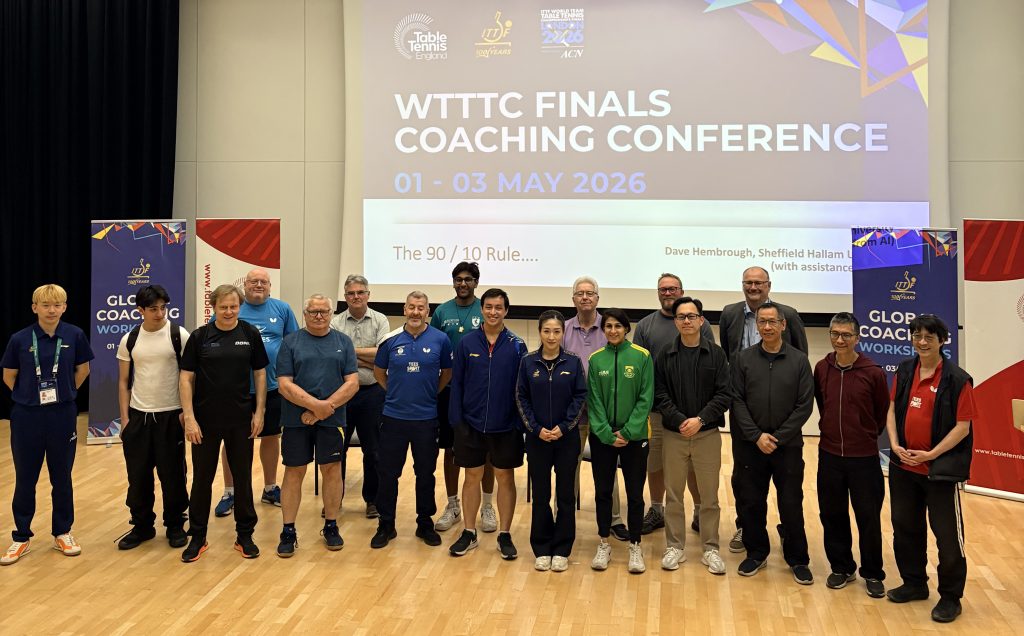
Into this environment, the International Table Tennis Federation and Table Tennis England Coaching Conference took place during the Worlds.
Below, we look behind the scenes at the conference, and also hear from some of the elite coaches who were plying their trade in London.
The Coaching Conference brought together coaches from across the table tennis community for three fantastic days of learning, discussion, and sharing ideas.
It featured a brilliant mix of presentations, practical sessions and open conversations with some of the sport’s most respected players and coaches.
Attendees had the opportunity to hear from former women’s world No 1 Liu Shiwen, who shared her experiences from competing at the very top of the game. She also spoke openly about the importance of adapting throughout a career at the highest level. She reflected on how changes in rules, equipment, and playing styles constantly forced players to evolve, while also highlighting the role of speed, variation, and decision-making in modern table tennis.
Her experiences gave coaches valuable insight into developing adaptable and mentally resilient players.
One of the standout moments of the event was an engaging practical session led by multiple world champion Jörgen Persson (current Saudi Arabia coach) and Joo Se-hyuk (Korea Republic). Coaches were able to see the detail behind modern defensive play, from movement and posture to decision-making and transition play. The session reinforced the importance of developing strong technical foundations, creativity, and tactical awareness in young players.
Mikael Andersson (Director of Sports Development, ITTF) and Dave Hembrough (Sheffield Hallam University) both delivered insightful sessions focused on player development and coaching principles. Discussions explored areas including decision-making under pressure, creating realistic training environments, and identifying the key habits and priorities that help athletes progress over the long term.
Their sessions encouraged coaches to reflect on both the technical and wider developmental aspects of supporting players, sparking valuable conversations throughout the conference.
A workshop delivered by Evie Collier (Table Tennis England Coach Learning & Development Manager), exploring the psychological side of coaching, also created really valuable discussion throughout the event. The session focused on the psychological behaviours coaches can develop in players, as well as how coaches can best support athletes before, during, and after competition.
Conversations explored areas such as managing emotions under pressure, helping players reset after setbacks, building confidence through challenge, and creating environments where athletes can reflect and learn from competition experiences.
Coaches shared honest experiences and practical strategies from their own environments, making it a really valuable discussion point of the conference.
A huge thank you goes to the ITTF for their continued support in delivering another high-quality coaching event. Special thanks also to the David Ross Education Trust and Bobby Moore Academy for providing such a great venue and welcoming environment for everyone involved.
Events like this continue to show how important it is for coaches to come together, share ideas, and keep learning from each other.
As well as his role at the conference, Jorgen Persson was coaching the Saudi Arabia men’s team during Stage 1b at the Copper Box Arena.
He told us: “I try to share my knowledge, what I learned in all these years as a table tennis player first and then as a coach, so it gives as much as possible to them – and of course to get a good relation with them that they ‘buy’ my things.
“They understand what I’m trying to speak with, they are good listeners here, and of course that’s important.”
He also had this message for young players aiming for the top: “It’s hard work of course to get there but enjoy (it) and believe in yourself and also create your own style.”
Hear more from Jorgen below.
France coach Nathanael Molin talked to us about his work with his nation’s men’s team, including on psychological aspects.
He said: “During the competition I am focused on the team and many staff to help me to make the job, of course with video, with physio, with physical practice, with many parts of high-level performance. So, it’s not only me, it’s part of the team and we build this together.
“Table tennis is not only technique, it’s not only how to make backhand, forehand, service, it’s many, many things around this. Also to understand the player . . . for me, the first psychology is the coach, it’s not the psychologist, for the players.”
We also spoke to Sweden’s Marcus Sjoberg, who formerly coached England to ITTF Team World Cup bronze in 2018, who talked about how he had worked with his team on ‘winning the tight moments’. See the interview below.