
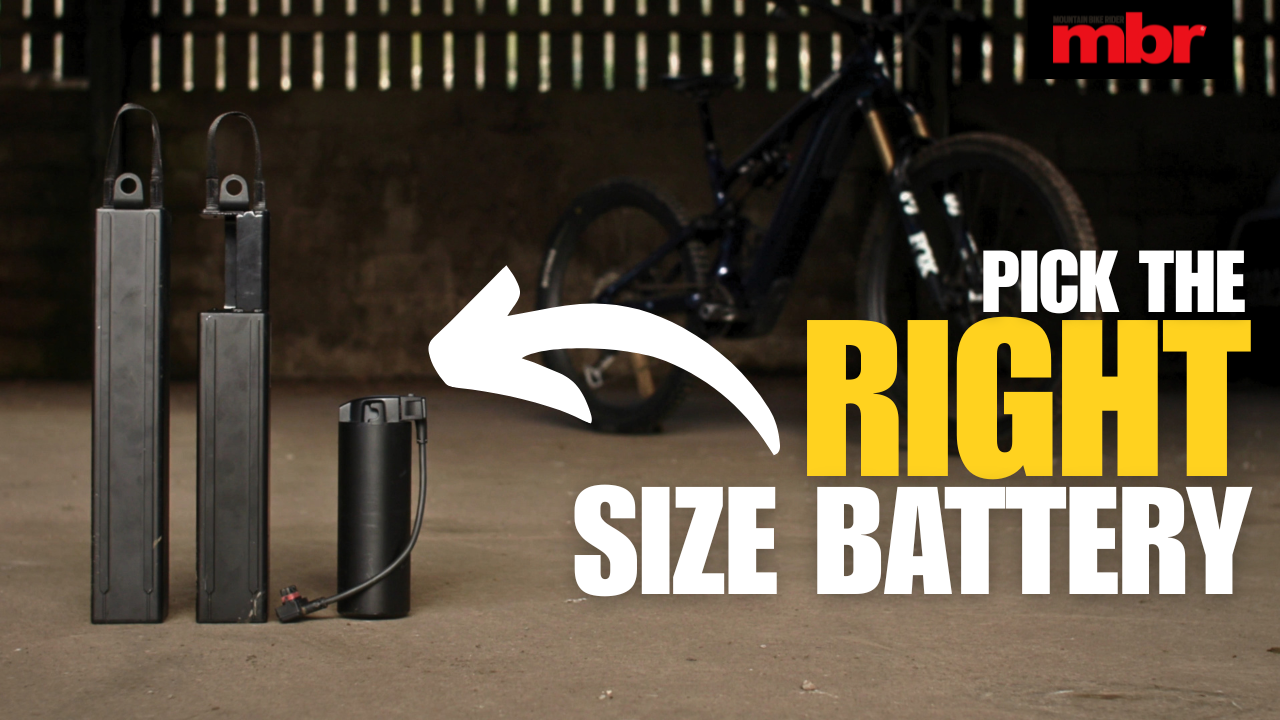
Choosing the right battery size for your e-bike is not just about giving you enough range: it also affects a multitude of other factors, including power, weight balance, suspension set-up and handling.
This content was produced in association with Specialized
We’ve been using the latest Specialized Turbo Levo 4 to dig into the differences and what to consider when deciding on the right battery size for your e-bike.
The key aspects to consider are:
- Weight distribution – for balanced handling and agility
- Range – How far can you ride? Power – Can all the batteries generate the same power from the motor?
- Suspension – Have you optimised your suspension settings to account for the different weight and weight distribution?
- Handling – How does the different weight distribution affect the handling of the bike?
As one of the best electric mountain bikes on the market, the Specialized Turbo Levo 4 makes a great test bench for this because it can run off three different battery sizes: 840Wh, 600Wh, and 280Wh.
The first two options are internal batteries that can be removed from the down tube, while the third is a range extender that can also be used on its own. Adding the range extender to the internal batteries means you can also have 1,120Wh for huge all-day rides, or by combining the 600Wh and the 280Wh you get 880Wh with a more centred weight distribution than you’ll find with the 840Wh.
It’s also a great choice for this test because the 800Wh and 600Wh batteries are different lengths, so the cells on the larger battery extend further towards the head tube, placing them higher and altering the weight balance. Some batteries, such as those from Bosch, are the same length, but fatter, so the global weight is different, but the affect on the weight distribution of the bike is less pronounced.
Battery weights are as follows: 840Wh – 4.4kg 600Wh – 3.2kg 280Wh – 1.65kg Weight distribution and total bike weights are as follows (Size S4 Pro without pedals): 47.2/52.8% – no battery – 20.0kg 47.6/52.4% – range extender – 21.65kg 48.2/51.8% – 600wh – 23.2kg 49.2/50.8% – 840wh – 24.4kg 48.9/51.1% – 840Wh and range extender – 26kg The best weight distribution is with the range extender alone, while the 600Wh saves 1.2kg and shifts 600g rearward compared to running the 840Wh.
We range tested all three batteries – same bike, same rider, same settings, same trails, same conditions, same day – with the Specialized 3.1 motor update installed, in Turbo, and here’s what we achieved: 840Wh battery 1,279m climbed / 1.52m climbed per Wh / 17.5kph average speed / 123bpm average heart rate 600Wh battery 905m climbed / 1.50m climbed per Wh / 17.4kph average speed / 129bpm average heart rate 280Wh battery 582m climbed / 2.07m climbed per Wh / 13.5kph average speed / 127bpm average heart rate.
The range extender sees a lower consumption rate and a lower average speed simply because it produces less power. The max power it will produce is about 380W compared to the 810W with the internal batteries. Hopefully that gives you some insight into how changing your battery size can affect more than range, and help you tune the handling characteristics of your bike.