

A confidential investment pitch seen by BikeBiz has revealed the reality behind Accell Group’s “Ride to Win” strategy, detailing the need for investment, a manufacturing shift to Hungary, and a plan to cut office-based headcount by 40%.
BikeBiz can reveal that internal documents, titled “Project Horizon”, show that the Accell Group, owner of brands like Raleigh, Lapierre and Ghost are facing significant financial pressures.
Whilst recent public messaging has projected a picture of more stable ground, the documents show that the business needs a €95 million capital injection to address a significant working capital deficit that threatens its operational stability.
The presentation reveals restructuring plans, remaining stock excess, changes to manufacturing, reduced headcounts and office closures.
Ownership and Debts
As it stands, the current search for a capital injection follows a turbulent financial period. At the height of the pandemic cycling boom, the group was acquired by investment firm KKR for approximately €1.56 billion. In late 2024, following a market cooldown and industry-wide inventory excess, the group reached an agreement with stakeholders to reduce its debt from €1.4 billion to €800 million. By February 2026, a further restructuring saw KKR exit its majority ownership, handing its equity to a consortium of “super senior lenders” in a deal that involved another “significant debt reduction”. Despite these successive debt write-downs, the “Project Horizon” documents from April 2026 show the Group continues to carry €419 million in long-term debt. The document serves as a formal pitch for an “incoming sponsor” to step in and stabilise the group.
Revenue forecasts show a projected fall from €870 million in FY25 to €735 million in FY26. Internal documents point out that decline isn’t just due to market demand, but primarily driven by a “continued prioritisation of higher-margin products at lower volumes.” However, while P&A sales are expected to remain broadly flat, the pitch admits that topline growth across the group has been “significantly constrained by working capital limitations.” The pitch notes that while the group is operating with ‘historically low inventory levels’ for current ranges, its €110 million ABL facility is ‘fully drawn.’ Internal documents admit that these ‘cash constraints’ have resulted in ‘limited availability for investment in stock levels,’ a factor the report identifies as having ‘significantly constrained’ topline growth by limiting the group’s capacity to fulfil new orders.
While Accell continues to roll out new models, internal documents reveal that the group’s financial recovery is also being slowed by clearance inventory estimated at a value of €28 million for FY26 [“the business continues to hold a level of clearance stock, which is estimated at 28 million units for FY26”]. This legacy stock is reducing the Average Selling Price (ASP) by €23 and dragging total margins down by 4%.
The ‘Fit to Ride’ Program
To establish what management calls a “fit for purpose” cost base, Accell launched the ‘Fit to Ride’ transformation program in early FY25, which aims to streamline operating expenses (Opex) through two distinct waves of initiatives:
- Wave I & II Savings: To date, the group has identified €145 million in total annual savings. As of March 31, 2026, €47.6 million of Wave I savings have been achieved.
- FY26 Targets: The group expects to make €56.1 million in Opex savings this year, with €48 million of that target already achieved.
Some of the group’s brands.
Ride to Win
Following ‘Fit to Ride,’ Accell revealed its ‘Ride to Win’ phase in April 2026, sharing plans to move the group from a collection of independently operated brands to a single, integrated “One Accell” platform.
Publicly, the Ride to Win phase is described as having three core pillars:
- Streamlining the product portfolio to focus on high-growth categories.
- Consolidating the global supply chain, including the shift of volume manufacturing to specialised regional hubs like Hungary.
- Enhancing dealer support through centralised platforms like MyBikeService.
In its April 16 update, Accell announced it was “accelerating the next phase of its transformation: Ride to Win,” a strategy specifically focused on enhancing commercial performance, stating that this phase leverages its “unique combination of strong, iconic bike brands, a leading parts & accessories business, and a strong European dealer network”.
In contrast, ‘Project Horizon’ documents suggest that whilst structural changes are taking place, the group’s financial health is fragile. Internal documents, seen by BikeBiz, reveal a picture of a business with severe liquidity pressure. The €95 million needed is comprised of €30 million for emergency short-term liquidity and €65 million for working capital.
Restructuring Plans
To secure necessary funding from an “incoming sponsor” and prove the business can return to a projected €185 million EBITDA rebound by 2026, Accell has outlined a radical restructuring of its European footprint:
- Manufacturing: The group intends to transition the bulk of its volume production away from the Netherlands to Hungary, a move already in motion following the decision to close the group’s manufacturing facility in Heerenveen. Internal data reveals a cost disparity, with the documents noting costs of €516 to manufacture a bicycle in the Netherlands, compared to just €141 in Hungary. The €375-per-unit saving is described as a critical pillar for restoring the group’s margins. With the change to manufacturing in Hungary, Accell is forecasting a dramatic margin increase, rising from 8% in FY25 to 18% in FY26.
- Workforce and Office Reductions: The plan targets a 40% reduction in office-based (SG&A) headcount. The document outlines plans to close 50% of its total office locations with just one office per country of operation.
- Portfolio and R&D Consolidation: To simplify a “paralysed” supply chain, Accell aims to reduce (mobility) platforms by 51% and SKUs by 42%. In sports, the aim is to reduce platforms by 32%, models by 49% and SKUS by 44% by MY28. Historically independent design hubs will be integrated into just 2-3 global R&D locations.
- Supply Chain Optimisation: Currently operating from nine distribution centres, the group intends to shrink its footprint to five primary distribution locations by 2028.
- Sourcing: Accell’s long-term strategy through 2030 relies on increased sourcing from India to further expand margins and support the introduction of newer, higher-margin models.
Accell UK
Whilst this leaves questions about the Nottingham headquarters, public records show strain is also evident in the UK, with Accell UK and Ireland Ltd (Company 00139076) failing to file its statutory financial accounts, which have remained overdue since September 2025.
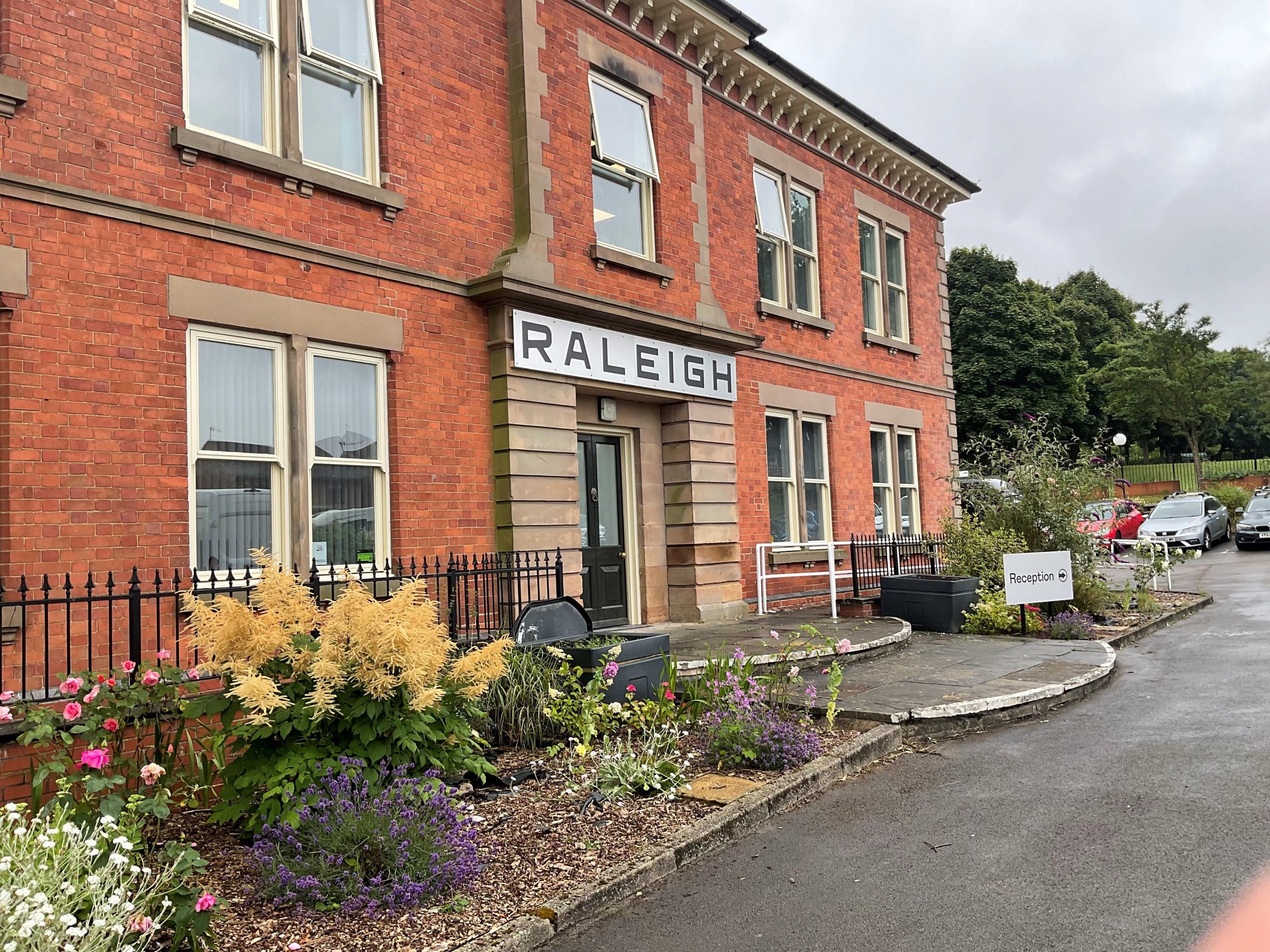
Raleigh’s UK HQ
Further evidence of lender control is found in a legal “Debenture” registered on February 12, 2025. This document gives Kroll Trustee Services Limited, acting as Security Agent for the lenders, a fixed and floating charge over all UK assets, bank accounts, and intra-group debts.
However, speaking to BikeBiz, one UK-based dealer noted a “definite shift” in operations, specifically regarding commercial flexibility. “There is very little flexibility with pricing now,” the dealer remarked, though they noted that stock levels remained stable and delivery dates were largely unchanged. They also confirmed that credit terms were unaffected: “They now offer an extra 1% margin by paying for direct debit at 30 days.”
ESG Milestones and P&A Growth
Despite the instability, the Accell Group maintains that its core mission is a significant asset for any incoming sponsor, as detailed in the documents under several ESG (Environmental, Social and Governance) milestones:
- To date, the group has repurposed over 250,000 battery cells through circular economy partnerships and has achieved 100% renewable electricity usage across its operations.
- To date, the group has signed up over 300 partners to the ESG training campaign programme.
Another shift detailed as a pillar of recovery is the group’s XLC brand. As the ‘largest player in the European Parts & Accessories market,’ management forecasts sales in this sector will grow from €300 million to €375 million by 2030. The presentation states that while the general Parts & Accessories (P&A) portfolio has historically achieved margins of around 20%, the XLC brand has consistently realised margins greater than 30%. This sits significantly above the rest of the P&A portfolio, which typically achieves around 20%, leading the group to argue there is a ‘clear path to achieving margins greater than 25%.’

XCL. Photo: Accell
September Deadline
One of the most pressing concerns in finding an “incoming sponsor” is existing debt. Following the group’s restructuring in mid-February 2026. Under the current agreement, Accell is utilising a “Payment-in-Kind” (PIK) arrangement for its most senior debt. The documents state that “all SSF [Super Senior Facility] interest are PIK until September 2026 as of the new financing agreement.”
In September, assuming no other agreement is reached, the interest is added to the loan principal. And while the PIK provides a temporary shield, Accell “continues to be required to pay interest expense on a quarterly basis related to the working capital facilities.”
The September deadline may well represent a critical financial ‘cliff edge,’ but the broader ‘Project Horizon’ strategy signals a fundamental shift in Accell Group’s DNA. Securing the €95 million injection would provide the working capital necessary to restart a “restricted” supply chain and allow the “Ride to Win” phase to become a commercial reality. For the industry, the outcome will either determine whether some of Europe’s most established brands emerge as part of a leaner, centralised group, or face more uncertainty.
Accell Group has been contacted for comment regarding the €95 million funding requirement and the proposed restructuring plans. At the time of publication, the group has not responded.
Editor’s Note: This report is based on internal “Project Horizon” investment documents dated April 2026. BikeBiz has sought to report these findings as accurately as possible, prioritising key financial data, manufacturing transitions, and workforce implications that are within the public interest of the cycling trade. While this article focuses on these core operational shifts, the original presentation includes a wide range of data and further long-term strategic plans not fully detailed here. BikeBiz remains committed to objective reporting and has provided Accell Group with a right of reply to ensure a balanced perspective.