
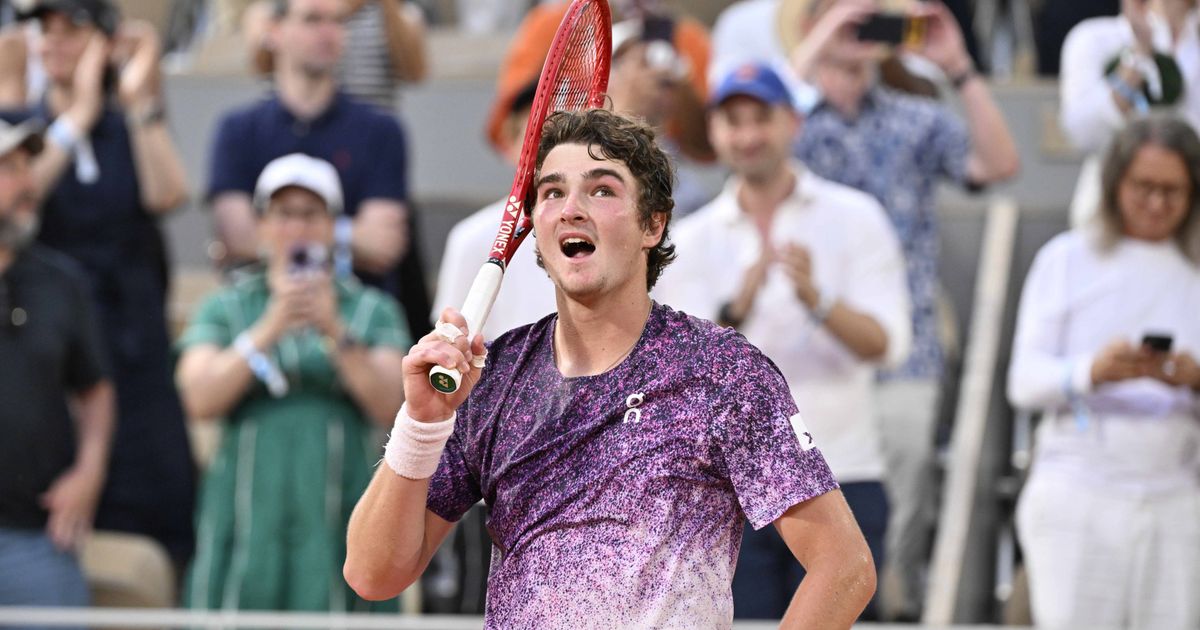
Fonseca entered Paris with limited momentum, but said his level improved gradually through the early rounds, including a near-defeat that helped stabilise his performance before facing top-tier opposition.
His transition to grass, however, has not followed the same trajectory, with an immediate first-round exit at the Halle Open exposing the difficulty of adapting his game to faster conditions.
“Super tight match” in Paris: the Djokovic breakthrough
Fonseca described the Djokovic match as a contest defined by pressure moments and physical attrition rather than sustained dominance. He pointed to the difficulty of starting the tournament without confidence, before gradually finding rhythm through successive rounds.
Joao Fonseca after defeating Djokovic to reach the quarter-finals of Roland Garros 2026
The victory over Djokovic, he said, emerged from staying competitive in key moments rather than controlling long stretches of play. “The first round was tough, the second round I almost lost it and got through in three sets,” the Brazilian added. “I think that motivated me, and of course against Novak it was a super tight match, Casper and all of them were very good matches, so it was a positive week and gave me a lot of confidence coming into the start of the grass season.”
Statistically, Fonseca converted six breaks from 15 opportunities while Djokovic struggled physically in the closing stages of a match that extended close to five hours. The Brazilian also saved 11 of 16 break points, a key factor in sustaining momentum across shifting phases of the contest.
Grass transition and early exit in Halle
Fonseca acknowledged that grass requires a fundamentally different approach to clay, particularly in timing, positioning and point construction. He highlighted the reduced reaction time and the need for immediate execution, where points are often decided within a few shots.
Unlike Roland Garros, his grass campaign did not extend beyond the opening round, with a straight-sets defeat at the Halle Open. He noted that his preparation was limited to only a few days on the surface, which restricted his ability to fully adapt. “The surface has changed a lot, but on clay you wait more for the ball, it’s slower, so you have more time to produce power.”
“Here it’s very quick. Even at love-40 on your serve, you can still win points. Every little opportunity is important. Sometimes the opponent produces two returns and then you can’t see the ball. It’s very fast, and approaching the net is really important.”
Fonseca is scheduled to continue his grass preparation in Eastbourne ahead of Wimbledon, where he will again attempt to translate his Roland Garros breakthrough into competitive consistency on faster surfaces.