

Several comments had questions regarding Sinner. The most lively centred on his aesthetic appeal for the broader tennis fan: is Sinner boring to watch?
A couple of years ago I wrote an article on the encroachment of pickleball and padel onto the tennis scene. Within that piece was the consideration of why we watch sports, with a quote from Stephen Mumford being central:
“Sport makes us run faster, jump higher, exhibit the maximum strength. It is an entirely artificial contest, insofar as its prelusory goals tend to be worthless or worth little. But what is important about them is that their pursuit creates the athletic beauty we seek: fully-exerted human bodies, graceful style, intricate tactics and real drama.”
— Ways of Watching Sport
David Foster Wallace circled something similar in his famous Federer piece for the New York Times:
“Beauty is not the goal of competitive sports, but high-level sports are a prime venue for the expression of human beauty. The relation is roughly that of courage to war.”
“The human beauty we’re talking about here is beauty of a particular type; it might be called kinetic beauty.”
— Roger Federer as Religious Experience
Mumford and DFW highlighted something 15-20 years ago that is now coming to a head in today’s quant-saturated sports era.
I think there are three main ingredients that maximise viewing pleasure in tennis. The first is what we could call visible mastery: the seemingly effortless elliptical swings and footwork that send the tennis ball whirring back and forth with net-flirting precision. The second is to have something important at stake, so that risk-taking carries meaning. Finally, we must have uncertainty — not only of who will win, but how they will win.
That last element is what is being examined here. If I were to address the thread’s two sides faithfully, I think it goes something like: Sinner’s power alone is something to behold, and his ability to problem-solve in the medium-term (introducing the forehand drop shot, refining the serve to bot-godly levels) is genuinely incredible to follow. This I wholeheartedly agree with, and as a tennis sicko I will always be in awe of Sinner’s game. But the counter has merit too: Sinner’s game is the apotheosis of a ubiquitous style that leaves little room for variation; the point of perfecting the two-handed topspin backhand is to render the slice useless, just as perfecting the three-pointer rendered the mid-jumper useless in the NBA:

If you’ve been reading this blog the last few months, you may have noticed that I’ve been circling around this theme of tactics dying, of pure racquet head speed (‘best stretch wins’) becoming the endgame of polyestered tennis. Many others are hinting at this:
Zverev has talked about it a lot. It’s not tennis anymore, and I’m paraphrasing, but everyone is just ripping off both wings. The skill aspect of playing a short slice, a deep slice, playing high and heavy and catching the next one on the rise as a redirect, using the variation that we see Carlos do so well, that’s kind of gone out the window, because if you play a slice on a slow court and the ball checks up a little bit, guys will take full cuts on it.
— Chris Eubanks for Andy Roddick’s Served
“I feel like the biggest thing is that the traditional patterns in tennis are gone. I feel like ten years ago, if you were pushed deep in the corner, you were taught ‘alright, hit that heavy over the net crosscourt and get back in the point’. I feel like guys now, if your weight is behind the ball and you’re balanced, you have the option to just green-light it big down-the-line whenever you want. Guys are more aggressive from every part of the court now than they were ten years ago.”
— Sam Querrey with Karue Sell
It’s easy for me and other diehards to love watching Sinner paste his backhand against another hapless opponent in another 1000s city. Of course, not having Alcaraz or another worthy challenger to chase it down is bad for tennis; if any player dominates without a worthy adversary it’s bad for tennis. But challengers inevitably arrive.
My bigger concern is about the further homogenisation of the game itself.
Here I will replug a notion I walked out in the padel tennis piece regarding “middleweight tennis”…
I’ve tweeted multiple times (here, here) recently that “middleweight tennis”— involving players who aren’t big enough to servebot and who use their footspeed and racquet work to win points — is the sweet spot in 2023.
Dan Evans is the perfect canvas: his old-school game creates great contrast against multiple play-styles. Watch this three-minute highlight of Evans vs Alcaraz from the US Open.
This is as padel-y as pro tennis could ever get:
Dan Evans got to #21 in the world as a 5’9’’ slicing anachronism. I don’t think it’s an accident that his match highlights feature prominently on TennisTV’s YouTube page, or that they dedicated a highlight reel video to him despite a lack of silverware; Evans hits different.
To me, his legacy is mainly about showing what tennis could be when shot power, racquet skill, movement, and IQ were perfectly in balance. Think also of the famous Sincaraz rally from Miami several years ago:
In this particular rally, Alcaraz’s variation shot-percentage jumped to 54.5% and Sinner’s to 25%. The rally featured five slices, two angles, one drop shot, and one running back half-volley forehand, all welded onto the sliding open-stanced modern footwork patterns and drilled together at breakneck speed.
Tennis has always put its thumb on the scales when the game needed adjustments in service of aesthetics — slower balls/courts post-Sampras, shot clocks, fifth set tie-breakers. The question now is, how do you put the poly-genie back in the bottle, should the tour-wide trend toward more double-fisted baseline power continue?
Aesthetics without competition becomes exhibition. Competition without aesthetics becomes sterile optimisation.

I wanted to answer this because it’s something that has been discussed more broadly given the domination of Sincaraz + Djokovic at the slams in recent years. My answer is that the last strong year we had was 2019 before Covid. The Big-3 were all competing and Thiem and Medvedev were becoming genuine threats:

So yes, it’s been a weaker era.
Since then we’ve had a transition out of Fedal and into Sincaraz. You could argue everyone else from that time largely plateaud: Zverev and Medvedev held their bridesmaid status; Tsitsipas/Berrettini/Rublev/Ruud etc. weren’t able to meaningfully improve their weak backhands.
But then we got a cohort of younger guys who had the kind of athleticism and shot quality that could become threats — Rune, Draper, Fils, Musetti — but one-by-one, each has had their progress stalled by long-stints on the sideline with injury.
Rune, Draper, and Fils were all rising in mid-2025 (they were ranked #10, #4, and #14 respectively coming into last year’s French Open). Musetti was the only one who had a healthy 2025, but even his best effort — a semifinal match at RG with Alcaraz where he had a lead — was cut short by injury.
Instead of late 2025/early 2026 becoming the period where the chasing pack strengthened and arrived, they have been completely gutted, adding Alcaraz to the sidelines since April. Less a weak era, more a promising era weakened.

I don’t think “going under” Sinner is a weakness in the traditional sense, because Sinner’s backhand is actually excellent at countering slice for a two-hander, given how much racquet speed he can generate with his forehand-y swing path, but I still think it is a better tactic than going toe-to-toe with him because at least by slicing low to him it forces him to be slightly less aggressive — he has to dedicate more units of racquet head speed to lifting the ball — and this gives the opponent a little more time and height to work with.
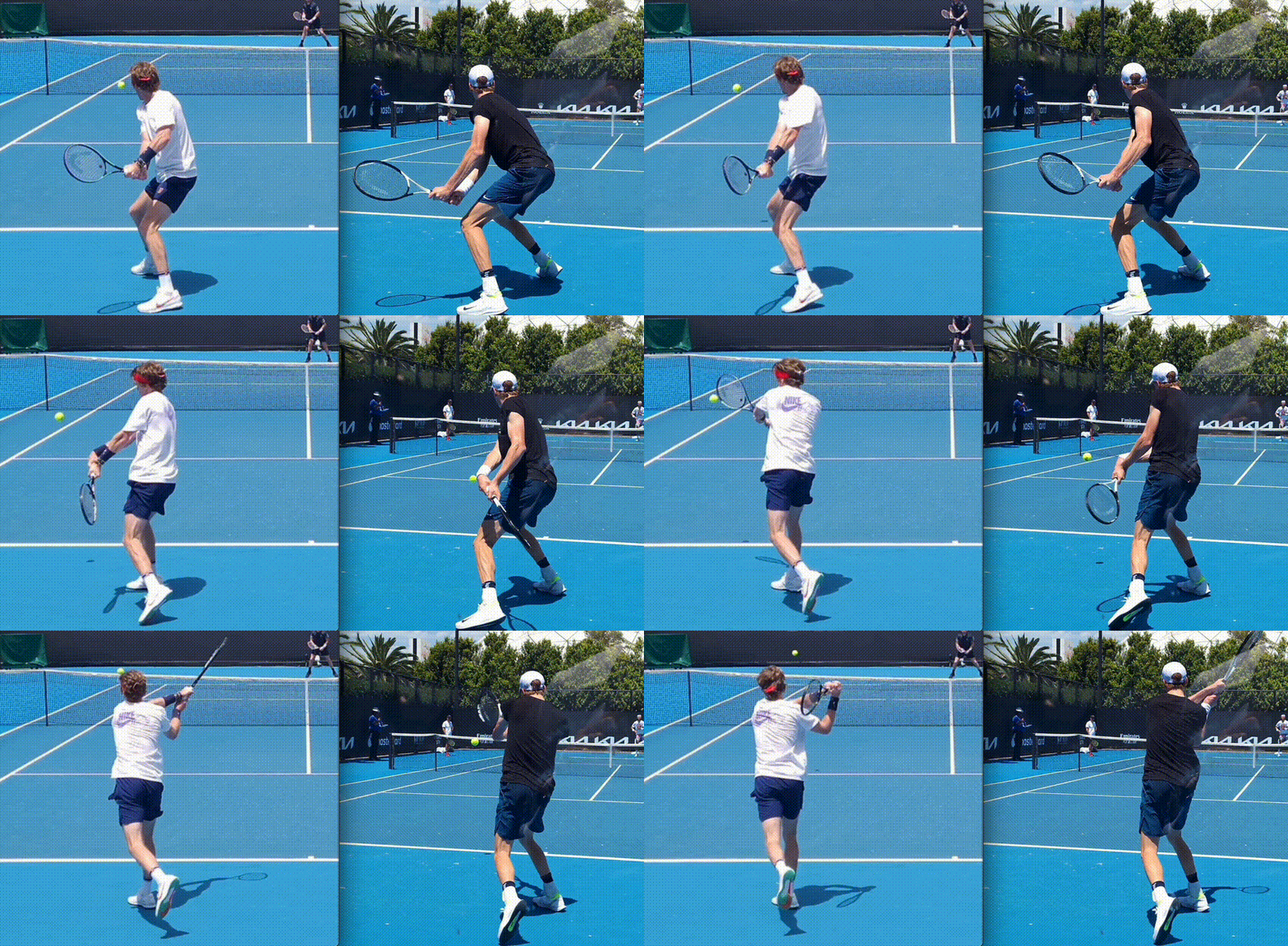
I kind of directly answered this question in this Dimitrov vs Sinner Miami final from 2024, and we saw at Wimbledon last year how effective Dimitrov’s slice worked against Sinner in favourable conditions like grass.
So, does Sinner need to develop a better slice? Maybe. But the number of players who own an effective slice capable of getting the ball low there and a dangerous forehand to unload on the next ball (Alcaraz, Dimitrov, Berrettini… is that it?) is few and far between. This is still the tour’s problem much more than it is Sinner’s.

I like Jodar’s backhand for a couple of reasons. One is that it’s much flatter than his forehand, so it’s naturally a bit of a rhythm breaker for his opponents (Norrie and Kyrgios have this feature), but he also gets the racquet head in a higher power position, so he is adept at stepping into high balls (or second serve returns) and drilling it back with speed. As Macdam mentions, he is pretty compact so he can take it quite early.
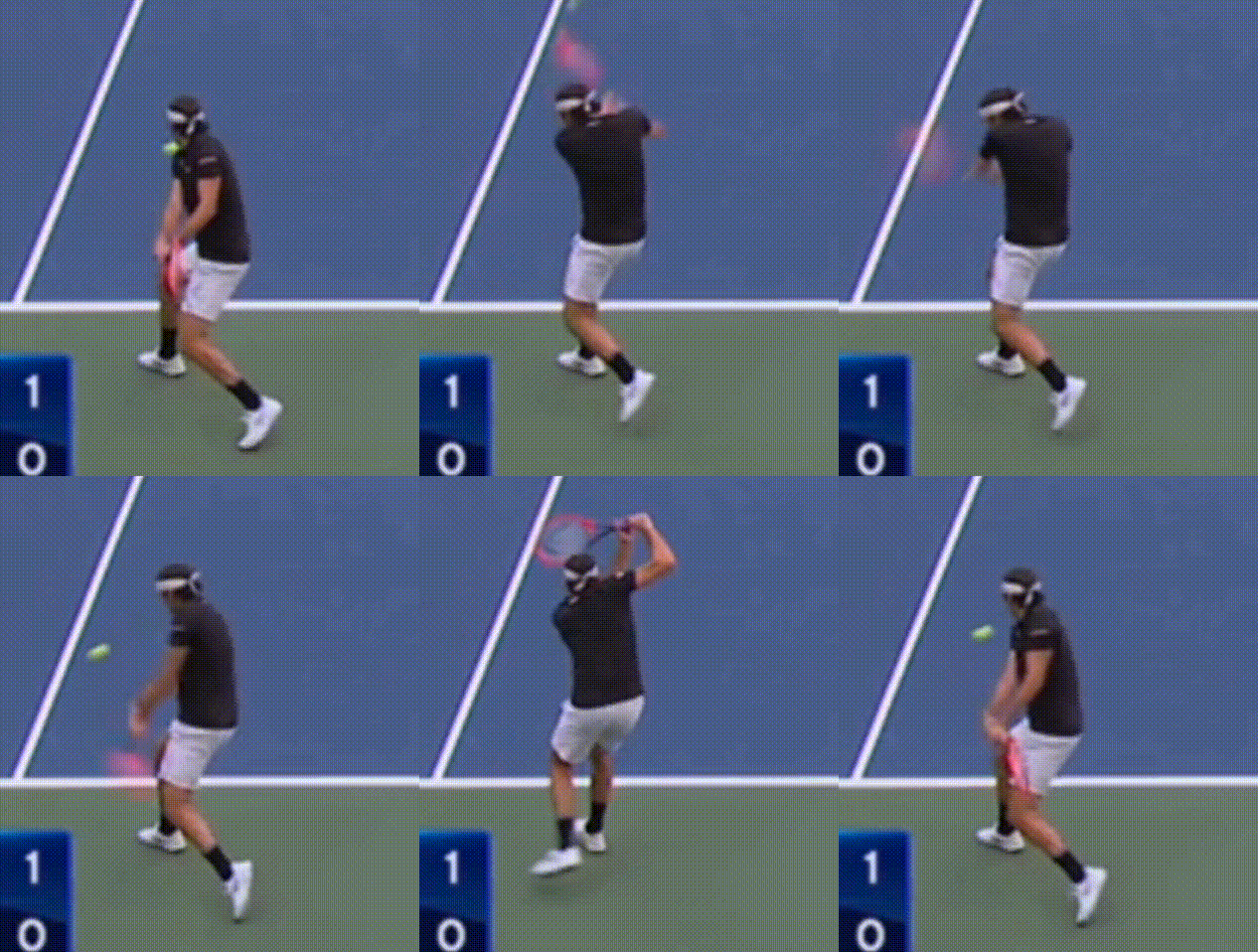
Is it an outside/nextgen setup? Yes. Frauderer asked for a kind of decision tree or “cheat sheet” for techniques. This won’t be exhaustive, but one thing to notice is that if a racquet head has a “weak” slot position, where the racquet tip doesn’t lag inside the ball line very well (think Jodar or Rublev’s backhand compared to Sinner/Fils, or RBA’s forehand compared to Nadal), then the racquet path must be flatter, going “through” the ball rather than angular and rolling over it. Conservative grips can help in this regard (I touch on this near the end of best stretch wins) but closing the strings in the slot is also helpful, and one way to notice that push feature is to see that locked-wrist finish, where the racquet head is more upright, rather than rolling and pointing right from this view.

Fritz with an extreme example:
From the last mail bag:


Dan Evans, obviously. I’ve sung his praises for years because he carried the torch of what tennis could be when it comes to variety of heights and spins, and creating pressure through net sneaks and angles. He’s head and shoulders above the in that regard (maybe Musetti is the best top example now).
Because the type of player you’re describing is endangered, nowadays I often find enjoyment in specific qualities dialed to 11 in certain players. I think Tien’s precision on the forehand down the line is the tour’s worst paper cut, subtle but so effective. In contrast, Fonseca’s willingness to unload the extended-grunt-forehand always creates an atmosphere that the Brazilians lean into.
Tommy Paul uses a super flat backhand hard crosscourt, and without a big forehand, he also does well to get forward and mix it up.
Moutet is one of the last true counterpunchers, and his touch and racquet work usually makes a highlight or two.
In the women’s game, Ash Barty was the last top player with great variety. Her slice was unrivalled and her forehand used much more spin than most women, so her ability to mix up flights and spins was her greatest weapon, in that her ball was so different from what you often see on the WTA tour. Muchova’s movement and court craft is up there.
I often just love great technicians as well. Rybakina and Jovic for the women off the ground, Djokovic and Sinner for the men.
-
Really looking forward to Safuillin versus Ruud. The Russian has been on a sneaky tear through Challengers and qualifying, and has a big aggressive game that could rush Ruud in these hot conditions.
-
Altmaier is also a tough test for the fourth-seeded FAA first up.
-
Fonseca vs Prizmic Round 2 could be a cracker. Two of the best youngsters with a likely third round against Djokovic.
Who am I picking?
I think the semis will be Sinner vs Medvedev and Djokovic vs Zverev. Wanted to pick Ruud, but I think his draw is daunting.
That’s all I got. See you in the comments. HC.
*If I didn’t answer your mailbag question here, I’ll try and answer it directly in the comments section of the last mailbag, so stay tuned for a notification.