
Summary
The teep, also known as the push kick, is one of Muay Thai’s most fundamental and frequently used techniques. Functionally, the kicking equivalent of the jab, it controls distance, disrupts rhythm, sets up combinations, and serves as a defensive shield all at once, making it one of the most tactically versatile weapons in the entire art. This article takes a detailed look at the teep from every angle: the mechanics of the chamber, snap, and recovery; the difference between lead and rear leg variations; why the teep works at every level of competition; the drills that build it into muscle memory; and the common mistakes that undermine its effectiveness. Whether you are new to Muay Thai or refining an established game, the teep is a technique you will return to for your entire training life. As Muay Thai World Champion and Evolve MMA instructor Chaowalit Jocky Gym puts it, “The teep is the technique that tells me everything about a fighter. If they use it well to create space, to time counters, to control the pace, I know they understand Muay Thai. It is simple, but mastering it is anything.”
Key Takeaways
- The teep is the kicking equivalent of the jab, and should be used just as frequently. Like the jab in boxing, it is not primarily a power strike but a control tool that dictates distance, sets up combinations, and keeps opponents from settling into their own rhythm.
- Chamber before you extend, always. Bending the knee to approximately 90 degrees before extending the leg is what generates a powerful, snapping teep. Simply pushing the leg forward without chambering produces a weak, easily read strike with significantly less force.
- Hip drive is what separates a functional teep from a great one. Thrusting the hips forward as the leg extends is the detail that converts a leg push into a strike powerful enough to send an opponent off their feet.
- Lead and rear leg teeps serve different purposes. The lead leg teep is faster and better suited for range finding and disruption; the rear leg teep is more powerful and more effective at stopping an advancing opponent or creating significant distance.
- Recovery is as important as the strike itself. Returning the leg quickly and cleanly to your fighting stance after the teep is what keeps you balanced and prevents your leg from being caught — a mistake that can cost you control of the entire exchange.
- The teep is one of the few techniques in Muay Thai with equal offensive and defensive value. It can be used to open up an opponent for follow-up strikes, to stop a combination mid-execution, or to reset the fight entirely — giving you a single weapon that operates across multiple tactical situations simultaneously.
Understanding The Teep
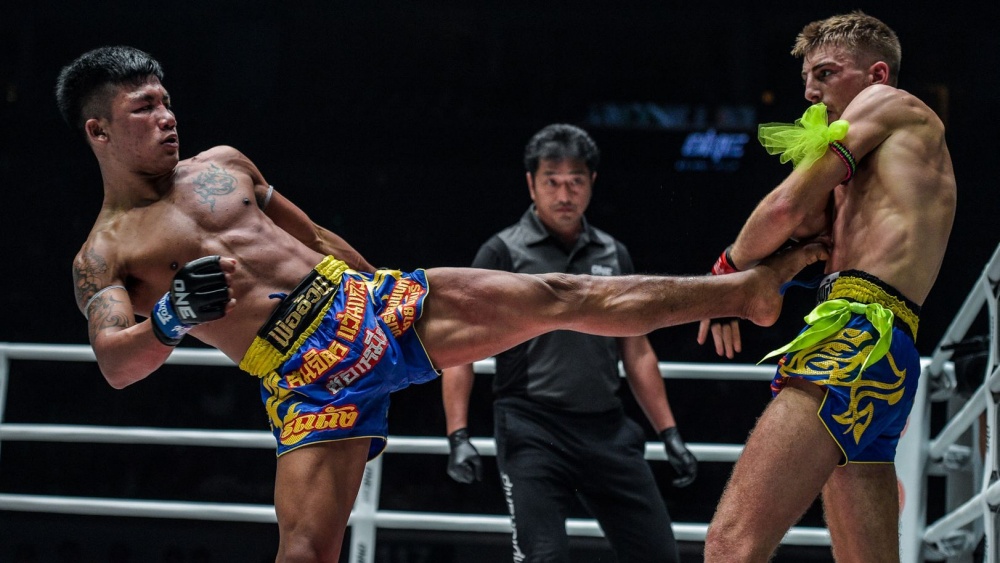
While the teep is also known as the push kick, it’s more than just a simple shove with your leg. It’s a powerful weapon that can demoralize opponents, create space when you’re getting crowded, and disrupt your opponent’s rhythm. A well-timed teep is also more than enough to send an opponent flying to the canvas.
Unlike most kicks used in Muay Thai that involve striking targets with your shin while throwing your leg like a bat, the push kick uses a snapping motion and aims to make contact with your feet.
The teep is an easy technique to learn, and it’s one of the first moves you should master. Watch a professional Muay Thai fight and you’ll quickly see how effective the technique is. If you ever find yourself in a fight and aren’t sure what to do, throw a teep. It’s one of the selected martial arts techniques with both defensive and offensive uses. The technique often leads to the most rewards when paired up against other strikes.
Breaking Down The Teep
Let’s take a closer look at how executing a teep works:
- Stance: Start in your fighting stance with your feet shoulder-width apart. Keep your weight evenly distributed and tighten your core. A balanced stance is crucial when performing the technique since it momentarily leaves you on one leg.
- Chambering The Kick: Raise your kicking leg upward as you prepare to throw the kick by pushing off the balls of your feet. Your knee should be bent at about a 90-degree angle. Chambering the kick instead of simply extending your leg leads to a more powerful attack.
- Snap: Finish the kick by pushing your leg forward with your quads while thrusting your hips forward. This dual action creates a snap that leads to a powerful blow that could force an opponent to take a few involuntary backward steps. Pivot your base foot slightly to add a little more force into the technique. The arm on your opposite side should be up, protecting your face, while the arm on the same side as your kicking leg swings down.
- Recovery: Aim to push through your opponent when throwing a teep and quickly return your leg to your fighting stance.
The teep can be thrown with either leg, and the mechanics remain the same for the most part. Teeps thrown with your lead leg are faster but less powerful, while the reverse is true for teeps thrown with your rear leg. Lead leg teeps are excellent for measuring range, while rear leg teeps are more effective at keeping opponents off you.
Why The Teep Works
Some of the reasons why the teep is one of the most used techniques at all levels of Muay Thai training include:
- Distance Control: The teep allows you to push opponents away whenever necessary. Every successful use forces your opponent to adjust to close the distance, opening up opportunities to land counters.
- Defensive Shield: The teep also serves as a defensive weapon that prevents opponents from launching attacks on you. It can stop opponents right in the middle of combinations or disrupt their rhythm, hindering their ability to put strikes together.
- Setting Up Combinations: You can use the teep to create openings for follow-up strikes since it leaves opponents off-balanced. You can follow up a teep with punches, kicks, or knees. For example, a teep to the body could force an opponent to lower their guard, leaving them vulnerable to head strikes. You can also feint throwing a teep to create openings.
Drills To Perfect Your Teep
Mastering the teep isn’t something that happens overnight. You must drill it so often that it becomes part of your muscle memory. It takes practice, focus, and plenty of drilling—here are some drills to add to your training regimen:
- Shadow Teep Drills: The first step to mastering the teep is drilling its mechanics more times than you can count. Start slow, ensuring you chamber the kick, thrust your hips forward when extending your leg, and quickly bring your leg back to your stance.
- Heavy Bag Drills: Once you’re comfortable with the technique, it’s time to start aiming at a physical target. A heavy bag gives you excellent feedback on how much power you’re landing with and helps to improve your timing and accuracy. Try to hit the bag as it swings back toward you.
- Partner Drills: Partner drills will improve your ability to land the teep during fights. Have a training partner come at you while you try to keep them off by throwing teeps. This drill helps to improve your ability to gauge distances. You should also work on following up your teeps with combinations.
Some of the common mistakes to avoid when drilling the teep include:
- Overcommitting: Overextending when throwing a teep leaves you off-balance and vulnerable to counterattacks.
- Poor Balance: Not having a balanced stance when throwing the teep also opens you up to counters. Work on your foot placement if you often feel wobbly in your fighting stance.
- Lack Of Follow-Through: Returning your leg to your stance is just as vital as throwing the teep properly. Taking your time to bring your leg back opens you up to counters and getting your leg caught.
- Telegraphing Your Intent: The best teeps are often thrown without any tells. Practice good mechanics to avoid giving opponents any telltale signs they can pick up on.
Frequently Asked Questions About The Teep In Muay Thai
Q: What Is The Difference Between A Teep And A Front Kick?
A: The teep and the front kick are closely related but serve different tactical purposes and use slightly different mechanics. The front kick — as seen in karate and other traditional martial arts — is typically a thrusting or snapping motion aimed primarily at causing damage. The teep, while also capable of causing damage, is fundamentally a control and disruption tool. It prioritises push and distance management over penetration, and is used far more frequently as a defensive and rhythm-disrupting weapon than as a finishing strike. The teep also involves more deliberate hip drive and a focus on pushing through the target rather than simply making contact with it.
Q: Where Exactly Should The Teep Make Contact On The Opponent?
A: The most common and effective target for the teep is the midsection — specifically the solar plexus and stomach. A clean teep to the solar plexus can momentarily wind an opponent and significantly disrupt their forward momentum. The chest is another common target, particularly when the goal is to create distance rather than cause pain. Some fighters also use the teep to the face as an insult or a surprise disruption — it is legal in most Muay Thai rulesets, though it requires significantly more precision and is used sparingly. The thigh teep is a faster, lower-target variation used to disrupt an opponent’s base and balance rather than push them away cleanly.
Q: How Do I Stop An Opponent From Catching My Teep?
A: The two most reliable ways to prevent your teep from being caught are to throw it with conviction and recover quickly. A teep thrown without commitment, slow, half-powered, with a lazy recovery gives an opponent time to read it, step to the side, and grab the leg. A fast, well-chambered teep with an immediate recovery is significantly harder to catch. Varying your timing and not falling into predictable patterns also helps if your opponent can anticipate when the teep is coming; catching it becomes much easier. Finally, mixing up your targets (body, chest, thigh) keeps opponents from locking onto a single defensive response.
Q: Can The Teep Be Used Effectively In MMA And Kickboxing As Well As Muay Thai?
A: Yes, the teep translates directly and effectively to both MMA and kickboxing. In kickboxing, it functions identically to its Muay Thai application: distance control, rhythm disruption, and combination setup. In MMA, the teep serves the additional purpose of keeping opponents from closing the distance to initiate takedowns, making it a valuable anti-grappling tool in addition to its striking applications. Several high-level MMA fighters have built their striking game significantly around the teep for exactly this reason. The mechanics are identical across all three disciplines — mastering it in Muay Thai gives you a fully transferable weapon.
Q: How Do I Use The Teep To Set Up Other Strikes Effectively?
A: The teep creates openings in several ways depending on where it lands and how the opponent reacts. A teep to the body that forces an opponent to step back resets the distance and can be followed by a rear leg body kick or a stepping jab as they come back in. A teep that causes an opponent to lower their guard, either from the impact or in an attempt to catch the leg, opens the head for a high kick or a cross. A feinted teep that causes the opponent to react defensively can create openings across the entire body. The key is to observe how your specific opponent responds to the teep and then build combinations that exploit that reaction consistently.
Q: What Is A Teep Feint And How Do I Use It?
A: A teep feint involves initiating the chamber of the teep, raising the knee, without completing the kick, with the goal of triggering a defensive reaction from your opponent that creates an opening for a different strike. For example, raising the knee as if to teep will often cause an opponent to step back, lower their guard, or commit to a defensive movement. You can then use that reaction to step in with a punch combination, a body kick, or a knee. The teep feint is most effective when you have already established the teep as a credible threat — meaning you have thrown it successfully enough times that your opponent genuinely believes you are going to complete it when you raise your knee.
Q: How Important Is The Teep For Scoring In Competitive Muay Thai?
A: In traditional Muay Thai scoring, individual teeps do not typically score as highly as clean roundhouse kicks or knees, because they are primarily push strikes rather than damaging impact strikes. However, the teep contributes indirectly to scoring in significant ways: it controls the pace and range of the fight, disrupts an opponent’s scoring opportunities, and sets up the higher-scoring strikes that follow. Fighters who use the teep intelligently throughout a fight demonstrate ring control and technical dominance, qualities that experienced Muay Thai judges notice and factor into their overall assessment, even if the teep itself does not appear on the scorecard as a direct point.
Q: How Long Does It Take To Develop A Reliable Teep For Use In Sparring?
A: The basic mechanics of the teep are among the most accessible in Muay Thai and can be learned relatively quickly. Most beginners develop a functional teep within their first few weeks of training. Developing the timing, range management, and tactical awareness to use it effectively in live sparring takes considerably longer, typically several months of consistent drilling and sparring exposure. The teep’s apparent simplicity is deceptive — the gap between a teep that works in drills and one that works against a resisting, unpredictable opponent is significant, and closing that gap requires accumulated sparring experience that cannot be shortcut.
Final Thoughts
The teep is the technique that rewards a lifetime of attention. It is one of the first things you learn in Muay Thai and one of the last things you truly master — because its value lies not just in the mechanics of throwing it correctly, but in the judgment of when to throw it, against whom, and to what end. A beginner uses the teep to keep people away. An advanced fighter uses it to control the entire shape of a fight — dictating distance, managing pace, creating openings, and shutting down an opponent’s game plan one well-timed push kick at a time.
Drill the mechanics until they are automatic. Study how elite fighters deploy the teep in professional bouts and notice the tactical intelligence behind each one. Bring that understanding into your sparring and let it evolve with your game. The teep will never stop teaching you — and the more seriously you take it, the more it will give back.
You may also like:
What Is The Scissor Knee And How To Throw It