
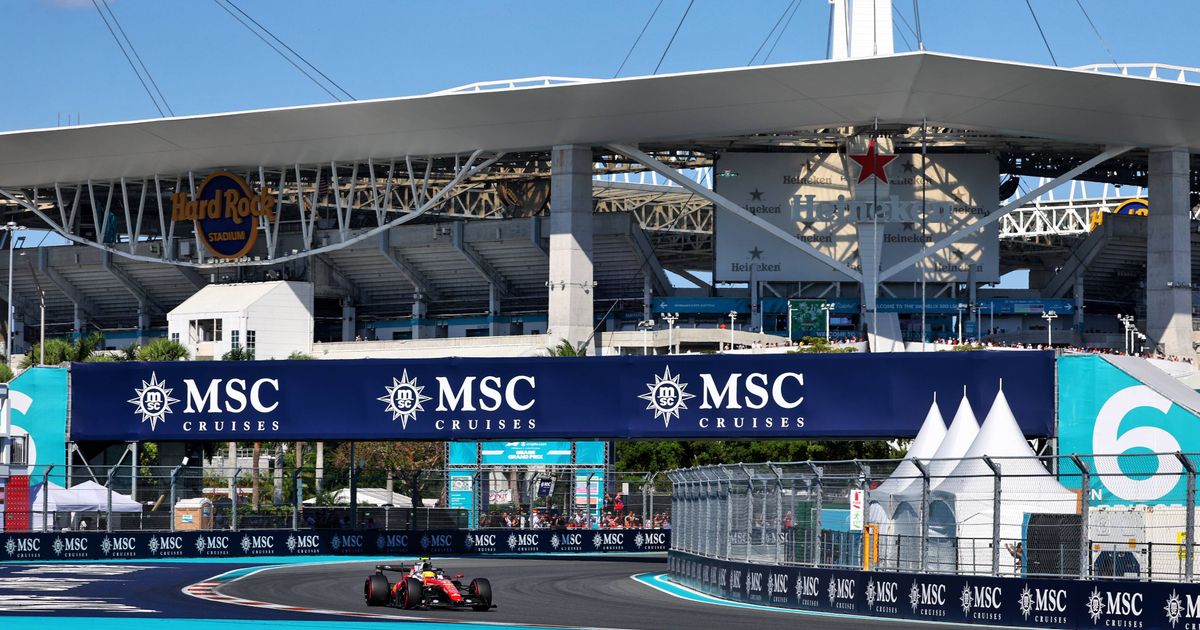
“Following discussions between FIA, FOM and the Miami promoter, the decision has been taken to move the start of Sunday’s Miami Grand Prix to 13:00 local time in Miami due to the weather forecast that is expected to bring heavier rainstorms later in the afternoon close to the original planned race start time.
“This decision has been taken to ensure the least amount of disruption to the race, and to ensure the maximum possible window to complete the Grand Prix in the best conditions and to prioritise the safety of drivers, fans, teams and staff.”
Miami GP to start earlier to avoid weather complications
Local weather forecasts pointed to thunderstorms and heavy rain arriving around afternoon time, raising concerns that the scheduled race start could coincide with the worst of the conditions. Formula 1 therefore decided to bring the start time forward, with the Miami Grand Prix now set to begin three hours earlier at 13:00 local time (18:00 p.m. UK time) in an attempt to avoid the expected weather later in the day. The new start time will also have an impact on the Formula 2 schedule, with the feature race now set to get underway at 09:25 local time.
Florida’s weather safety protocols regarding lightning storms are known for being very strict. Even visible lightning in the distance, thunder or particularly threatening skies can already trigger concerns before heavy rain reaches the circuit itself. Events are often suspended automatically whenever lightning is detected within roughly an 8-mile (13-kilometre) radius of the venue.
Photo: Race Pictures
The protocol was introduced this season as part of Formula 1’s new regulatory package and is designed specifically for weekends in which severe wet-weather conditions could have an impact on safety and car behaviour. Its activation also brings significant implications under parc fermé rules, an area that has historically limited teams from making setup changes between qualifying and the race itself.
Under the revised regulations, teams are now allowed to intervene on certain aspects of the car in order to better cope with wet conditions. One of the key changes concerns ride height adjustments, which can be made to reduce the risk of excessive plank wear. Changes to the front wing angle are also permitted despite parc fermé restrictions remaining in place. The new rules additionally affect the operation of active aerodynamic systems. In rain conditions, only the front aero system can still be partially activated, while the rear wing must remain closed throughout and no boost is allowed.