
Updated May 9, 2026 12:49AM
Choosing a tire for a gravel race is like picking handles for your kitchen cabinets. Both come in a range of sizes, textures, and styles. People can go on ad nauseam about their philosophies regarding both. However, until you have renovated a kitchen or raced in a gravel race, you remain blissfully unaware of how much something seemingly so insignificant can consume your life.
Tire selection and tire pressure in gravel racing, I have come to learn, are a blend of art and exacting science. Terrain, depth of field, weather, rider weight, bike handling skills, confidence, risk threshold, duration of the course, wheel width, frame size — I could go on — all factor into a rider’s decision regarding which tires to run. Before starting this calendar year, I thought I would be at an advantage not having a tire sponsor for the season. Having the luxury to choose whatever tires I wanted pre-race would give me an edge. But, this seeming advantage has also turned into what feels like a curse. I have wasted many hours of my life thinking about tread patterns, tire pressures, and the cheapest and fastest way to get a set of tires to Andorra.
In my first two gravel races this season, I felt like I really didn’t nail my tire selection or tire pressure. Yet, like Goldilocks, I entered The Traka, “Europe’s biggest gravel race” this past weekend thinking I had finally got my tires “just right.”
Taking place in Girona, Spain, The Traka is a weekend gravel bonanza. Organized by the Catalan-based organization Klassmark, it has quickly become one of the most important gravel events in the world. Behind Unbound, it is hard to think of another race that can compete in terms of scale, size, and significance. With four different distances taking place over the Spanish May long weekend — 100 km, 200 km, 360 km (this year actually 320 km), and “adventure” (560 km) — a combination of gravel racers, influencers, ex- and current pro road cyclists and mountain bikers, and an entire host of brands and amateur riders descend on the already cycling-saturated medieval town.
Regarded as one of the most besieged cities in Europe (according to my walking tour guide), there are hints of past turmoils and invasions all over the city. I was based in Girona full-time or part-time from 2016 to 2021, and one of the places I lived in had over 500 people executed during the Spanish Civil War right on my doorstep. Like the hole in its eastern-facing wall left from when Napoleon invaded, it now feels like the world of cycling has also torn into the city and left a lasting mark. It’s almost impossible to walk through the narrow cobbled streets of the town without hearing the hiss of a freehub body or seeing a group of middle-aged “guiris” (a Catalan/Spanish term for Northern Europeans/North Americans) walking around in hideously colored technical socks and t-shirts with graphics of cranks or vintage bicycles. Cycling-oriented cafes are everywhere, and where one bike shop has failed (I invested in one of them—RIP The Service Course), seemingly five have replaced it.
There is a reason for this. In every direction from Girona, there is a vast array of very quiet gravel and paved roads that lead you up incredible climbs, down serpentine paths, and to world-class vistas. Having ridden in the region for over a decade now, I still occasionally find new roads or gravel routes. Year-round, the climate is always rideable, and being just over one hour from the Barcelona airport, along with several discount European airlines offering direct flights into the town’s airport, Girona has become the go-to destination for cyclists all over the globe.
Ten years ago, Girona was where most non-European professional riders called home. This was largely due to Lance Armstrong. In the early 2000s, doping was criminalized in Italy and France, so rather than risk imprisonment, Armstrong and other dopers decided to move from Nice and Como to Girona. Although the sport cleaned up, riders continued to stay for the aforementioned reasons, and word began to spread about how great the place was. In the influencer age, everything accelerated. Those who used social media to promote bike brands and cycling culture quickly realized that Girona could provide the perfect backdrop for their content, and the algorithms ran with it. During this period, the average wages of pro cyclists also increased dramatically. Pros, who once earned tens of thousands to race their bikes, were now earning hundreds of thousands, if not millions. Those who lived in Girona began to realize that if they moved three hours north to Andorra, the income savings would be significant (10% tax rate vs. Spain’s roughly 50%). Thus began a mass exodus of pro cyclists and a mass influx of influencers.
Nothing demonstrated this transition to me more than when I was out and about with gravel racer and YouTuber Dylan Johnson a few months ago at a Rule 28 camp. Girona has been the only place in the world where I have been regularly asked for a selfie. While hanging out with Dylan — a guy who has been very helpful in my tire selection — a group of young cyclists approached us. Preparing myself for the inevitable request for a selfie, I watched as they walked right past me and asked Dylan for a photo. I was ignored.
Over the past decade, between the pros and the influencers, few who have come to Girona (myself included) have really integrated into the town or the culture. Instead, most have often imposed on it their desires for flat whites, avocado toast, and high-end Airbnbs. With a few exceptions, aside from “bon dia” and “si us plau,” little time was spent by these ex-pats learning Catalan. Therefore, with skyrocketing real estate prices and clueless cyclists riding five abreast on a climb or in the wrong direction down a one-way street, locals have become increasingly annoyed with their new invaders.
Enter The Traka
Despite some animosity from a few locals, I love Girona for a host of reasons. The blend of great food and incredible activities makes it a Disneyland for fit adults. Not only is the road, gravel, and mountain biking great, but it is also one of the best places for trail running. Klassmark has capitalized on this. From trail racing to alternative triathlons, the organization’s wide range of endurance events are unique, creative, and showcase what the region has to offer. The Traka is its marquee event, and because of its location, timing in the calendar, and drive to create challenging courses, riders from all walks of life flock to it.
I took part in the 200 this year, and on the start line were former world and Olympic mountain bike champion Nino Schurter, former world road champion Alejandro Valverde, American Gravel Champ Brayden Lange, and a slew of influencers with more followers than I have. Traditionally, the 200 has been the strongest event on the men’s side, but this year it took a back seat to the 360. In my mind, the best gravel racer in the world this year, Mads Würtz Schmidt, along with Romain Bardet, Matthew Beers, and big names like Lachlan Morton, all took part.
I have two regrets from this race: my tire choice and not taking part in the 360.
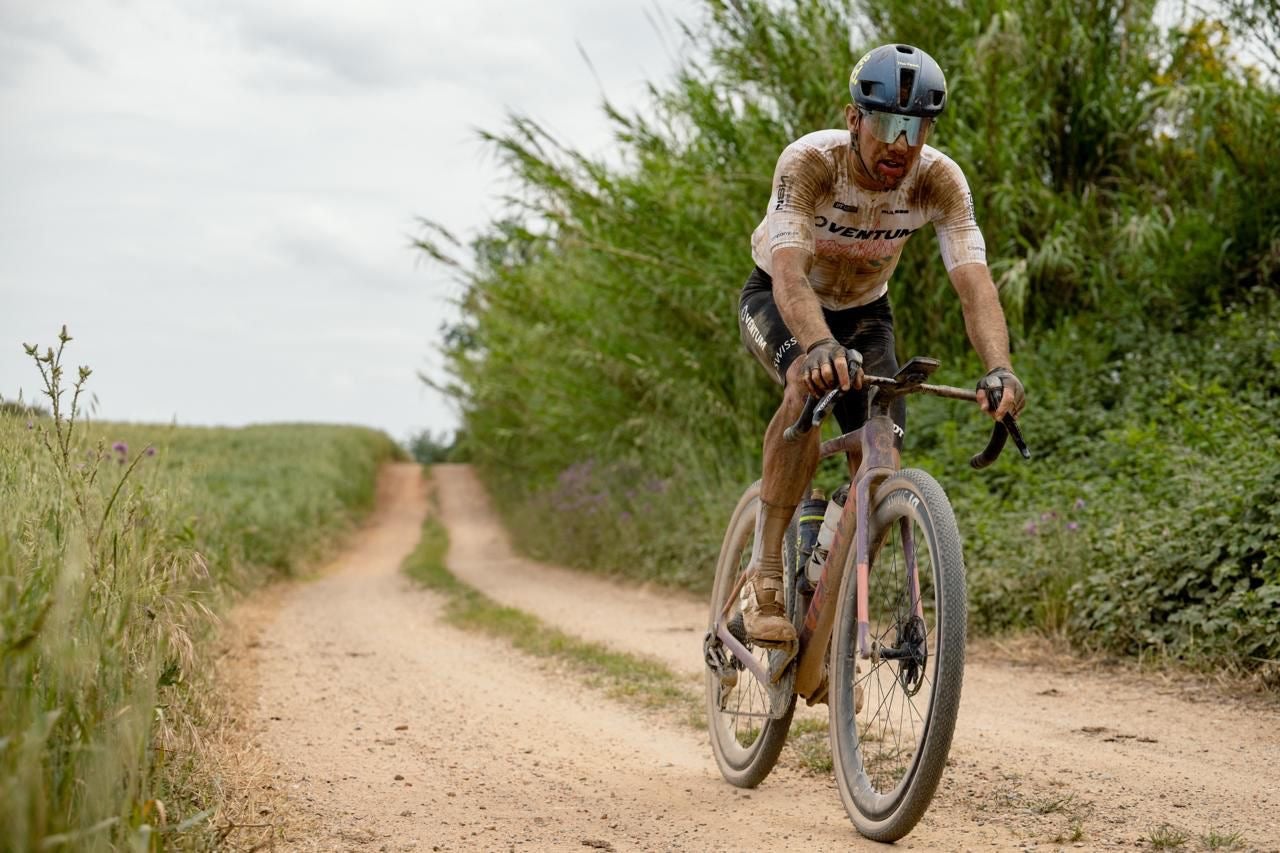
Prior to starting the Traka, I decided that I would fully commit to a fast tire. In my previous two outings, because my Ventum GS1 has a large amount of clearance, I had chosen to go with larger mountain bike-style tires. At Sea Otter, I used, on Dylan’s recommendation, the Schwalbe Thunderburt. However, in that race, I did poorly, and I couldn’t discern whether it was my bike handling skills, my legs, or my tire choice that slowed me down. So this time around, I decided to ignore the experts and go for broke. I slapped Continental Terra Speeds on my DT Swiss wheels, quite possibly the fastest and most aggressive 45mm tires on the market, and in the opening kilometers, I was pretty pleased with my decision.
I am not known as a skilled cyclist. At one point, I was probably the worst descender in the pro peloton. Through courses with a descending coach named Oscar Saiz and trial by fire, I managed to get to a place where I wasn’t a menace. By the end of my career, though, I became very skilled in understanding the flow of the peloton and positioning myself within it. In my last years, thanks to the guidance of riders like Simon Clarke, I learned to feel how the peloton moved. I remember at my final Tour Down Under, before the opening stage, telling the entire team, “This is exactly where and when a big crash is going to happen.” Sure enough, at that point, I positioned myself on the opposite side of the peloton from where I predicted the crash would occur and proceeded to watch as a big pile-up ensued.
Those instincts have not left me, and in the opening 6 km of the race, on paved roads, with my super-fast tires, I entered the first climb of the day in the perfect position. For the next 40 km, I thought to myself, “Where should I attack to win?” I felt amazing through the opening climbs, but then, as we began the first proper descent, all of my confidence went out the window. In previous gravel races, I could hold the wheels of others; however, at Traka, I became a hazard. Riders desperately scrambled to get around me. I couldn’t lean the bike over, and with every corner, I watched as the top riders flew past. By the end of the descent, I was way off the front group and had to claw my way back.
With a bit too much pressure — 1.8 bar (roughly 26 PSI) and minimal tread — I was bouncing and sliding all over the gravel. It was embarrassing. Even on the flats, I would lose ground whenever the road turned, and I had to make big efforts to come back. I was already pretty gassed when we hit the final climb, and on the long descent that followed, I hit a bump, causing both of my bottles and my remaining gels, which were attached to those bottles, to go flying off my bike. With no outside support allowed except in the feed zones, and my support crew only in the previously designated area, I faced the challenge of riding the remaining 80 km without food. With 40 km left, I was still in the group that sprinted for 9th, and there was only relatively flat terrain remaining, but the lights went out, and like every gravel race I have done this season, I limped home with an epic hunger bonk.
This is also why I regret not doing the 360. Despite bonking and getting my ass kicked in the 200, the race itself didn’t truly scare me. I knew that no matter what, I would make it home. Part of my objectives for this year is to put myself more outside of my comfort zone, and this wasn’t a true test. The 360, on the other hand, would have been.
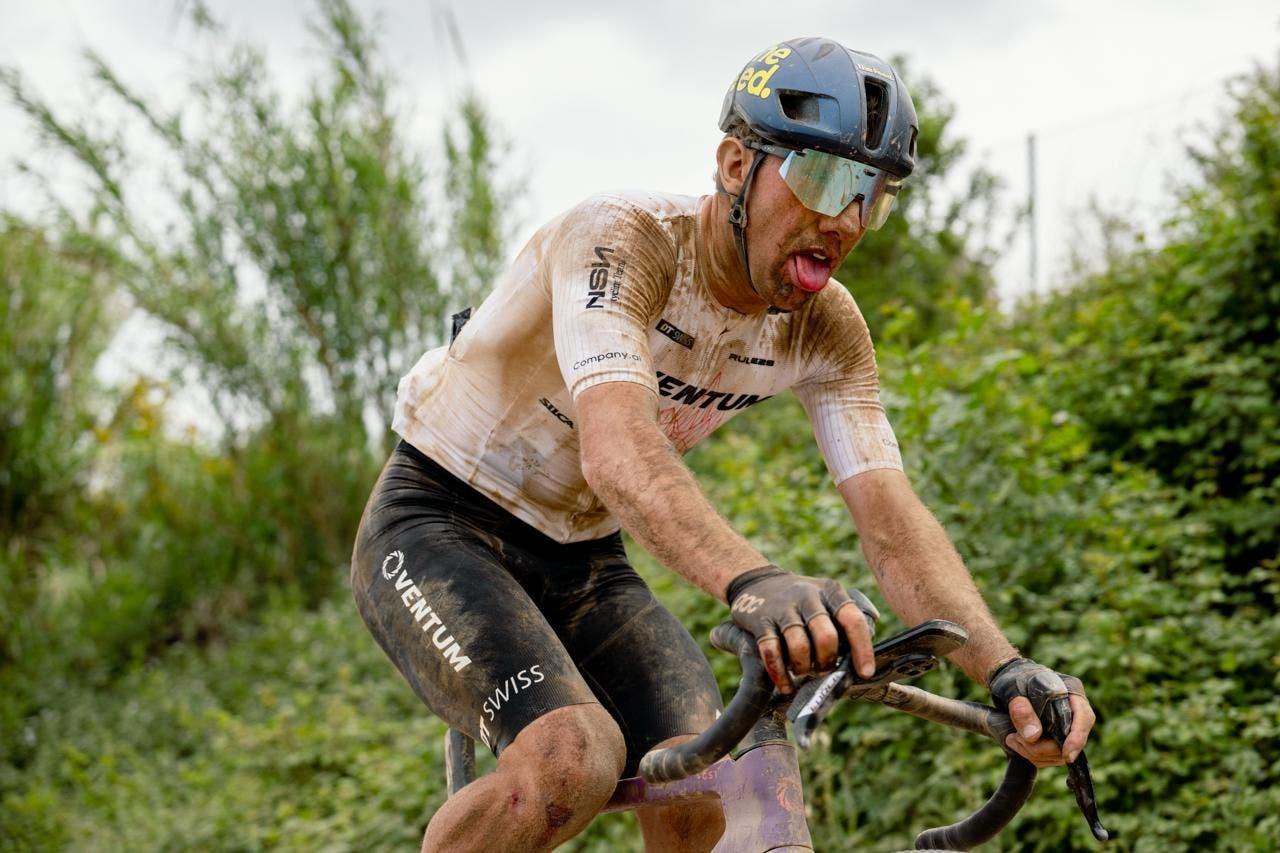
One thing I don’t regret is waiting for the dust to settle post-race to start writing this blog. In the aftermath of the race, some gravel and road pros, as well as influencers, took to their online platforms to note the dangers of Traka. There were also complaints about mismanagement in start times and the lack of enforcement of race regulations.
Since I had written about the need for improved safety on the road, one might think that I would find myself on the side of those riders complaining about the lack of safety in the race. Surprisingly, after finishing this race, I empathize more with Traka. Yes, this event was dangerous. Yes, Klassmark likely needs to adapt to its exploding success, and the sport will probably have to create a set of standards for major races like this one (the UCI Gravel Series is doing this, though). I really enjoyed reading Adam Jordan’s solutions on this subject, but unlike pro road cycling races, The Traka is not a UCI-registered event. It isn’t beholden to the rules and regulations of any governing body. Those who participate don’t need a license and sign up accepting that the responsibility for their safety lies with themselves. The Traka specifically outlines this before the race.
I made the foolish decision to race on fast tires at this event, but at no point did I put myself in a position to experience a cataclysmic event. I did this because I knew what I had signed up for. No team was forcing me to do this race; no contract stated that I could lose pay if I didn’t participate, and my career, like every other participant at this event, was not going to be jeopardized by not racing. I know several gravel racers who choose not to do Santa Vall or The Traka because they believe it to be too dangerous. This, in my mind, is the right course of action. If you feel it is too risky, until it conforms to a governing body’s set of standards, don’t do it. Stick with the UCI Gravel Series, where there are road closures and accountability, or take part in races like Life Time Grand Prix’s Sea Otter.
If you expect the level of control, safety, and organization of a Swiss-based federation or a North American-style event on a long weekend in Spain, you just don’t understand the country. I don’t recall there being an expression “works like a Spanish watch.” A month ago, I made a lunch reservation, and my Spanish friend literally showed up two hours late.
Most of the time when I race a major event in Spain I think; “It is a minor miracle that an event of this magnitude got off the ground.” I have participated in editions of the Itzulia (Tour of the Basque Country), a proper WorldTour race, where the course itself isn’t announced until a few weeks before the start. Think about that — a race where 18 WorldTour teams are showing up, picking rosters, bringing buses, taking flights, booking hotels, etc., and the course isn’t yet known.
Late start times and logistical mishaps are par for the course at any Spanish event. The only reason anything gets done in Spain is that everyone is comfortable with a bit of chaos. As a person who is not known for his punctuality or organizational skills, it is one thing I have come to love about living in the area. People are just more relaxed, and I believe it is one of the reasons why it is one of the safest places in the world to ride a bike. Drivers sometimes don’t even bother passing you; they just wait and then wave when you realize that they are behind you.
This organized chaos is one thing that makes The Traka unique, so why should we outsiders come in and expect the event to be like it is back home? To me, social media and the internet have made the world feel a bit more ubiquitous and a bit less interesting — the abundance of avocado toast is an example of this. So when I am surprised by something, or see something that is special, and genuine to its roots, I want to preserve it and celebrate it. We already got our flat whites; so maybe we should just let Girona have The Traka.