

Cyclists Hub is supported by its readers. We may receive a commission if you buy products using our links.
All content on Cyclists Hub is written by humans, not robots. Learn More
The global road cycling landscape is currently undergoing a paradigm shift as Chinese brands transition from being anonymous original equipment manufacturers (OEMs) to established performance brands.
Pardus unveiled the Spark Evo Gen 4 in China a few days ago. It caught my attention because it seems to take the best from some of the Western and Chinese aero frames. Below, I’ve summarized what we know about it based on the launch event.
NOTE: I had to translate information from Chinese sources, so some information might not be 100% factually correct.


The Pardus and Taishan Group Relationship
To understand the engineering behind the Spark Evo Gen 4, let me provide some context. Pardus operates as a subsidiary of the Taishan Group, a massive industrial conglomerate that has served as a primary equipment supplier for multiple Olympic Games.
This institutional backing gives Pardus access to research and development resources that are often unavailable to smaller Western boutique brands. The Spark Evo series is the brand’s flagship aerodynamic offering. The Gen 4 benefits from a vertically integrated production process where every stage, from the initial carbon fiber layup to the final paint application, is managed in-house.
Pardus also sponsors several UCI Continental teams, including China Glory, St. George Continental Cycling, and TUFO-PARDUS Prostějov (fun fact: the last team operates not far from where I live). The Spark Evo Gen 4 was developed with direct feedback from professional riders.
Frame Construction and Materials
The Spark Evo Gen 4 utilizes HMS-EPS+. This refers to high-modulus carbon with increased strength coupled with an Expanded Polystyrene (EPS) molding process. Unlike traditional molding methods that use inflatable bladders, which can result in internal wrinkles or resin pooling, the EPS method ensures higher compression of the carbon layers and a smoother internal surface. This results in a structurally consistent frame, though not necessarily the lightest in its class.
The frame uses about 86% T800, with the rest M40 high-modulus carbon fiber. This choice provides high tensile strength to withstand pedaling forces. In contrast, the Pardus Super Evo, the brand’s lightweight endurance model, utilizes a higher percentage (80%) of T1100 carbon to achieve a lower frame weight of approximately 680g. The Spark Evo Gen 4 frame weighs approximately 950g in size Medium, reflecting a focus on aerodynamic tubing depth and lateral stiffness over absolute weight savings.
| Feature | Specification |
| Construction | HMS-EPS+ Carbon Fiber |
| Material Blend | 86% T800 & M40 High Modulus |
| Frame Weight | ~950g (Size M, Painted) |
| Fork Weight | ~370g – 400g |
| Bottom Bracket | T47 Threaded |
| Brake Mount | Flat Mount Disc |
| Axle Standard | 12x100mm Front / 12x142mm Rear |
| UDH Compatible | No (Uses H581P/DODH036) |
Pardus emphasizes improved pedaling stiffness. It claims a 25% increase in rigidity compared to the previous generation. This improvement was achieved through a revised carbon layup in the bottom bracket area and an oversized junction between the chainstays and the seat tube.
Aerodynamic Design and Wind Tunnel Optimization
The primary design objective of the Spark Evo Gen 4 was the reduction of aerodynamic drag (CdA). Pardus collaborated with the Chinese national team to conduct wind-tunnel testing. The resulting design features longer, water-droplet-shaped cross-sectional profiles. This design is reminiscent of the Ridley Noah Fast or Cervélo S5.

A critical focus was the integration of the fork and frame. In previous generations, the gap between the fork crown and downtube created turbulence. The Gen 4 features a more integrated fork-to-frame joint that mitigates turbulence generated by the spinning front wheel and fork legs.
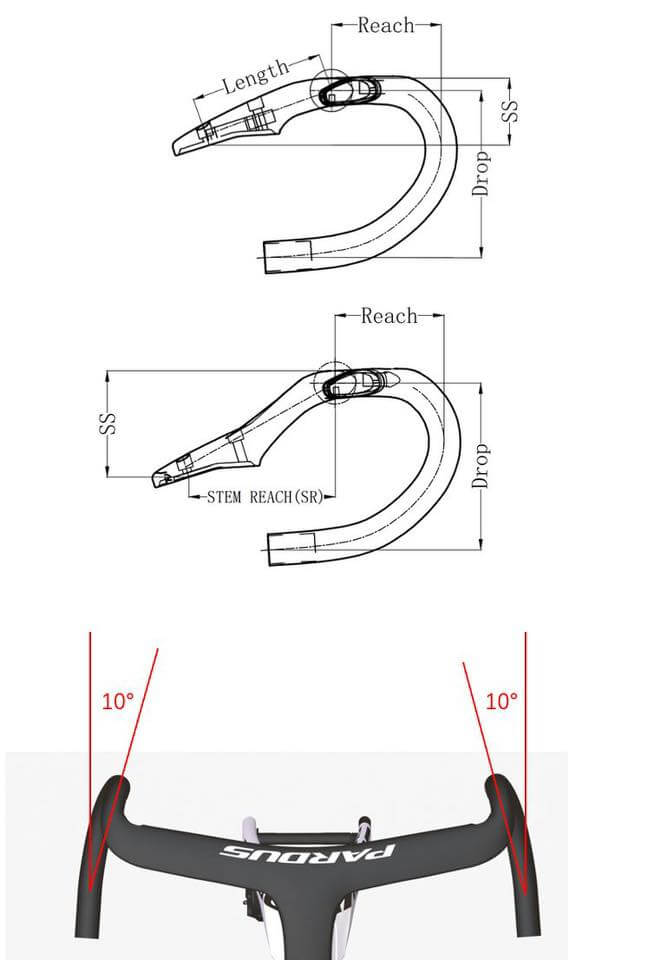
The integrated MVMT M-Silver A-Type handlebar system completes the package. This cockpit features fully hidden internal routing and a flat aerodynamic top section. While aesthetically clean, internal routing through the headset can make long-term maintenance, such as bearing replacements, more difficult.
Geometry: The “Long and Low” Philosophy
The Gen 4 geometry has been optimized for more direct power transfer and stability during high-speed cornering. The chainstay length has been shortened to 405mm across all sizes, down from 410mm in previous versions. Despite the aggressive rear end, stability is maintained by increasing the front wheelbase to keep the total wheelbase under 1000mm.
Pardus has standardized the trail at 57mm across the entire size range. This ensures consistent handling characteristics regardless of frame size. The Stack-to-Reach (STR) ratio remains below 1.4 for racing sizes, keeping riders in a low, aerodynamic posture.
| Measurement | XXS | XS | S | M | L | XL | XXL |
|---|---|---|---|---|---|---|---|
| Stand over height (mm) | 721 | 739 | 751 | 767 | 782 | 798 | 815 |
| Reach to stem (mm) | 360 | 370 | 378 | 385 | 395 | 405 | 415 |
| Stack to stem (mm) | 488 | 505 | 518 | 534 | 548 | 562 | 577 |
| Frame reach (mm) | 366 | 376 | 384 | 391 | 401 | 411 | 421 |
| Frame stack (mm) | 470 | 487 | 500 | 516 | 530 | 544 | 559 |
| Stack/Reach Ratio | 1.36 | 1.36 | 1.37 | 1.39 | 1.39 | 1.39 | 1.39 |
| Frame Stack/Reach Ratio | 1.28 | 1.3 | 1.3 | 1.32 | 1.32 | 1.32 | 1.33 |
Source: Pardus
The integrated cockpit offers 380mm width, a 50/80mm rise/drop, and stem lengths ranging from 100mm to 160mm in 10mm increments.
Pricing and Value Proposition
The Pardus Spark Evo Gen 4 retails for roughly half the price of comparable models from brands like Specialized or Trek. In the Chinese market, a full build equipped with Shimano Dura-Ace is priced at ¥59,999 (~$8680), while the Ultegra version is priced at ¥39,999 (~$5790). For those looking for the frameset only, the standard paint option costs ¥19,999 (~$2,900).
Complete builds weigh between 7.5kg and 8.0kg. This makes the Spark Evo heavier than some Western superbikes, such as the Specialized Tarmac SL8. However, the Tarmac SL8 also carries an eye-watering price tag of approximately $14,000 for the S-Works version.
In terms of Chinese alternatives, I should mention Winspace complete bikes. Their pricing is even more competitive. Hopefully, I’ll get a chance to test the Evo Gen 4 against the Winspace T1600.


Summary
The Pardus Spark Evo Gen 4 should be a stiff, purely aerodynamic bike that meets the demands of professional racing while remaining relatively affordable. It adopts the T47 BB standard, but it’s not UDH compatible. Still, I believe it will be an interesting prospect, especially once Western pricing is revealed. I’ve contacted a Czech distributor, so I hope to get my hands on it. Until then, stay tuned.