
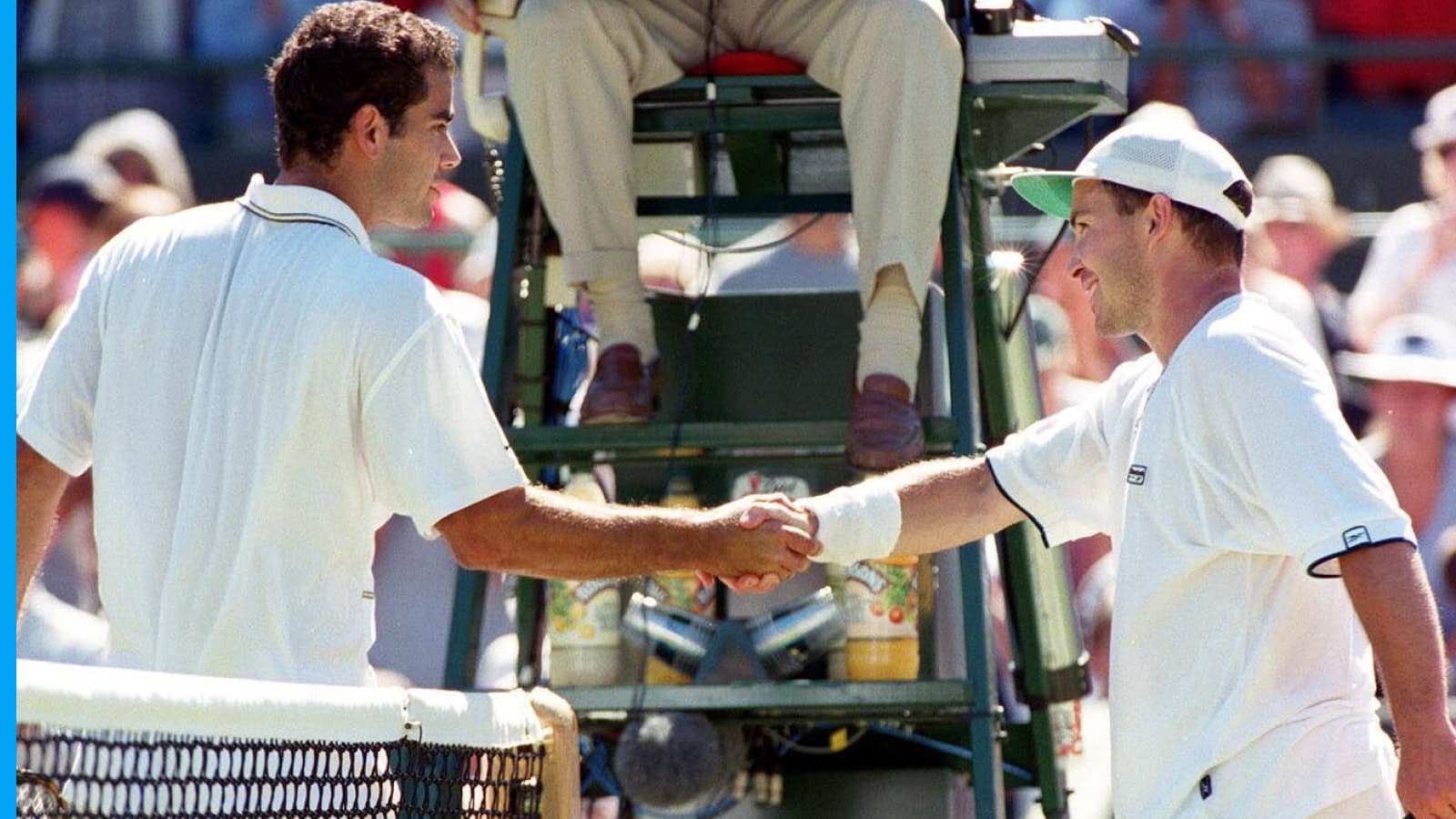
He lived the dream by playing at Wimbledon and representing his country in the Davis Cup, but Danny Sapsford admits he would still class his career among the ranks of the ‘journeyman’ professionals.
Sapsford reached the third round at Wimbledon in 1999 and took on the great Pete Sampras in what proved to be his final match as a professional.
He reached a career high of No 170 in singles and No 83 in doubles and while those numbers may seem modest, he still achieved more than 99 per-cent of the tennis world who try and fail to make it onto the famous grass courts at Wimbledon.
A third round appearance in a Grand Slam is also a fine achievement and in an exclusive interview with Tennis365, Sapsford suggests he may have reached the peak of his potential in an era when big serving giants dominated.
“Well, I certainly feel like I was a real journeyman,” he adds. “ I was by no means a top top player, but obviously I sustained a career for 13 years and I was financially independent.
More Tennis News
Carlos Alcaraz told one of his biggest qualities may have a negative impact on his game
Carlos Alcaraz and Jannik Sinner told they are ‘not in the same bracket’ as Federer, Nadal and Djokovic
“So I was, I was good enough to keep myself going. I’ve seen so many, what I feel better players fall, by the wayside, through lack of funding, for whatever reason, or lack of money, and they haven’t had the results or the luck they needed.
“I had some good wins in the Davis Cup and at Wimbledon and I enjoyed my career. I had some real highs and there were some lows in there, but maybe I’ve blocked them out.
“John McEnroe said ‘the older I get, the better I used to be’ and maybe I follow that as well.
“You certainly have ups and downs in a tennis career. I quit a few times. But then, but when you get to that side, you feel that you’ve got kind of unfinished business.
“I got married quite young. I got married when I was 25 and that gave me just a little bit more responsibility, I think.
“So I went back on the court and the best years of my career were from 25 to 30, where I guess I was just that little bit more sensible. Maybe I was a little bit more professional and took things a bit more seriously and didn’t throw the towel in so quickly. So yeah, certainly having a bit of responsibility helped.
“Back in my day, it was very amateurish by comparison. There were no nutritionists and psychologists and physios and what have you that travel with you. You were just by yourself reading books.
“Mentally, I always felt I was quite sound and that was probably one of my strongest points. So I was able to cope with the losses and the tough days on the road, and I felt like my fuse was always a lot longer than everyone else’s.
“That mental strength was important to me. I was just kind of plodding along, and that’s how I used to get my wins. So if anyone was having a bad day, I could capitalise on it.”
Danny Sapsford speaks to Tennis365
Sapsford’s name still crops up from time to time in Wimbledon commentary, as the relative lack of success for British players means his achievement of reaching the third round at the All England Club in 1999 is still referenced.
“I know I was sitting watching Wimbledon, and this was going back probably two or three years now, and it was, I think it was one of the years where there were three British men all made the third round.
“So the commentator asked John McEnroe if he could name all the players and he said, that must have been Greg Rusedski and Tim Hemman, but he didn’t know who the third one was. And the commentator said… it was Danny Sapsford.
“Clearly, there was no recollection from John, but he said, oh my God, Danny Sampson, I wonder what he’s doing now?
“I was watching on the TV and I was just about to go and deliver a blind tennis session at school in Wimbledon. Wow. So I was thinking, come and talk to me about this because we do so much good work in our charity and we want to get the word out to as many people as possible.
“It would be so nice to raise awareness of what we do and they can get in touch to expand our disability programme and maybe find a partner who wants to work with us.”
Sapsford is now proudly leading the Bright Ideas for Tennis charity, which raises money for good causes in the sport and has a focus on disability tennis.
“Over the last 14, 15 years, I’ve visited, I’ve delivered 600 open days at clubs around the UK, raised well over £2m for those venues at those open days,” he added.
“We’ve coached 100s of thousands of players, and hopefully we’ve reinvigorated the adults and inspired the kids, and at the same time, raise money that then provides free tennis sessions for those communities. So that kind of strand of our charity works really, really well.
“Then, the last five or six years, we’ve very much put a lot more focus on the disability aspect.
“We currently provide free weekly coaching at 200 venues across the UK, and our goal is to get to 500 within five years.
“So we’re actively looking for new venues, new coaches that want to take part. We support them, sport all venues, all coaches.
“We also have our big fundraiser every year where pros come and join us on a 24-hour tennis marathon and we raise money for disability tennis.”
More information about the Bright Ideas for Tennis charity can be found HERE
READ NEXT: T365 Recall: When Jeremy Bates ended Britain’s ’17 years of famine’