

Updated May 11, 2026 01:50PM
The Giro d’Italia is not racing Monday, but no one in the peloton is resting.
After three opening routine but ultimately costly stages in Bulgaria, the 2026 Giro hits its first of three rest days, but it comes after a massive transfer back to Italy that leaves most riders a bit peeved off.
“I would rather have avoided the travel,” Jonas Vingegaard told Feltet.dk. “I have brought my mask and hand sanitizer.”
The Giro’s three-stage grande partenza — or the “big start” — in Bulgaria is already wrapped in controversy, with a nasty, high-speed crash Saturday drawing criticism from teams and riders about unsafe racing conditions.
Several top riders were forced to abandon, including three top names from UAE Emirates-XRG, with pre-race podium favorite Adam Yates out of the race even before it hits Italian roads.
And if that’s not enough, the entire Giro entourage packed up Sunday and trundled off to Italy.
At least the riders flew from Sofia to southern Italy on Sunday evening.
Team staffers and equipment faced a far more draining trek.
Bikes and race infrastructure were packed into trucks and buses, and crossed borders and traveled more than 1,500km by road and ferry.
The transfer stretched to nearly 24 hours before everything is rebuilt ahead of Tuesday’s restart.
Or at least that’s the plan.
Big money behind the ‘Big Start’
Why do organizers push grand tours so far beyond “home roads?”
There is hype of expanding the global reach of the sport and growing cycling’s audience, but everyone knows the real reason: money.
The Giro reportedly received around 10 million euros to kick things off in Bulgaria, the latest in a string of foreign starts that are reshaping grand tour racing and pushing the boundaries of how far a race can go.
Recent editions rolled out from Budapest in 2022 and Albania in 2025, and there’s talk of bringing the Giro to such far-flung sites as the United Arab Emirates or even North America.
Foreign starts are a bonanza for grand tour operators, and everyone’s jumped on the bandwagon.
The Tour de France kicks off in Barcelona this July, and the Vuelta a España will launch from Monaco, and both races have copied the Giro’s push into new lucrative markets.
These “big starts” might be headaches for teams and riders, but they deliver big profits for race organizers.
Hosting fees can reach into the tens of millions, with the ASO deal for the 2027 Tour start in the UK reportedly topping 20 million euros.
Over the past 30 years, foreign starts have become a key part of the funding puzzle for grand tours, something that’s accelerated in the past decade in both scope and distance.
Transfers, of course, are part of any grand tour, and there are often internal flights and long bus trips within the borders of France, Spain, or Italy as well.
After stage 20 in the northern mountains, the Giro will transfer again to Rome for the final sprint stage.
To accommodate the longer distances, the UCI allows a third rest day for these foreign adventures.
And race organizers usually book-end the foreign transfers with relatively short and uncomplicated stages.
But teams and riders are not happy to see race organizers stuff their pockets while they pay the logistical and physical price without sharing a piece of the larger financial pie.
A logistical puzzle
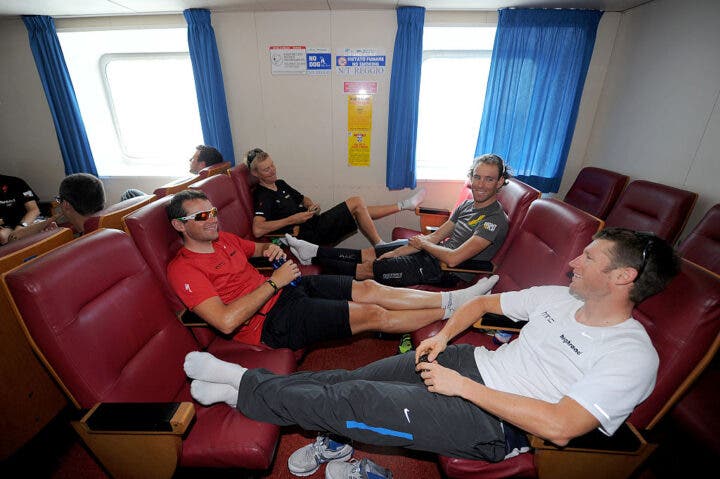
Behind the scenes, these long-distance “rest days” are closer to a test of nerves and stamina for team staffers than anything relaxing.
Riders and key staff like sport directors fly, but mechanics and drivers are charged with the gargantuan task of moving the 2,000-vehicle-strong caravan from Bulgaria to Italy.
Most teams have their service course spread across Benelux or in France and Spain, so just getting to Bulgaria was already a long drive. Several teams didn’t come with their full fleets, and opted to send some vehicles directly to Italy.
One team official confirmed to Velo that many teams piggybacked this year’s “big start” in Bulgaria with the nearby Tour de Hongrie, starting on Wednesday.
Teams racing both at Hungary and the Giro sent one crew to Bulgaria, which is now traveling to Hungary, and had another crew waiting in Italy for the arrival of the Giro entourage.
The rest embarked on an overnight odyssey that included buses and ferries.
Crews packed up after Sunday’s stage, drove south through Bulgaria into Greece, boarded a ferry to Italy, and then continued by road to Catanzaro deep in Italy’s “boot.”
And what do fans get out of it? Locals get a chance to see a grand tour up close, but the racing in these foreign starts is generally pretty low-key because organizers don’t want to put too much pressure on the peloton too early.
Racing resumes in Italy on Tuesday with the 138km stage 4 from Catanzaro to Cosenza that’s expected to end in a bunch sprint, but the peloton will arrive a bit cranky from the Bulgarian triptych.
“The first night I slept well was last night,” Vingegaard said of his Bulgarian start. “There was also a lot of noise at the first hotel, but that is part of it. It is not like I have slept badly, but I have not slept super well either.”
No wonder no one in the peloton calls it a rest day.