
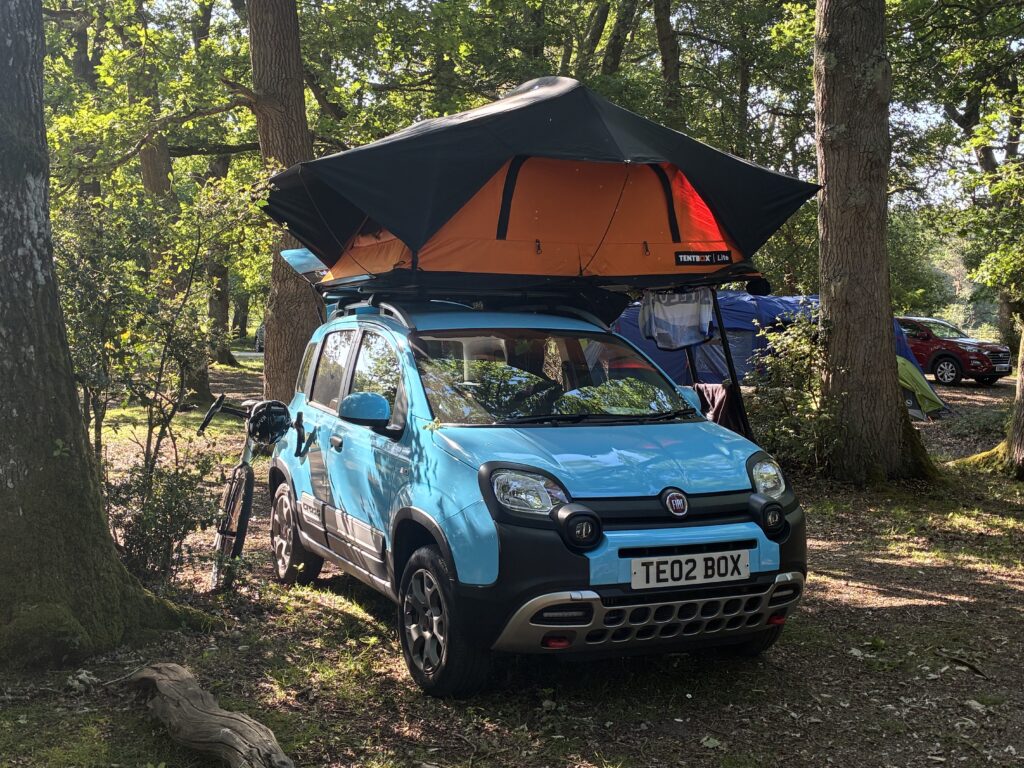
If you’ve an appetite for off-road exploration, but prefer to ride with your bike largely unencumbered, the Tentbox Lite car roof tent might prove an appealing option. Quick and easy to set up and take down again, it provides a low hassle overnight base from which to explore more remote areas by bike.
Car roof-mounted tents are now ‘a thing’, it seems, and a relatively recent thing at that – in terms of popularity anyway.
As both off-road cycling and wild camping have taken off, it seems like a match made in heaven, so Hampshire-based company TentBox provided us with the Lite 2.0 to put to the test.
To camp or not to camp?
Hardcore bikepackers may turn their noses up at such a ‘camping for softies’ concept as the TentBox, feeling the whole idea of gravel exploring is to get away from it all in the wilderness. Fair comment.
On the other hand, I spent two days exploring the virtually empty trails of the New Forest unburdened by luggage. I had a warm shower at the end of my sweat-drenched rides, and a proper cooked meal (shout out here for the KitchenBox we were also loaned – a fabulous piece of kit with a price tag to match), both evenings with a glass of wine as the sun went down.
Much as we avoid driving the car unless absolutely necessary, this feels different. Pull up wherever the fancy takes you, explore to your heart’s content by bike, then know that a good night’s sleep awaits – no silly inflatable mattresses, no freezing ground seeping into your bones, and no wrangling guy ropes and tent pegs for hours.
Camping… why bother?
Full disclosure: I’m no fan of camping. Years of holidays under canvas when our kids were little left an indelible mark that has proven stubbornly resistant in the decades since they flew the nest.
Once they’d gone and the financial burden of raising three children was lifted – our own fault, obviously – it was boutique hotels, Egyptian cotton and Neal’s Yard bath products all the way. No more cold and damp mornings, gradually deflating airbeds and tepid showers for us.
The final camping straw came one weekend many moons ago as I prepared to hammer home the last peg securing our monstrous, multi-roomed home-from-home into rock-hard earth as sundown approached somewhere on the Kent coast. We were around two hours into the task at this point, looking forward to opening the wine.
A vintage Mini pulled up at the pitch opposite. Two young Dutch fellas sprang out – matching tans, sun-bleached hair and perfect teeth. One whipped out a ladder from the boot, while the other undid a clip on a big box attached to the roof rack of their tiny car and – lo and behold! – a tent sprang up. They clambered inside, settled down, and were snug in their sleeping bags before we could even wield the corkscrew.
The following morning, I watched open mouthed as they reversed the process and were on their way in less than ten minutes. I vowed never again to subject the family to this ridiculous notion that any part of the experience of wrangling guy ropes, bendy poles and groundsheets was enjoyable. Perhaps we weren’t the outdoor types after all.
Back to the future
I had seen the future. It was just unclear when that future would become the present. Turns out it is now.
Brothers Ollie and Neill Shurville experienced a similar eureka moment whilst travelling around France after spotting the occasional vehicle roof-mounted tent at campsites. Why had nobody done this before?
> Cycle touring isn’t dead: here’s why you should be embracing adventure on two wheels
Well, they had, as early as the 1950s. The issue back then was finding roof bars or racks capable of securely hosting a weighty piece of kit above the passengers’ heads, so it was back to the drawing board. But nowadays, roof boxes, bicycles and pretty much anything, including the kitchen sink, can all travel safely and securely up top.
Launching the first model in 2014, TentBox has now shifted over 100,000 units worldwide and expanded to half a dozen options, from the lightweight and compact GO (£999) through to a chunky Land Rover edition of the rugged Cargo 2.0 (£2,699).
And cyclists are clearly in the target market in these increasingly off-road exploration times. I first spotted TentBox at The Bike Show in Alexandra Palace in 2023 and had been keen to try one ever since. It was time to hit the New Forest, with the Van Rysel GRVL AF for company.
Small is beautiful
We were loaned the Lite 2.0 to test, described by TentBox as being great for small cars. Indeed, to prove the point, it was mounted on the firm’s own Fiat Panda. It’s worth remembering, as we cyclists come with a lot of baggage (physically, rather than emotionally – though possibly both) that the space where you’d most likely usually position your bikes is taken. A boot rack is therefore going to be required. Not a problem – just something to bear in mind for owners of compact cars.
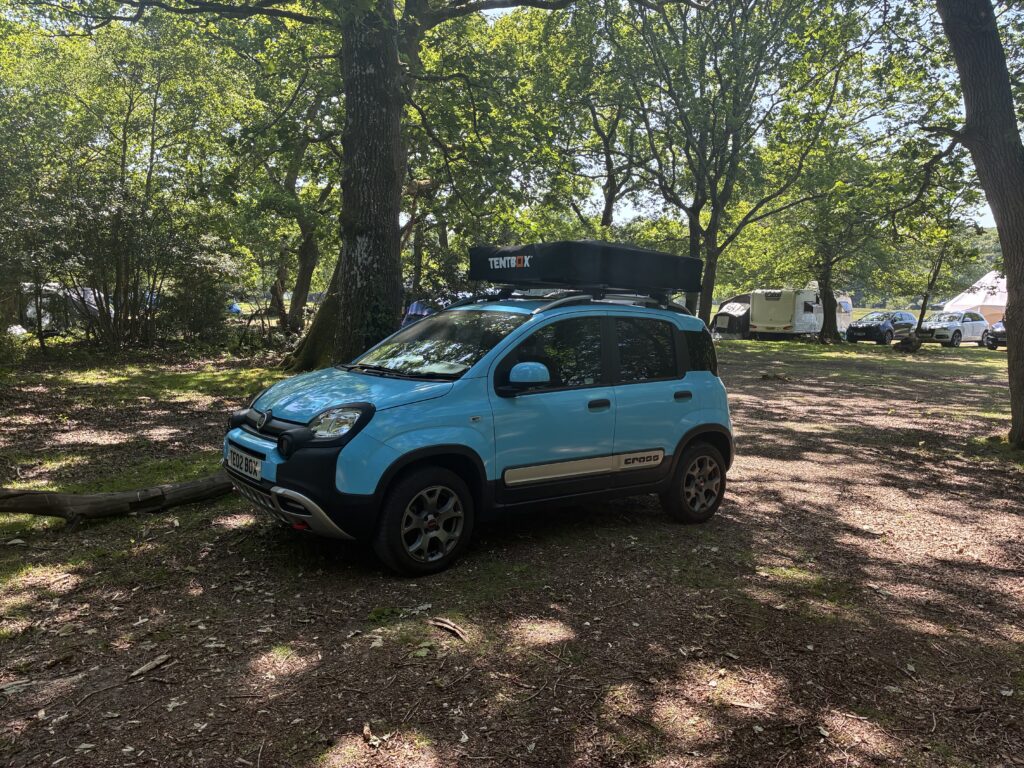
The Lite tips the scales at 50kg. For comparison, their hardshell Cargo comes in at 72kg. So it’s a fairly hefty piece of kit that will require two people to mount on specific oval-shaped roof bars. TentBox recommends Summit bars which they can supply from £149. It will take around 30 minutes to fit, according to the manufacturer. Should you not have a garage and park on the street, it will need to be removed and stored in your property. Thieves love them, sadly. But you wouldn’t leave your bike out there, would you? The same principle applies.
Mike from TentBox ran me through the features and the unpacking process, mentioning his record time for setting-up was a tad over four minutes. I took just over 10, but there was a lot to remember first time round. Given a couple more goes, the claimed five minutes looks eminently achievable.
The build quality is clear right from the off, as the heavy-duty zip holding the travel cover glides away, the bendy porch poles holding the removable rainfly cover slot perfectly into position, and numerous Velcro straps and clips keep everything neatly in place. The attached foldable ladder is actually used as a lever to open the whole shebang, which makes it a simple process to set up single-handedly. It’s a very pleasing operation all round.
Room with a view
As the 2.0 nomenclature suggests, the new Lite has had an overhaul based on feedback from owners of the first generation. Upgrades include a quilted memory foam mattress, larger air vents and a finer fly mesh to keep those pesky little biting critters at bay. The last of those clearly worked, as I was nibbled far less than had I been sitting out in my south London garden. No complaints on the mattress front either. It may not be Simba standards of comfort, but a good night’s kip was enjoyed on both nights under the stars.
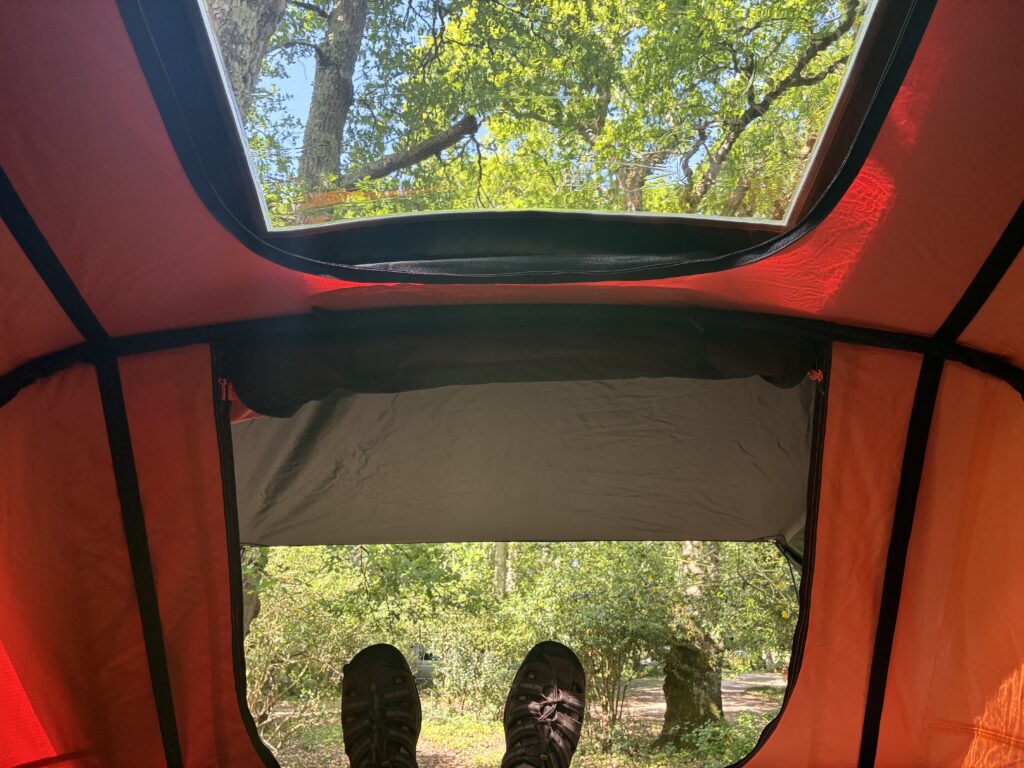
Talking of which, the views from the multiple windows and skylights really added to the experience of being close to nature – the New Forest tree canopy above, constellations visible though the gaps in the foliage, wagtails skittering away outside, plus a band of ponies ambling past at dusk.
As it happened, it was also the hottest May Bank Holiday on record in the UK. However, at no point was the dreaded hot plastic smell of my camping past detected, and I even woke in the middle of the second night feeling chilly as all the air vents were fully open.
The only way is up, baby
Two sweltering gravel rides in the New Forest and two nights on top of the car later, I considered the downsides to the whole concept. A news item on the high occurrence of falls from loft ladders I’d read a few years back came flooding back every time I descended. Forwards? Backwards? Sideways? I never quite got to grips with that one.
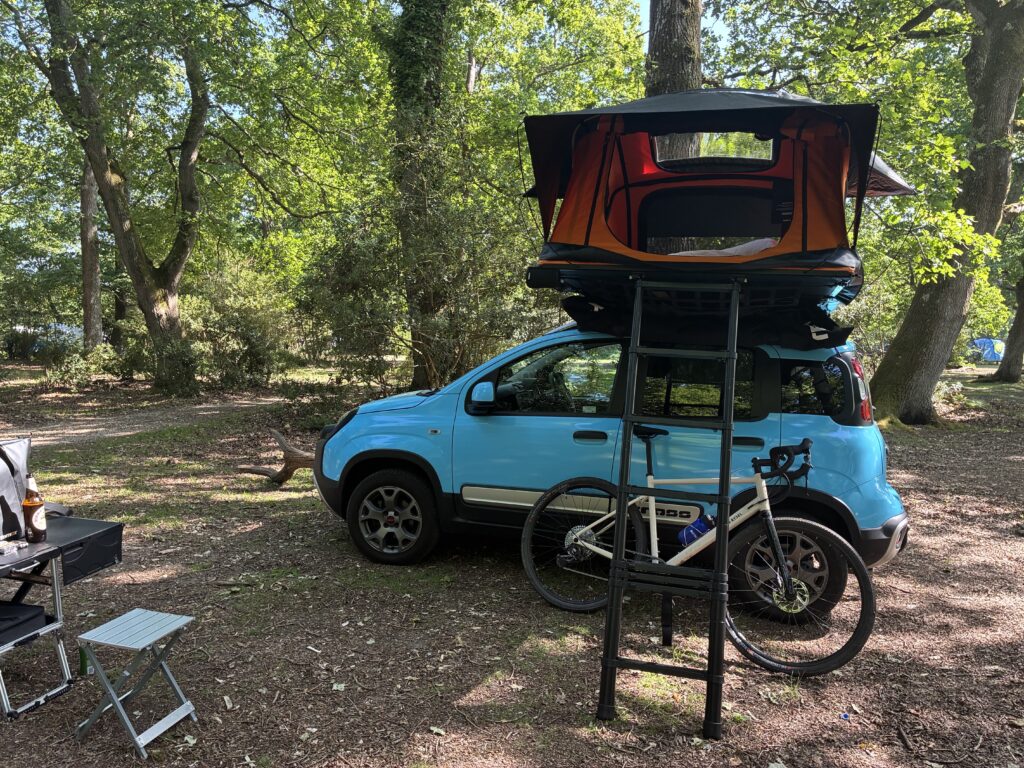
Plus, for a man of a certain age, peeing in the middle of the night is practically a given. Your options are either clamber down and make your way to a suitable spot or – without wishing to be too graphic on the subject – take a receptacle up there with you…
Minor quibbles though – and age-related, frankly. The Lite is very well-designed, beats camping on cold and uneven ground, and there’s no danger of being trampled to death by stampeding livestock – Mrs C’s recurring nightmare.
Value
Inevitably, the Instagram algorithms are now bombarding me with alternative options for roof-mounted camping. Driving home on the M3, I spotted a James Baroud – not a brand I was familiar with until researching this review. Launching its first automatic-opening rooftop tent in 2005, the Portuguese company’s products seem to go down well with 4×4 owners and big motor drivers. Starting at £1,950 and going all the way up to an eyewatering £4,200, a JB is a serious investment but appears to be built to last.
Thule, of course, we cyclists are familiar with thanks to their quality bike racks, and the Swedes have a fine range of both hardshell and softshell models worth looking at. They also do a cool range of compatible awnings and extensions to broaden the scope of the roof top unit.
British company Latitude’s products are the closest match to TentBox I found, both in terms of price and design. At £1,295, the Latitude Scout features a 20cm longer mattress than its rival for those of us on the tall side. The Lite nicks it aesthetically, for my money, but looks are totally subjective.
Conclusion
Overall, both pricewise and quality-wise, the TentBox Lite is a great piece of kit. If bikepacking feels a step too far, it is a great alternative. Whether you prefer being on solid ground or up in the air is a personal choice, but aside from the points detailed above, the ability to park up and be snug as a bug in less than 10 minutes is a winning combination and an experience I’d gladly repeat. A Grand Tour awaits.
> How to choose the best bike for your next big bikepacking adventure
What does the manufacturer say about this product?:
Refreshed for 2026, the Lite now features improved comfort, better ventilation and some smart new design touches. It opens manually in around 5 minutes using a simple fold-out design. Inside, a comfy quilted mattress (that stays inside when packed down) creates a cosy sleeping space that’s always ready to go. Double skylights and large windows keep things bright and airy, while internal pockets, external storage netting, and a roll-away pole bag help keep everything nice and organised.
Lightweight, practical and road-trip friendly – the Lite is a great choice if you want everyday versatility and minimal bulk.
Tell us some more about the technical aspects of this product:
Fast-opening, fast packing away, spacious and airy with great views too. Sleep where you want, when you want.
Rate the product overall for quality (1-10):
8/10
Rate the product for performance when used for its designed purpose (1-10):
8/10
Rate the product for value (1-10):
9/10
How does the price compare to that of similar products in the market, including ones recently tested?:
Stacks up well against the opposition, with Latitude’s products being the closest in terms of price and quality.
Did you enjoy using the product? Yes
Would you consider buying the product? Yes
Would you recommend the product to a friend? Yes
Use this box to explain your overall score
Nothing to fault.
Age: Height: cmWeight: kg
I usually ride: My best bike is:
I’ve been riding for: I ride: I would class myself as:
I regularly do the following types of riding: