
- Steven Jackson claims the starting running back nod: Jackson beat out Todd Gurley II by carrying the ball 700 more times during his Rams career with identical efficiency and a superior 1.21 yards per route run average.
- Bobby Wagner secures a roster spot despite brief tenure: The veteran linebacker forced his way onto the team on the strength of a premier, class-leading 90.0-plus PFF grade over just one dominant season in Los Angeles.
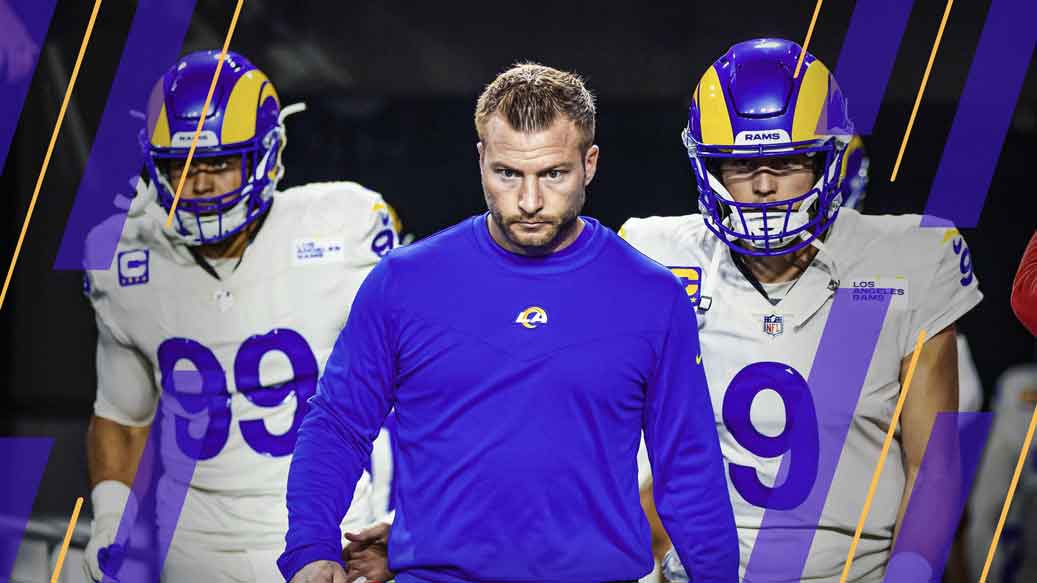
- Sean McVay-era stars completely dominate the offensive unit: Reflecting a dramatic structural shift in franchise scoring efficiency, 11 of the 12 offensive selections stem from rosters coached by McVay since 2017.
As part of PFF’s celebration of 20 years of NFL data, we’re building an All-Star team for every franchise, highlighting the best players at each position from the PFF era. This installment turns to the Los Angeles Rams.
PFF’s database dates back to the 2006 NFL season, providing a unique lens for evaluating and comparing players across eras. More details on the methodology used to construct these teams are available at the bottom of the page.
Offense
PFF arrived after most of “The Greatest Show on Turf” era had ended. Following a top-10 finish in points scored in 2006, the Rams failed to rank among the NFL’s top 10 offenses until Sean McVay’s arrival in 2017. In fact, Los Angeles finished outside the top 20 in points scored every season from 2007 to 2016. Unsurprisingly, 11 of the 12 players on this offensive roster come from the McVay era.
The lone exception is Steven Jackson, who earned the running back spot over Todd Gurley II. While Gurley reached a higher peak, Jackson carried the ball more than 700 additional times during his Rams career, and the two produced nearly identical efficiency. Jackson also held an advantage in yards per route run, posting a 1.21 mark compared to Gurley’s 1.16 on a larger sample of routes. That combination of longevity and efficiency ultimately gave Jackson the edge.
Center proved to be the most difficult position to fill. The Rams have not had a center remain in the role for more than two and a half seasons over the past 20 years. Seven different players logged between 2,000 and 3,500 offensive snaps at the position, and none clearly separated himself from the pack based on PFF grades. Austin Blythe ultimately earned the spot, aided in part by his strong play at guard during his time with the Rams.
Defense
Aaron Donald was the easiest selection on this roster and the clear centerpiece of the defense.
While the offense is almost entirely composed of players from the Sean McVay era, the defensive roster draws from a much wider range of seasons. The Rams fielded below-average defenses for much of the past 20 years, but several standout players emerged at different points during that span. One of the franchise’s best defensive seasons came in 2025, driven largely by the dominance of its front four. Kobie Turner earned a spot on this team as a result, while Jared Verse appeared poised to challenge William Hayes for the final edge defender spot before being traded to the Cleveland Browns.
One of the more surprising selections came at linebacker, where future Hall of Famer Bobby Wagner earned a spot despite spending only one season in Los Angeles. Wagner was the only Rams linebacker during the PFF era to record a 90.0-plus grade, while no other linebacker reached 80.0. In total, Rams linebackers produced only five seasons with a grade of 70.0 or higher, and James Laurinaitis was the only player to accomplish that more than once.
Despite his limited tenure with the franchise, Wagner’s lone season was dominant enough to outweigh the longevity advantages held by every other Rams linebacker, including Laurinaitis.

Methodology
Selections were based on normalized PFF grades adjusted by season. To balance peak performance and longevity, only a player’s five best seasons with a franchise from 2006-25 were considered. Any season with an overall PFF grade below 60.0 was excluded, ensuring that strong years helped a player’s case while weaker seasons were not held against him. Postseason play was included, though all seasons were capped at a 16-game equivalent to maintain consistency across eras. At each position, the player with the highest score under this methodology earned the spot.
Each team consists of 12 offensive and 12 defensive players. Because 11 personnel and nickel defense were the league’s most common alignments over the past two decades, those personnel groupings served as the foundation for every roster. Teams received either a second tight end or a fullback, depending on whether they used more 12- or 21-personnel. Defensively, teams received either a third interior defender or a third linebacker depending on whether they primarily operated from a 3-4 or 4-3 front.
Players who logged significant snaps at multiple positions during their tenure with a franchise were eligible at either spot. In most cases, those players were assigned to the position where they provided the greatest value, though their versatility occasionally influenced the final roster construction.
Unlike some All-Pro teams that group offensive linemen by position type, these rosters were built according to where players actually lined up. If a team’s two best tackles both played exclusively on the left side, only the top left tackle was selected. One of the three wide receivers and one of the five defensive backs was also required to have significant slot experience. In a 4-3 defense, one linebacker needed experience at the Sam linebacker position, while in a 3-4 defense, one defensive tackle needed experience at nose tackle.
When multiple players are listed at the same position, the first name represents the top selection. Players designated as slot wide receiver, slot cornerback, nose tackle or Sam linebacker were selected specifically for those roles rather than as the third-best player within their broader position group.