
With the World Cup in North America, many of us long-time fans wonder if this time soccer will “Stick” as the beautiful game and supported and revered in the USA like it does throughout the world.
I am old enough to remember when this question was asked before – during the days of disco and pet rocks. For those too young to remember….it was a glorious ride.
The North American Soccer League (NASL), which operated from 1968 to 1984, represented one of the most ambitious and colourful experiments in American sports history.
Born from the merger of rival leagues, it sought to establish professional soccer as a major force in the United States and Canada.
At its peak in the late 1970s, the NASL dazzled with world-class talent, packed stadiums, and celebrity glamour, injecting soccer into the American mainstream in ways few could have imagined. Yet its dramatic rise and spectacular collapse left a complex legacy: it ignited widespread youth participation in the sport while exposing the pitfalls of unsustainable growth.
The league emerged in a challenging environment. Soccer had long been a niche sport in the U.S., largely confined to immigrant communities. Earlier attempts, like the American Soccer League of the 1920s–1930s, had limited success before fading.
By the late 1960s, two competing organisations—the National Professional Soccer League and the United Soccer Association—merged to form the North American Soccer League with 17 teams. Financial struggles nearly killed it after the inaugural season, reducing it to just five clubs. Survival required innovation. The league turned to international stars to draw crowds and media attention, a strategy that paid off spectacularly.
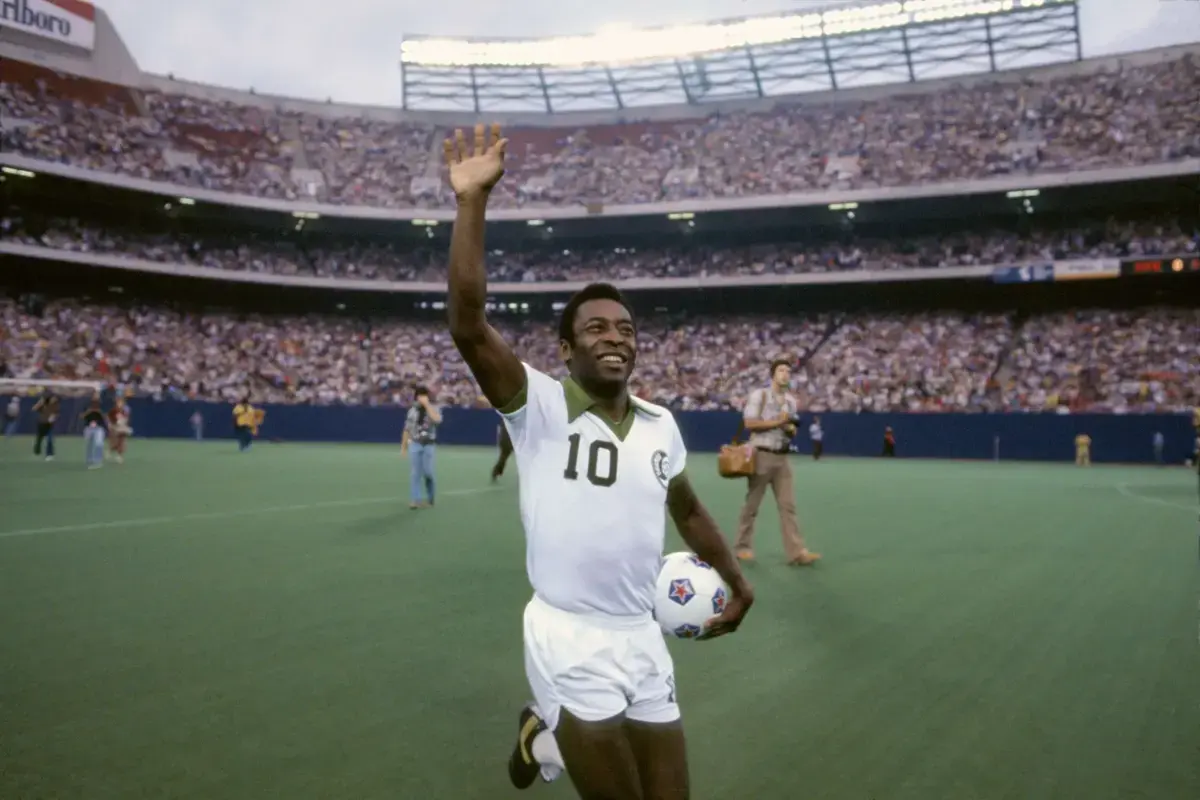
The transformation accelerated with the arrival of Pele in 1975. The Brazilian legend, widely regarded as the greatest player of all time, came out of retirement to join the New York Cosmos, backed by Warner Communications. Pele’s signing was a media sensation. He earned a record salary, becoming the highest-paid athlete in the world at the time, and his presence legitimised soccer for American audiences. Attendance surged league-wide and the Cosmos became the flagship franchise. Pele’s farewell match in 1977 at Giants Stadium drew over 75,000 fans, a record for American club soccer.
The Cosmos assembled what many called the “original Galácticos.” Alongside Pele, in 1977 they signed Franz Beckenbauer, the elegant German defender and 1974 World Cup winner. Beckenbauer brought tactical intelligence and leadership, helping the team dominate.
Other key figures included Italian striker Giorgio Chinaglia, a prolific scorer, and Brazilian captain Carlos Alberto. The Cosmos won Soccer Bowl titles in 1977, 1978, and 1980, averaging over 28,000 fans per game from 1977–1982, with peaks above 40,000. They weren’t just winning; they were entertainment. Games featured flair, showmanship, and a rock ‘n’ roll vibe that appealed to a celebrity-studded New York crowd.
Other teams also shone.
The Los Angeles Aztecs signed Johan Cruyff, the Dutch master of “Total Football,” in 1979. Cruyff brought artistry and drew crowds on the West Coast.
Legends like George Best, Gerd Müller, Eusebio, and Bobby Moore graced various rosters, lending credibility and excitement. Teams such as the Tampa Bay Rowdies (with my personal favorite, Rodney Marsh), Chicago Sting, and Minnesota Kicks developed local followings, blending international talent with emerging American players. The league expanded aggressively, reaching 24 teams by 1978, spreading soccer to cities unaccustomed to the sport.
Impact on soccer’s popularity in the USA
The NASL’s greatest achievement was cultural.
Before Pele, soccer was often dismissed as a “foreign” game. His arrival, combined with television exposure and star power, changed perceptions. Mainstream media covered matches, and families discovered the sport’s accessibility—no expensive equipment required, unlike (ED: American!) football or hockey. Youth participation exploded. Soccer shifted from ethnic enclaves into suburbs, becoming a top choice for children seeking a less violent, inclusive alternative to traditional American sports.
By the late 1970s, soccer was booming at the grassroots level. Millions of American kids joined leagues, laying the foundation for future generations. The NASL planted seeds for the 1994 FIFA World Cup hosted by the U.S. and the eventual launch of Major League Soccer (MLS) in 1996. Figures like former Cosmos executive Clive Toye noted that while the league failed as a business, it created knowledge and enthusiasm for the game that had never existed before in America. Attendance records, celebrity involvement, and high-profile matches helped normalise soccer, making it part of the national sports conversation.
The league also influenced playing styles and marketing. NASL teams emphasised attacking, entertaining soccer to suit American tastes, contrasting with more defensive European norms. This showmanship helped build a fan base, even if it sometimes prioritised spectacle over tactical depth (a trait that I feel ruins the game and is present in all American sports). Women’s soccer and indoor variants also gained traction in this era, broadening the sport’s appeal.
The Downfall: Over-expansion and economic realities
The NASL’s collapse was as swift as its rise. By the early 1980s, cracks appeared. Over-expansion proved fatal. Flush with success and expansion fees, the league added too many teams too quickly into unproven markets without stable ownership or fan bases. Many franchises lacked deep pockets, leading to financial instability. The economic recession of the early 1980s exacerbated problems, as sponsors and fans tightened budgets.
High player salaries, driven by the Cosmos’ spending, created an unsustainable arms race. While stars like Pele and Beckenbauer justified their wages through ticket sales, lesser teams haemorrhaged money when signing aging internationals. Disputes with the players’ union added legal and financial strain. Television contracts faltered as interest waned amid inconsistent quality and too many weak teams diluting the product.
FIFA’s decision to award the 1986 World Cup to Mexico, rather than the U.S., was another blow, removing a major motivational carrot. Warner Communications faced its own troubles (notably the Atari crash), cutting support for the Cosmos. Teams folded rapidly: from 24 in 1978 to far fewer by the early 1980s. The league limped to the end of the 1984 season and officially folded in March 1985. Only a handful of clubs survived in other forms and many stars returned to Europe or retired.
Critics point to poor management and a failure to develop domestic talent sufficiently. While internationals provided short-term hype, long-term success required American stars and sustainable infrastructure—lessons later applied by the MLS with its single-entity model and salary controls.
Legacy
Despite its demise, the NASL’s impact endures. It proved soccer could thrive in America, even briefly at the highest level. The youth boom it sparked produced talent pipelines that strengthened U.S. national teams. MLS, launched with more caution, built on NASL’s foundation while avoiding its excesses. Today, soccer is firmly entrenched in the U.S. sports landscape, with growing MLS attendance, successful World Cup bids, and a vibrant youth culture.
The NASL was a magnificent, flawed adventure—a rock ‘n’ roll chapter in soccer history. It showed the sport’s potential but also the dangers of chasing glamour without solid grounding. As one observer put it, it was “a magnificent success that eventually failed as a single entity,” but the enthusiasm it left behind transformed American soccer forever.
Today we have Major League Soccer (MLS) but I confess not following it too closely. Messi is it’s undisputed star and every club helps pay his salary! It’s probably more sustainable as it’s modelled comparably to foreign leagues. But, there is not the hype or the following as the golden times in the 1970s.
When the North American Soccer League was in its heyday, I was in love. Ironically not with an NASL team but with Newcastle United who I saw in late 1978 at St James’ Park.
I’ve written before how the fans, the atmosphere, and the passion were so unique and “unworldly” (the word I put in my diary as a 15 year old).
NUFC was authentic! It was not an event but a lifestyle…a beautiful star in which its fans orbited with a rabid fanaticism. And, in this humble man’s opinion, soccer is the USA will never “Stick” in spite of the World Cup, the billions of dollars, and the glitz and the glamour. It’ll need authenticity, the kind that comes when a club bears the weight of a city on it’s shoulders. And, that starts at birth and it takes generations to replicate.
Sadly, its not lost on wealthy Americans and their hedge funds who want to buy foreign teams to buy their authenticity, and that puts everything in jeopardy. No, for me, an American with a very cynical view of when sport and POP mix, I worry about American owners dragging their European teams/leagues down the same vortex that consumed the NASL.