
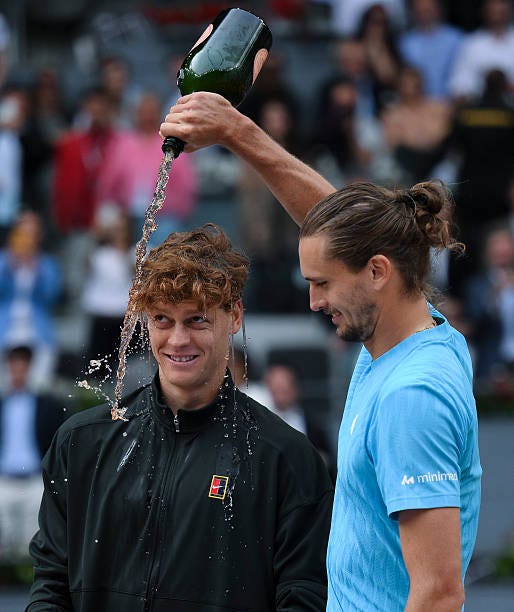
Jannik Sinner had just demolished the world’s No. 3 player in Madrid to win a record fifth Masters 1000 singles title in a row.
“At some point there will also be a down, which is normal,” he said, sounding close to apologetic.
He of course realizes that a 6-1, 6-2 victory that lasts less than an hour is not what the public is clamoring for or paying for in a big-ticket final. His overmatched opponent Alexander Zverev, short on solutions and belief, sounded even more aware, although perhaps not aware that this was the second shortest Masters 1000 final since 1991.
“First of all, super sorry for the final,” he said to the crowd, microphone in hand. “It wasn’t my best day.”
Zverev later made it clear that he wished this final had been played at night after all the late matches and 4 a.m. bedtimes he had experienced in previous rounds. He felt it would have been fairer to both players to keep the same schedule, although the final, which started at 5 pm in Madrid, was hardly breakfast at Wimbledon. It might even have turned into an evening match if Zverev could have made it competitive., Instead it was over in a hurry and in a flurry of Sinner winners and Zverev errevs (forgive me).
Zverev’s glum conclusion: “He’s very good of course, but I think today I would have lost to anybody to be very fair. I think today I played an awful tennis match,”
That might have been how it felt internally as he squandered opportunities and openings, but Sinner has beaten him nine times in a row for a bunch of reasons. This is a mis-matchup because patterns that favor Zverev against lesser talents – like the backhand diagonal – do not favor him here. It is because his often-devastating serve does not do the same damage against Sinner’s fast-twitch returns and because Sinner’s relentless excellence and burgeoning aura can make any opponent edgy and prone to trying to thread too many needles with shaky hands.