
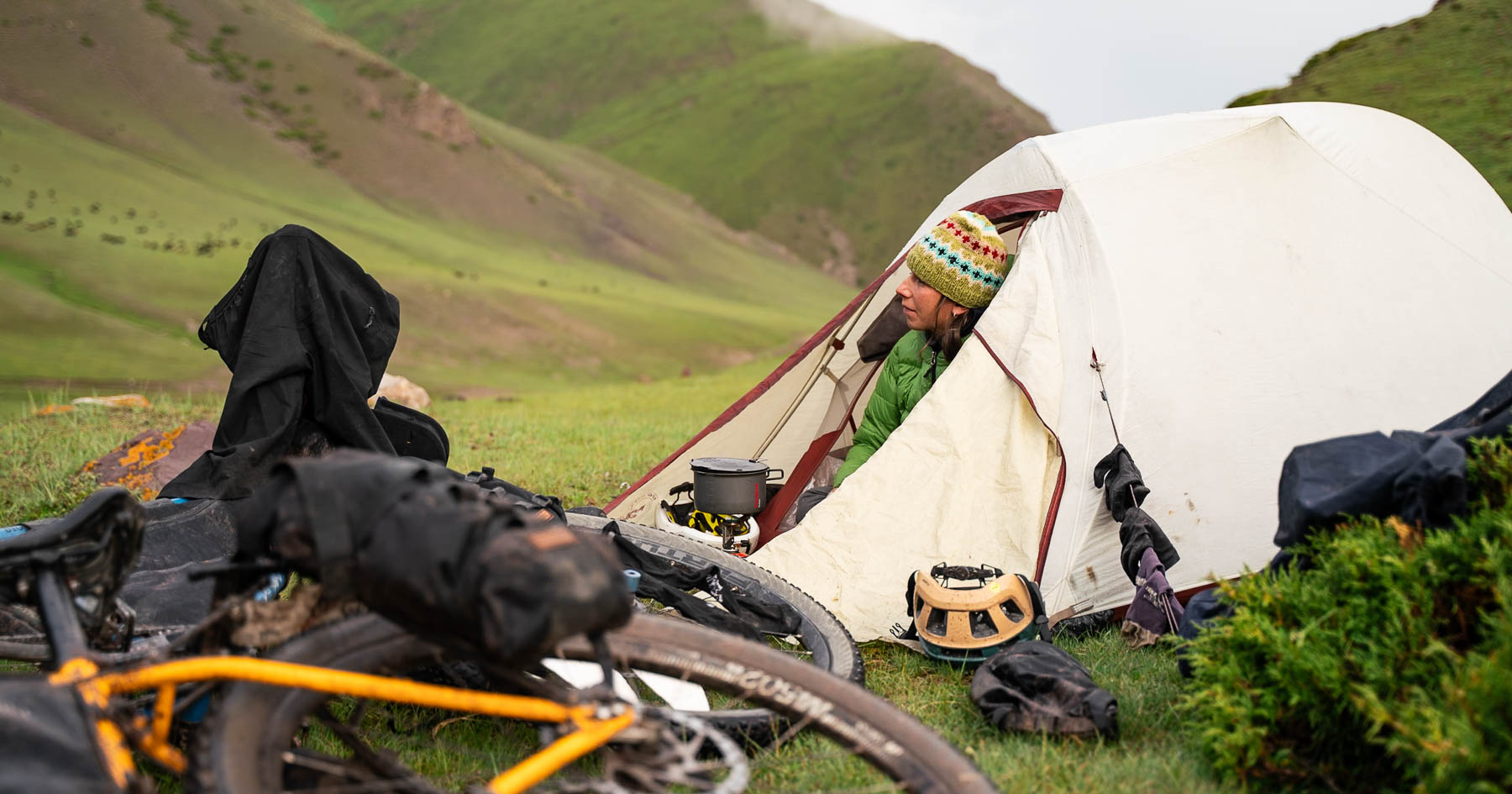
When it came time for Britt Walker to retire her trusty tent after more than seven years of service, she felt inspired to upcycle it into a practical mix of bags and other accessories to accompany her on future adventures and in everyday life. In this short piece, she shares an ode to her longtime shelter and a little about the meaningful project of giving it a second, third, and fourth life in new forms…
We packed the tent down for the last time on a quiet campsite outside of Caen, France. By then, the routine was second nature: pull the pegs, shake the fly, fold the poles. Roll, pack, strap. After a year riding from New Zealand to the UK, we could do it with our eyes closed. But this time felt different. We knew it would be the last morning we packed up camp, and probably the last time we’d see our old tent standing.


For a year, that tent had been our home. Our Big Agnes C Bar 2 wasn’t new when we set off. It was already six years into its life, worn in by shorter trips before we strapped it to our bikes and asked it to cross half the world with us. It coped through storms, relentless rain, humid nights, and long days on the road. At the end of each one, it became the place we could finally switch off.
It was small. Maybe that’s an understatement. People were always surprised. “A two-person tent!?” We’d laugh. We slept shoulder-to-shoulder like sardines, gear packed tightly around us. It wasn’t spacious, but it worked.

Over time, it started to reflect where we had been. Red dust worked its way into every nook and cranny from the long gravel stretches, salt encrusted the guy ropes, and damp settled into the ground sheet. It carried small marks and memories of each country we’d travelled through.
You can swipe through the gallery above.
One night on the west coast of New Zealand, the air went completely still, carrying that unsettling, eerie feeling that tells you something’s off. Sure enough, bang on 11 p.m., the storm hit. The tent flattened, poles bowed, nylon smothered our faces. Then, just to keep things interesting, our bikes decided to throw themselves on top of us, too. At which point, Al launched himself, stark naked, into the storm to save the tent, the bikes, and me trapped underneath, reappearing seconds later like a drowned rat. By morning, the campsite was unrecognisable, with tent debris everywhere, and people resorting to the toilets for shelter. But ours was still standing. A little sad, but stubbornly still standing.
At the other end of the spectrum were the nights in Turkey and Greece, when the heat never really left. Even after dark, it lingered above 40°C (104°F). The tent became less of a shelter and more of a sweltering refuge from the midges. When we were lucky enough to be near a tap, we took turns getting up in the night to soak our T-shirts, draping them over ourselves, and chasing seconds of relief before the water evaporated once again. Sleep was restless, but still, somehow, better than being outside.


Inevitably, the tent started to wear out. At first, it was minor, a drip during a storm, a tired zip. But five months in, we woke up lying in puddles. From then on, it became a constant repair project. We resealed seams, patched holes, stitched tears, and coaxed the zip back into line more times than I can remember. Technically, it had reached the end of its life. But throwing it away didn’t feel right.

Before travelling, I worked in set decoration and prop making, where objects aren’t just functional; they carry narrative. This tent felt no different. Once we’d returned home, it held too much of our journey to simply discard. So, instead of repairing it again, I took it apart. Dismantling it felt strangely significant. More deliberate. Cutting into the fabric, separating panels, and unpicking seams was a slow, reflective process. The familiar structure disappeared piece by piece, but in its place, new interesting features started to emerge. Zips, mesh pockets, drawcords, and buckles. Elements that had once worked together as a shelter, now separated into parts with new potential.

I started making bags. My original concept was to upcycle a unique bag for each of us—a way to carry memories, a piece of our travels, and a tangible connection to our journey. They were a small reminder of what we had achieved, when everyday life was starting to look different. Each bag was built entirely from our original tent, carefully repurposing and incorporating these small details so it still carried a little piece of its old life.


The project soon grew, and I started giving the tent a second life in various new forms. Since returning home, life has changed pace, but the tent has found itself on many new adventures. Shoulder bags for city cruising, stuff sacks for day trips, and hats and bags we’ve taken on weekends surfing in Cornwall, hiking in Scotland, and snowboarding in France. It’s all about keeping the adventures going, giving the tent a new lease of life whilst creating new memories. The tent has changed form, but it’s still travelling with us, just in a different way.
Since starting the project, people have begun sending me their old tents to rework, transforming them into personal pieces for future trips. That side of the project has been especially rewarding, bringing it full circle and connecting back to why I started in the first place. Al’s dad gave me one of his old tents recently, which I turned into a shoulder bag for his trip to the Himalayas, alongside a matching laptop bag for Al’s slightly less adventurous commute into London.

Moving forward, I plan to keep developing the project, transforming more old tents into one-off pieces that carry memories, support new adventures, and give old kit a sustainable second life.
Want to see more like this? You can explore our full archive featuring dozens of Make Your Own Bikepacking Gear features and tutorials using the #MYOBG tag.
Further Reading
Make sure to dig into these related articles for more info…
Please keep the conversation civil, constructive, and inclusive, or your comment will be removed.