
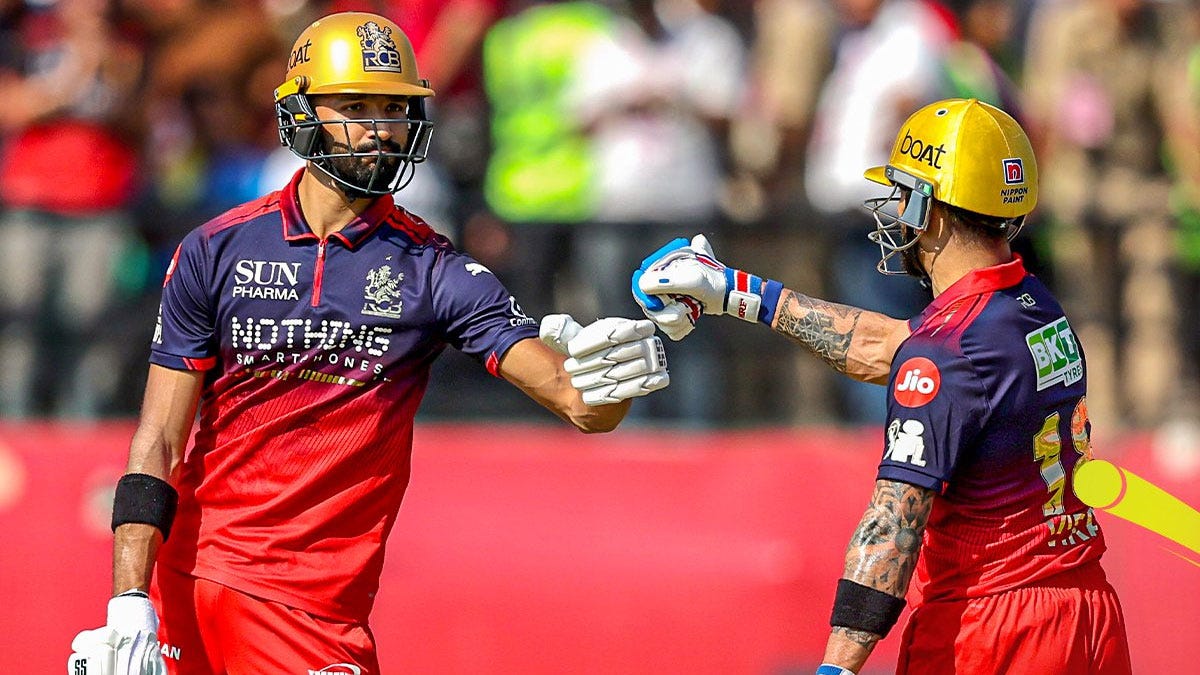
RCB beat PBKS by 23 runs, and officially became the first team to qualify for the playoffs. Meanwhile, PBKS have followed up 7 undefeated games with 6 straight losses, and are seriously threatening to miss the knockouts.
But, what happened beyond the headlines?
🚨 If you’re an RCB fan, I’d love if you could fill out this 2-minute survey on how you feel about the franchise this year. I plan to create a graphic story of your answers soon! 🚨
✍️ Written by Raunak Thakur, who runs Dead Pitch’s Society. Follow him on X.
RCB’s top order followed an interesting strategy today. Following a cautious first over, Jacob Bethell, Virat Kohli & Devdutt Padikkal all honed in on a single point of truth; PBKS’ bowlers have been under the microscope this season for conceding 200+ eight times before today.
The batters’ strategy was simple; go for boundaries on the first ball of every over, and try to ramp the pressure up on their opponent’s underperforming bowlers. From the 2nd over to 7th over, RCB forced a boundary on the first ball of all but one over, and scored 20 runs from just those 6 deliveries. On the one over when they didn’t get a first ball boundary, they scored on the second ball.
Kohli has a famous pace-on weakness to 4th-to-5th stump deliveries. Azmat Omarzai put one to him on the first ball of the 2nd over. Kohli swung and missed. The next ball was immediately dispatched for a maximum via a (slightly mishit) drive.
There was nothing majorly wrong with the ball, but the RCB opener took a chance and it paid off. Apart from Lockie Ferguson’s opening ball in the 4th over, none of the deliveries were particularly bad, but they all hit the ropes. ESPNcricinfo’s ball-by-ball commentary even pointed out that five of the six opening balls from overs 2-7 ranged from “nothing wrong” to “good length.”
RCB’s strategy had its desired impact. An already shaky bowling unit was rattled, and they got lost in their own heads. PBKS’ three powerplay bowlers got stuck trying to outdo their counterparts with consecutive pace-on deliveries, and a lack of variations. Ferguson didn’t dip below 140 KPH, while Omarzai and Arshdeep Singh lived in the 132-139 KPH range.
Instead, they tried to aim for perfect wicket-taking balls, and got hit when they didn’t execute perfectly. Against Kohli & Padikkal, who strike at 174.3 & 178.8 against powerplay pace this year respectively, it was never going to be a smart strategy.
Kohli scores 19.38% of his IPL runs in 2026 via flicks, and another 17.64% of his runs via pull shots. Punjab fed him exactly what he needed, with pace-on deliveries up front to flick and short deliveries to pull to the boundary, as he accumulated 25 runs in his beloved mid-wicket region. His strengths were not curbed, keeping him comfortable at the crease.
Similarly, 44% of Padikkal’s balls faced were good-length deliveries, and 41% were short-length. The RCB No.3, who scores 18.93% of his runs from pulls and 14.13% from cuts, plundered 32 runs with shots in those zones tonight.
To double down on PBKS’ misery, the duo are also hard runners who posted an elite non-boundary strike rate of 77.42 today. Even when the bowlers reigned in their wayward lines and lengths, RCB still found a way to put pressure on them.
Beyond the pacers, RCB also adeptly put pressure on the spinners. Hemant Brar, an SLA who is theoretically Kohli’s weakest matchup, was consistently kept away from the RCB veteran. Of Brar’s 24 deliveries, 19 went to left handers while Kohli was happy to push him around for 5 singles in 5 balls. Despite picking up Bethell’s wicket in the powerplay, RCB had no problem neutralising Brar.
Yuzvendra Chahal’s 7th over was perhaps the finest example of RCB’s strategy at work. Padikkal danced down the wicket to launch him for a 6 on the first ball, and the spinner crumbled. A couple of nudged singles, a perfectly timed boundary, and a no-ball that was punished by another 6 bookended a terrible return to bowling duties for the ex-RCB man.
Finally, belatedly, PBKS responded via a part-time bowler. Shashank Singh broke the spell in the 8th over by going back to the basics. He bowled at an average speed of 120.6 KPH, introduced multiple variations including hard lengths, slower bouncers at just 112.3 KPH, and even a tortoise-paced 103 KPH slower ball. Similarly, Omarzai copied those tactics in the 9th over.
Neither bowler conceded a first ball boundary, and gave away just 15 runs across both overs at a time when RCB were cruising 11.7 RPO. With the easy runs drying up, Padikkal overreached on the first ball of the 10th over against Brar. RCB’s aggressive intent was finally punished as DDP’s desperate shot was weaponised against him to induce a wicket.
PBKS have the bowlers and the smarts to take down obvious strategies such as RCB’s, but they don’t seem to have the confidence or accuracy to do so before it’s too late. By the time Padikkal was dismissed, RCB were flying at 97/2 in 9.1 overs.
It was the perfect foundation for RCB’s newest hero to walk in, and put on a player-of-the-match performance.
Data from ESPN, Cricmetric, & the Jio broadcast.
✍️ Written by Tarutr Malhotra, who runs Best of Cricket.
RCB’s batters are here for a good time, not a long time.
On average, a top 7 IPL batter faces 16.4 balls in 2026. Only 3 RCB batters can top that number; Kohli, Phil Salt & Padikkal (before today). On the other hand, only the flailing Jitesh Sharma comes in under the mean strike rate of 157.4 amongst RCB’s top 7 batters (after today).
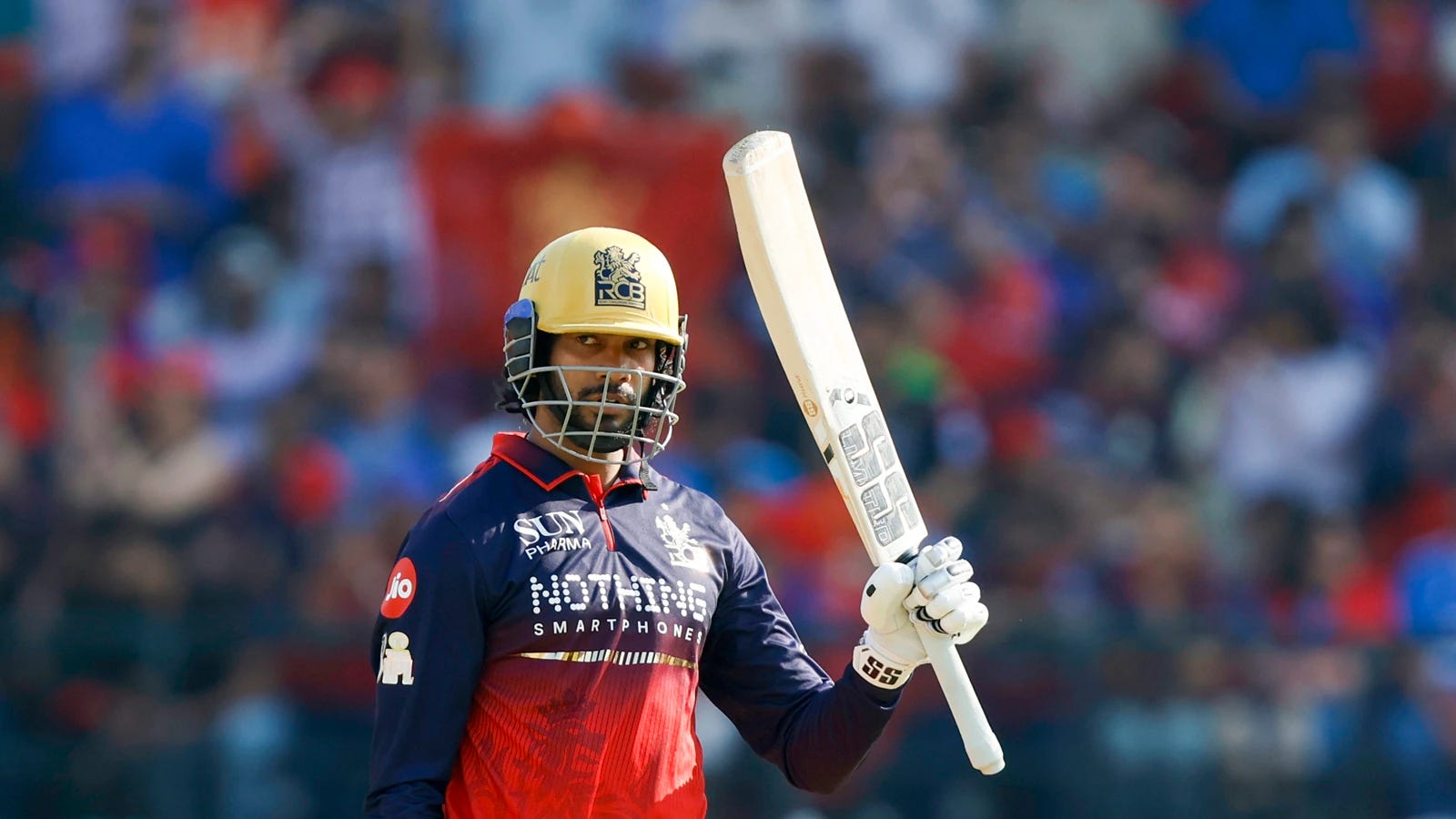
Venkatesh Iyer is the big mover across both categories after his scintillating 73* (40) against PBKS. He boasts a team high average balls faced of 23.3 and a season-long strike rate of 162.85 after the game-winning knock tonight. These numbers aren’t just important as another boast about the rich getting richer; Iyer is the solution to RCB’s oddly disjointed batting order that seems to produce either feast or famine numbers.
A 250-run total against the positive NRR CSK (+0.027), but just 175 against the abysmal DC (-0.993). Maybe those are matchup problems (they’re not), so how about their results in double headers? Against GT, they scored 206 and 155. Against MI, they scored 240 and 167. You never know which version of the defending champions are going to show up.
Key to this problem has been their dependence on the 37-year old Virat Kohli. Much maligned for his “slow anchor rates” in the 2020s, Kohli’s been praised for his reinvention into a 160+ SR powerplay devil. However, not enough has been made about how much RCB still depend on him to anchor them through the first two phases of the game.
Here’s a quick stat; RCB have faced “collapses” – defined as at least two consecutive partnerships with fewer than 15 runs scored each – 9 times this season. All but one of those collapses have happened after Kohli was already out. This stat should feel intuitive if you’ve watched RCB closely this season; they just feel shaky if the top order gets out before the death.
Considering half that top order was missing today with Salt’s and Rajat Patidar’s absence, the feeling should’ve been amplified. Instead, it felt smooth. The left-handed Iyer’s ability to run as aggressively as Kohli, to defer to him in the powerplay, to take over in the middle overs, to blunt the bowlers that affect the right-handed opener, AND to do all this without Kohli at the crease is important.
When Kohli got out, Iyer hogged the strike and accelerated effectively to make sure Tim David didn’t feel the pressure to dominate the death overs from ball one. Iyer faced 10 of the next 12 balls and scored 27 runs to keep RCB ticking, to let David get used to the pitch, and to keep the pressure back on the PBKS bowlers. David would eventually score a vital 28 (12).
By staying unbeaten tonight, Iyer’s innings became just the second instance of an RCB player who didn’t lose their wicket and faced at least 40 balls. The other? Kohli’s unbeaten century against KKR in the last game. Multiple RCB players – Pandya, Patidar, even David himself – have teased an ability to replace Kohli’s impact after the veteran gets out, but no one has done so as effectively or effortlessly.
Iyer has not only raised RCB’s floor by providing another anchor-type middle order bat, but he’s also raised their ceiling by proving that he can strike quickly in the middle overs when Kohli typically slows down. If the defending champions weren’t favourites before today, they should be now.
Data from our new database.
✍️ Written by Atharv Tambade, who run Pacers with Pretty Feet.
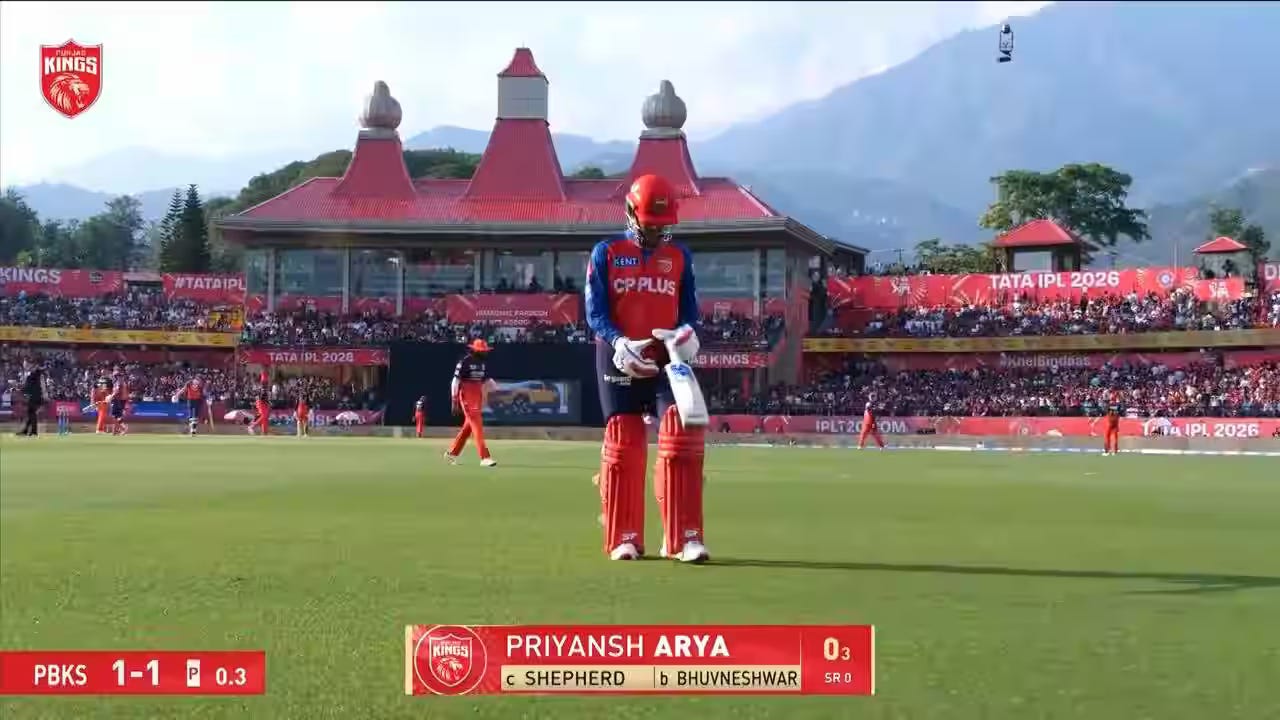
Prabhsimran Singh & Priyansh Arya have formed the basis of PBKS’ optimism this season, even as a record seven-game unbeaten start has morphed into a six-game losing streak. The bowling unit has been chastised for conceding 200+ so often, but the batting order – based on the openers’ performances – have been equally praised for repeatedly chasing down those 200+ scores.
On paper, today seemed the perfect opportunity for that run to continue. However, that belies a sudden drop in form caused by IPL bowlers figuring out how to cramp the batters. In PBKS’ first six games, the duo averaged 54 and struck at 249.2. In their last 5 games, those numbers have gone down to 34.2 and 143.7 respectively. If PBKS were to keep their playoff dreams alive, “PrabhArya” had to buck that trend.
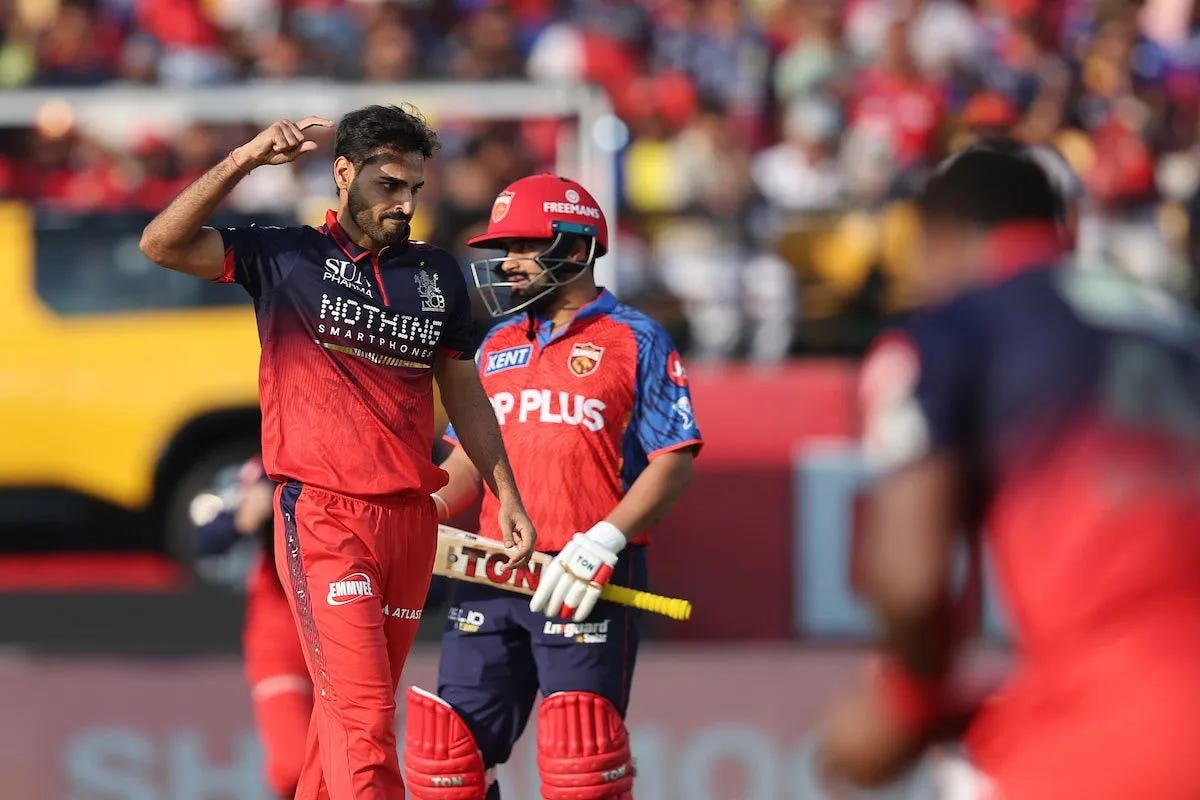
On the other hand, RCB were looking to Bhuvneshwar Kumar to end the game before it could become a contest. It’s fair to say Kumar won the battle and the war tonight, as he dismissed both PBKS openers for a combined 1 (7) against him. However, these weren’t just lucky deliveries against under-pressure batters. Kumar executed a plan perfectly.
He got Arya in the first over with a slightly short of good length delivery that swung away from the left hander. An ill-fated swipe across the line toe-edged the ball to mid-on, and Arya was back in the pavilion. This isn’t the first time he’s gotten out to this type of delivery. Shots across the line have been his Achilles Heel against both SRH’s Pat Cummins and GT’s Mohammad Siraj in recent games.
Like many modern batters, Arya likes to stay away from the line of the ball so that he can free his arms and swing hard. But, that technique can also create problems when he tries to drag the ball from outside his body to the leg side, because he is then forcing the shot against the angle from which the ball is coming. If the ball has slightly extra pace (as with Cummins) or is moving away from him (like today), it is prone to an uncontrolled top or bottom edge.
Prabhsimran’s case is slightly more nuanced. We know that Prabhsimran has a clear pattern when he bats. He likes to come at the bowler. Bowlers are still scared to go full to him because he can use his feet and hit the ball straight back over their heads. We see this pattern in a lot of modern openers, like Abhishek Sharma, who create room not just by backing away, but by moving slightly towards the leg side while coming at the bowler. That gives them space to free their arms.
In the last few matches, bowlers have come up with a different plan to stop Prabhsimran. They are targeting his body so that he does not get the room to free his arms. They target a very particular length to negate his footwork; deliveries that hit the bails or slightly shorter.
The logic is simple. The ball should not become a half-volley even if he takes two steps towards it, but it also should not be short enough for him to pull. Commentators usually call this the in-between length, and that is exactly what Kumar bowled today.
However, this delivery doesn’t work without the requisite build-up. Prabhsimran is an all-or-nothing batter. 44.6% of his balls faced are dots, while 1 in every 4 deliveries is a boundary. If you can build the dot pressure – like RCB did by limiting him to 2 (4) by the middle of the 3rd over – you can make him more vulnerable to an ill-timed swipe.
Other teams – including DC & GT – have employed the same strategy. RCB let the dot pressure build, then Kumar dangled a ball slightly outside off that looked like a release valve. Prabhsimran was overeager, late to his shot, and back in the pavilion in five deliveries.
Both their openers are very different. One is right-handed, the other prefers his left. Prabhsimran likes to come down the track, while Priyansh likes to stay back. Both of them like room, but the lines are different because of their handedness and their methods.
Kumar’s brilliance comes not just in his unerring ability to execute inch-perfect balls, but in his understanding of when and why he needs to choose a particular delivery. It’s how he picked up both openers’ wickets with minimal fuss, and all but ended PBKS’ chase before it even started.
Data from Cricsheet.
✍️ Written by Tarun Pratap, who runs The Rank Turner. Follow him on X.
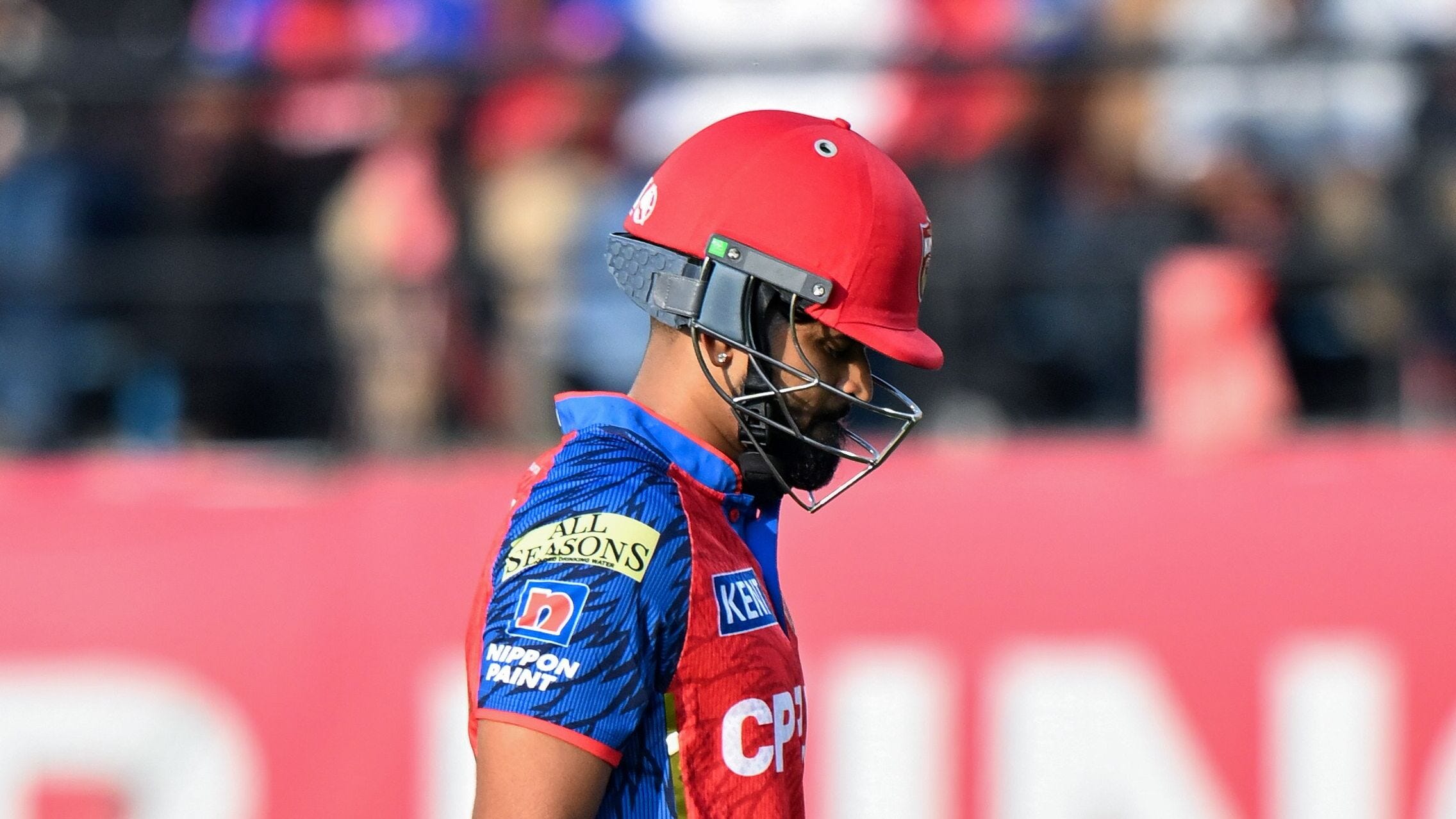
At times, Shreyas Iyer feels like the unluckiest cricketer in India. The captain who’s taken three different teams to an IPL final – winning it all in 2024 – has not played a T20I since late 2023, and has missed out on multiple T20 World Cup wins. Now, his well-oiled PBKS team look set to miss out on the playoff despite their record start to the season.
With PBKS’ openers out early, the burden of the chase fell on Iyer. He’d have to play the ultimate captain’s knock to keep their season alive. Instead, Iyer defensively prodded at a good length delivery, and edged the ball to the keeper. He was back in the pavilion having scored just 1 (3).
This dismissal was eerily similar to the way Iyer got out in the 2023 World Cup final. After the game, it was reported that the Australian think tank had identified him as a key wicket after his outstanding century against New Zealand in the semi-final. The plan was simple; play on Iyer’s well-known problem with the short ball.
Over the years, the batter’s issues against the short ball have been discussed extensively. Everyone remembers his former IPL coach, Brendon McCullum, sitting with his legs on the railing and signalling “bowl at the head” as Iyer walked out to bat at Edgbaston in 2022.
Since the 2023 IPL, the pull shot has been Iyer’s most productive scoring shot. Around 18.86% of his runs in this period have come through the pull. This is partly because teams have repeatedly targeted him with short balls, resulting in him receiving more short-pitched deliveries than most batters. However, his control percentage on the pull shot is just 58.21%, which reflects his continued vulnerability.
Over the years, Iyer has made technical adjustments, such as adopting a more open stance to counter the short ball, and he has shown signs of improvement. But, he doesn’t seem to have understood how his counters have created a new weakness.
Speaking on the official Hindi broadcast during PBKS’ previous game against MI, Irfan Pathan pointed out that because Iyer is constantly expecting the short ball, he tends to stay on his back foot and does not move it at all. As a result, on deliveries just outside off stump, he often is not close enough to the ball and ends up throwing his hands at it. If the ball has any hint of away movement, because of his static back foot, he can edge it.
This technique makes it difficult for him to defend against pace. Since IPL 2023, his control percentage while defending has been just 57.14%. Most batters on a similar length would get side on and play a dab shot to the third and pinch a single, but Iyer does not use the dab shot a lot.
Since 2023, IPL, only 1.49% of his runs against pace have come from a dab shot. This is understandable given that he has an open stance to counter short balls, which means it is tough for him to get side on and dab the ball. In all, he scores 13.4 runs below average against good-length balls outside off when hitting through the cover region.
This suggests that he finds it difficult to punch or push good-length deliveries through the off side, especially through covers. Dismissals like the one today often occur when he tries to drive or punch a good-length ball through the cover region, standing on his back foot without fully getting to the pitch of the ball.
Which takes us back to that 2023 final. The Aussie plan was simple; set a double bluff field for the short ball. Iyer would have to stay on the backfoot to negate the impact of a potential bouncer or the surprise fuller ball. The Aussies split the difference. Cummins bowled a hard length delivery just outside off stump, and a baffled Iyer edged it to the keeper.
It’s a delivery that has continued to haunt him. When he comes to the crease early while the ball is still swinging, bowlers target him. MI’s Shardul Thakur, GT’s Jason Holder, & SRH’s Eshan Malinga have all induced wickets from similar deliveries in the 2026 IPL alone.
Iyer’s weaknesses have been masked in the IPL since 2023 for two reasons; (1) he’s always played behind a world-class opening pair that rarely sees him facing powerplay swing, & (2) many teams are still targetting that short ball weakness that he’s improved upon.
However, in recent weeks as the PrabhArya combination has faltered, IPL teams are attacking Iyer’s static backfoot weakness again. With clear plans for PBKS’ top three – and desperately faltering bowling unit – it’s no wonder that last season’s finalists are in free fall at the moment.
Data from DeepCrease.