
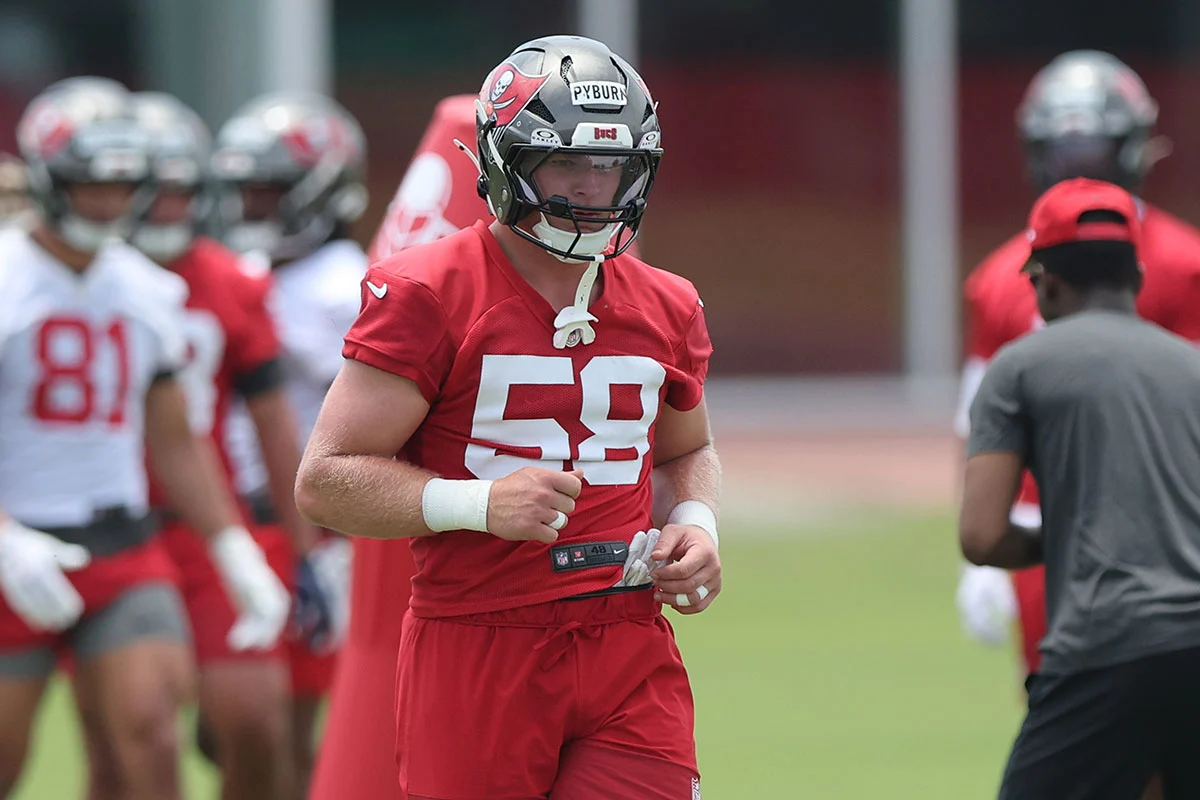
When undrafted free agency opened after the 2026 draft, the Bucs attracted LSU edge rusher Jack Pyburn with a $15,000 signing bonus and $100,000 in guaranteed salary. That $115,000 is a decent chunk of change, but not the max they can offer. They went bigger on offensive lineman Ben Scott last spring at $265,000 in guarantees.
But it’s also not throw-a-dart money. Tampa Bay specifically wanted Pyburn over a wide field of available undrafted edge rusher options, paid up to get him, and added him to a room with a half-dozen names already competing for what’s likely five or six spots.
What did the Bucs see that the league missed for seven rounds? I took a look at the tape and the production profile to see what lines up, what doesn’t and why the Bucs made Pyburn a priority.
Jack Pyburn’s Build
Jack Pyburn comes to Tampa Bay as a 6-foot-4, 258-pound stand-up edge rusher with one senior season at LSU and three years at Florida before that. He is a former heavyweight high school wrestler who moved from inside linebacker to defensive end in college. Pyburn weighed 262 at his LSU pro day on March 23 and declined to run the 40, do the bench press, and the vertical. But he did test at the broad jump, 3-cone and short shuttle. This was after he declined to test at the NFL Scouting Combine resulting in a narrow Mockdraftable profile.
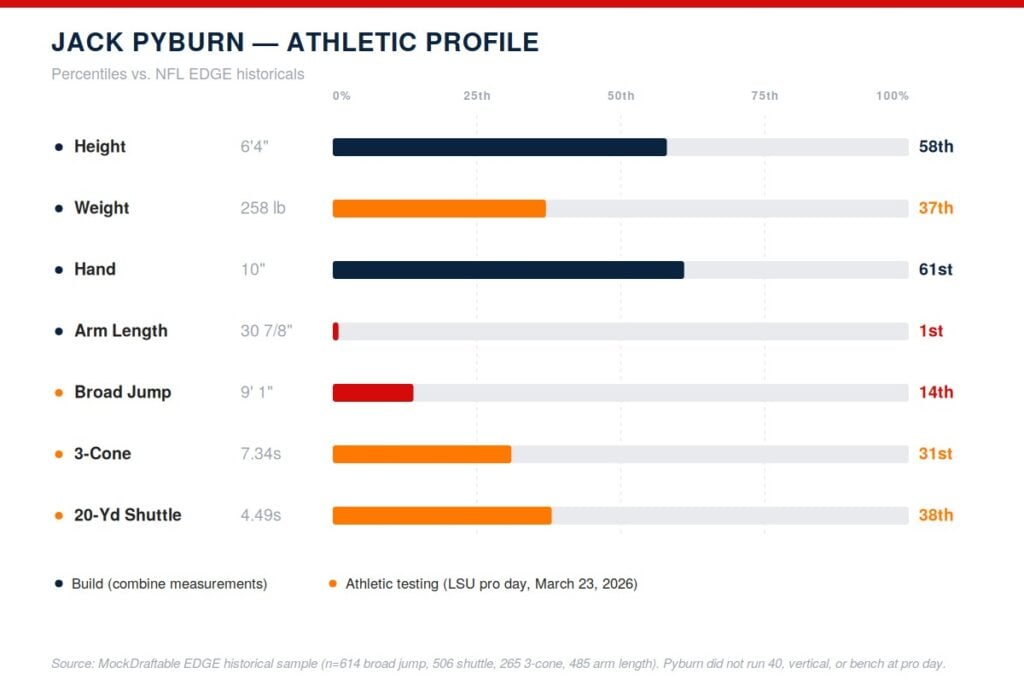
Pyburn has 1st-percentile arm length that evokes conversations around Rueben Bain Jr. Maybe the Bucs are collecting short arm kings as the new competitive advantage.
Traditionally, edge rusher is a length position. Long arms keep an offensive tackle off your chest, let you control the rep, allow you to disengage to the ball when you’ve won leverage. Pyburn’s 30 7/8-inch arms put him at the very bottom of the modern NFL edge rusher distribution.
And while the Bucs have said they don’t see it as a problem for Bain, continually citing Mike Tyson as if it was a talking point circulated throughout the building, they do show up as an issue for Pyburn on tape – but more on that later. The 14th-percentile broad jump is a real lower-body explosion concern. The 31st-percentile three-cone confirms that lateral redirect isn’t a strength. The portrait is of a built-up, well-conditioned, average-or-below-average mover who has to win with hands, leverage, and processing.
The Production
In four years and 41 games across Florida and LSU, Pyburn accumulated 132 tackles, 10.5 TFLs, and three sacks. His senior season at LSU produced 52 tackles, 5.5 TFLs, and two sacks. What jumps off the page on the defensive side is his career tackle rate: a 10.4 percent figure that ranks second among 280 qualifying FBS edge defenders. The ball finds him.
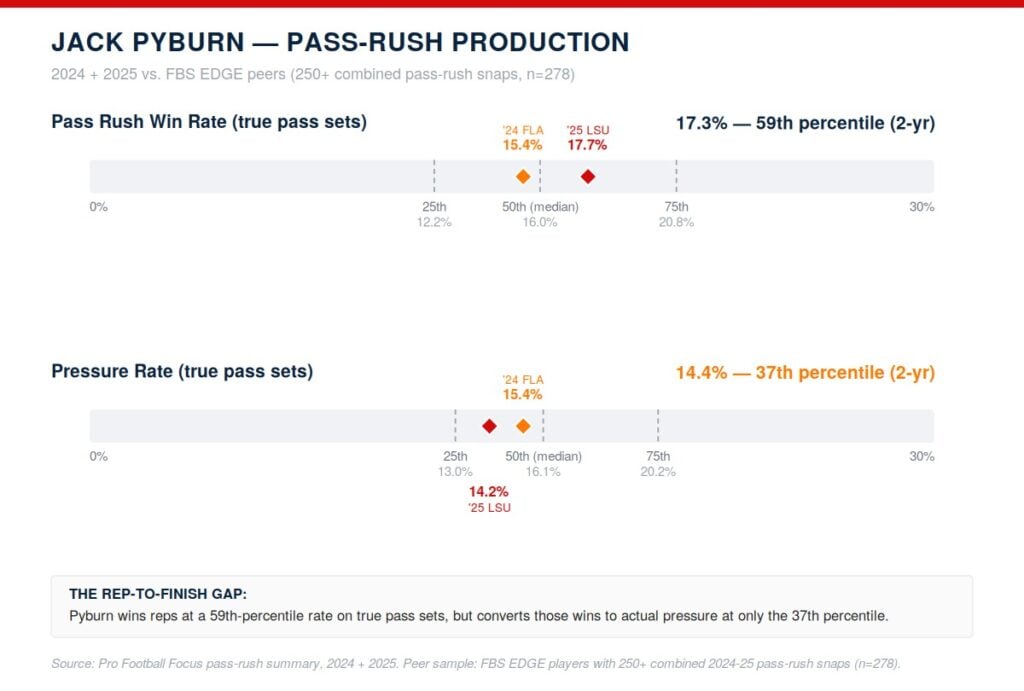
The pass-rush production looks more revealing when you cut it down to true pass sets, stripping out screens, RPOs, and quick-game reps. Across two seasons on legitimate pass-rush opportunities, Pyburn wins his repetitions at a 59th-percentile rate, a hair above the median for an FBS edge rusher. But when you measure how often those wins translate to actual pressure on the quarterback, the number drops to the 37th percentile.
He gets there. He often doesn’t finish. That rep-to-finish gap is why a player with 33 pressures in his senior season ended his college career with three sacks total.
What The Bucs See On Tape
To get a good feel of what Jack Pyburn has to offer, and where he struggles, I watched three games from his 2025 season. I use Pro Football Focus game grades to help me find a high-end, medium-tier, and low-end game in order to try and prevent a small sample size bias. The games chosen for Pyburn were Week 7 – South Carolina (56.1 pass rush grade), Week 11 Alabama (46.2 pass rush grade), and Week 12 Arkansas (70.5 pass rush grade).
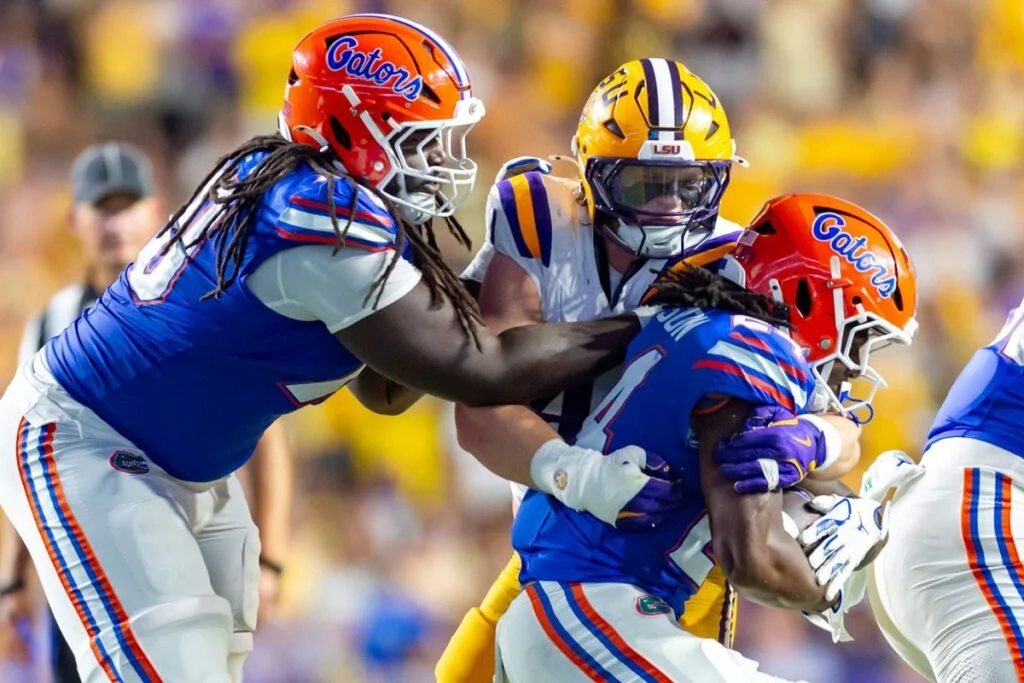
Against South Carolina, Pyburn produced his season’s largest pressure volume, eight on 35 pass-rush snaps. The film broke that down into three clean individual wins, four pocket-condense pressures that didn’t translate, and six pure one-on-one losses. The most consistent positive was his scheme execution.
LSU used him as a wrecking ball, clearing rush lanes for stunting teammates seven distinct times, generating a forced field goal, an interception, and two teammate sacks. Pyburn was such a nuisance overall that South Carolina started to double-chip him late in the game.
Bucs EDGE Jack Pyburn – Photo by: IMAGN Images – Scott Clause
Against Alabama, the picture darkens. Alabama identified him early and ran their offense at his side of the field. Pyburn produced one game-changing tackle for loss on a delayed screen and one clean interior-burst win from a 3-tech alignment. Outside those moments, the structural concerns showed up consistently. Pyburn’s long arm move lost three head-to-head leverage battles across the three games. His general effectiveness fell off a cliff when the level of competition improved – Alabama’s tackles are miles better than what South Carolina was trotting out last year.
Against Arkansas, with the competition tier dropped, the trait stack he relies on showed up cleanly. Pyburn stepped down on a tight end to disrupt the offensive line’s run flow, threw the tight end aside, and finished a tackle for loss. He produced another clean bend rep where he attacked the high side with a double swipe, won the corner with a rip move, and didn’t finish only because the quarterback stepped up in the pocket.
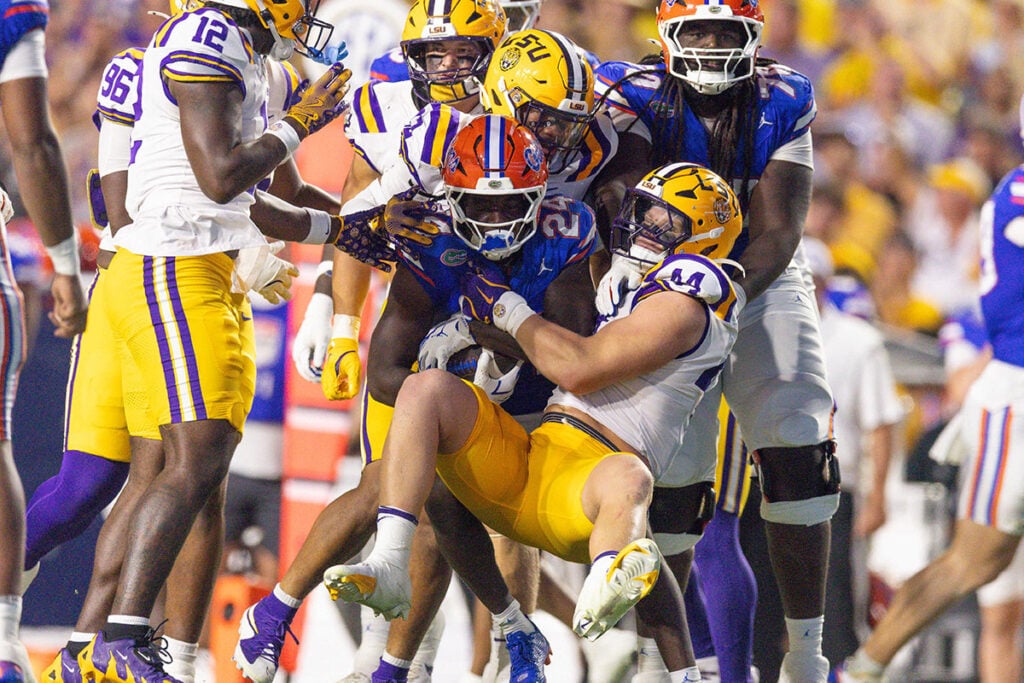
Bucs OLB Jack Pyburn – Photo by: IMAGN Images – Stephen Lew
Pyburn dropped into coverage and matched cleanly to a boundary receiver, getting a hand on the route and staying attached. He showed active zone eyes, looking to bracket a route rather than sitting in his landmark. The Arkansas tape’s contribution was confirmation that the trait stack is durable, the bend trait is better than I initially considered, and the recognition pieces hold up at every comp tier.
The composite is consistent. Three of the four pass-rush pillars Jon Ledyard taught me when I got into this field: get-off, acceleration up the arc, and change of direction all grade out as below average. The fourth, bend, is average and improved on the third look. His base anchor is good, his power is inconsistent, and his chip-protection vulnerability ranges from neutralized to stoned. Those are real reasons he went undrafted.
The Reasons The Bucs Bet On Pyburn
The traits that make Jack Pyburn worth a $115,000 UDFA bet cluster around four pieces, and they show up just as clearly on tape as the limitations do.
Recognition is a high-end NFL trait, with documented wins on plays designed specifically to manipulate him. Pyburn consistently processed well against misdirection. Several reps including play-action against South Carolina, the Alabama delayed-screen TFL diagnosed mid-loop on a stunt, and the Arkansas step-down read all show as evidence.
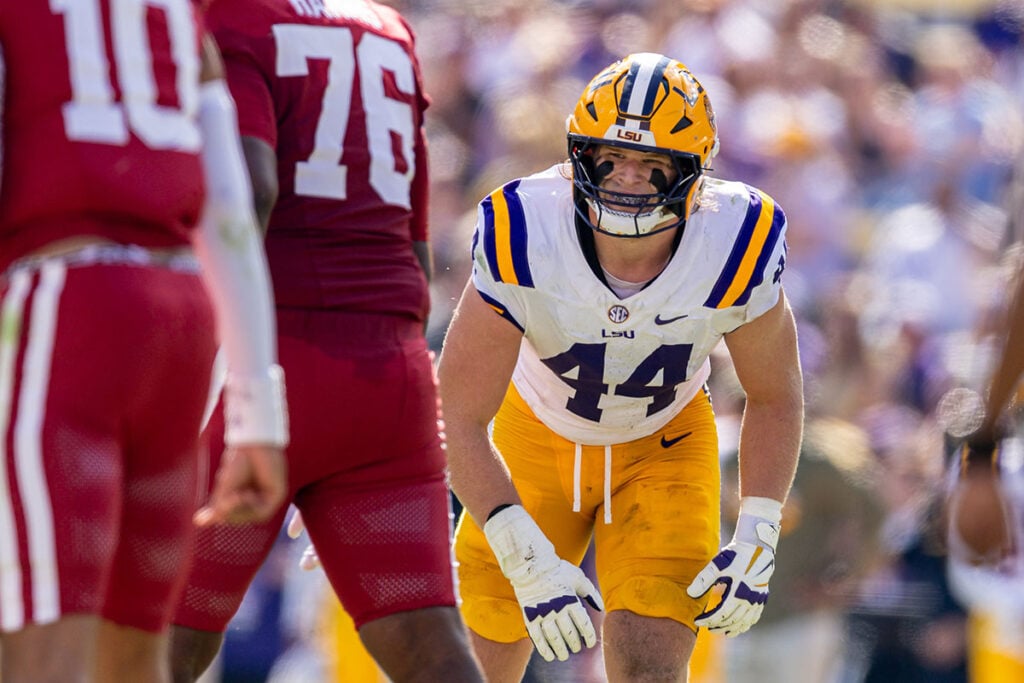
Bucs OLB Jack Pyburn – Photo by: IMAGN Images – Stephen Lew
Motor is the second-most durable trait, showing up into the fourth quarter of every tape with his physical traits failing; it’s the trait the tackle rate cited above is really measuring. Scheme execution is the third. LSU wasn’t afraid to use him as a 4i, 5-technique, 7-technique, wide-9, as a standup 3-technique or mugged over the A and B gaps.
Coverage usability is the trait the Arkansas tape upgraded most directly, with him showing active zone eyes. Todd Bowles should love that.
That combination of traits, plus a stand-and-strike run defense floor that produced more than a dozen clean wins across three tapes, profiles as a high-floor contributor. It’s not a starter’s trait inventory given the structural pass-rush limitations. It is, however, exactly what a coaching staff wants in a UDFA.
The Roster Math
The Bucs’ edge rusher room is set at the top with Yaya Diaby, first-round rookie Rueben Bain Jr., free-agent addition Al-Quadin Muhammad, 2025 fourth-round pick David Walker the likely two-deep, and Anthony Nelson and Chris Braswell fighting beneath them for final roster spots. Mohamed Kamara, retained on the practice squad, is a seventh. Pyburn enters as the eighth name.
The fight he’s actually in is with Kamara and fellow rookie Yasir Holmes, who impressed as a tryout player, for a practice squad role. Produce enough in camp and preseason to earn and the job is his. And if injuries open a window, climb onto the back end of the active roster.
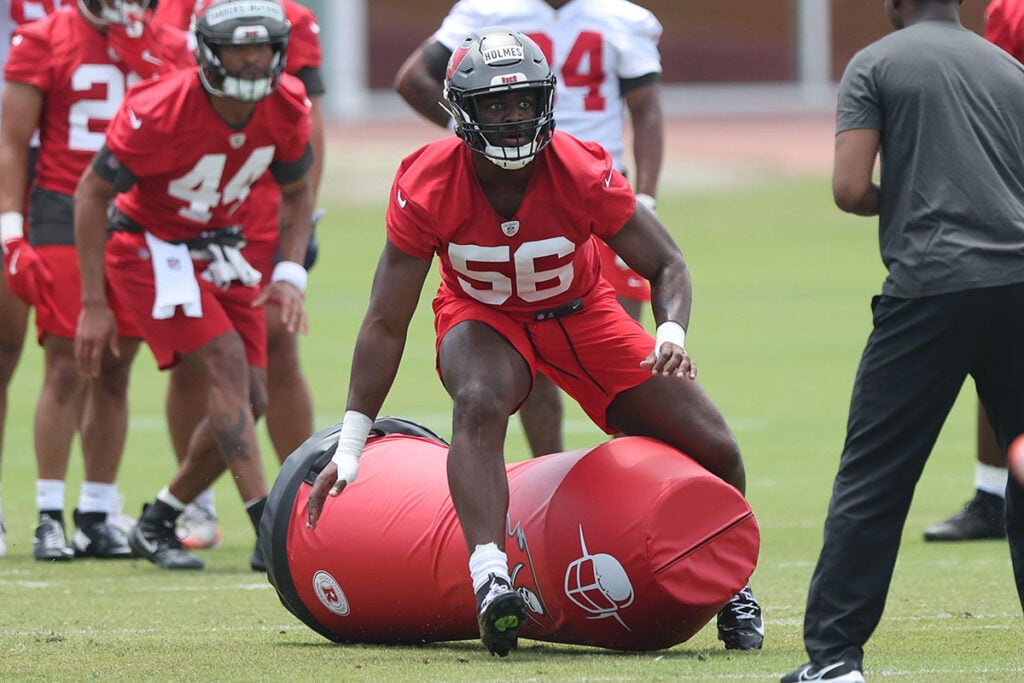
Bucs OLB Yasir Holmes – Photo by: Cliff Welch/PR
Todd Bowles’ defense rewards an edge rusher who can execute multiple assignments cleanly, plays well on early downs to earn third down reps, can set up teammates by selling out in pressure packages as a stunter, and runs with a hot motor. Pyburn checks all of those boxes, even if his athleticism is a limiting cap on his ceiling.
It’s enough for the Bucs to make a bet on Pyburn. It’s a small one in dollars and a smart one in scheme fit. The practice squad is the realistic outcome. If the structural limitations turn out to be coachable rather than fixed, Pyburn has a path to a roster role in year two. Either way, the Bucs paid more than dart-throw money. There’s a reason for that.