
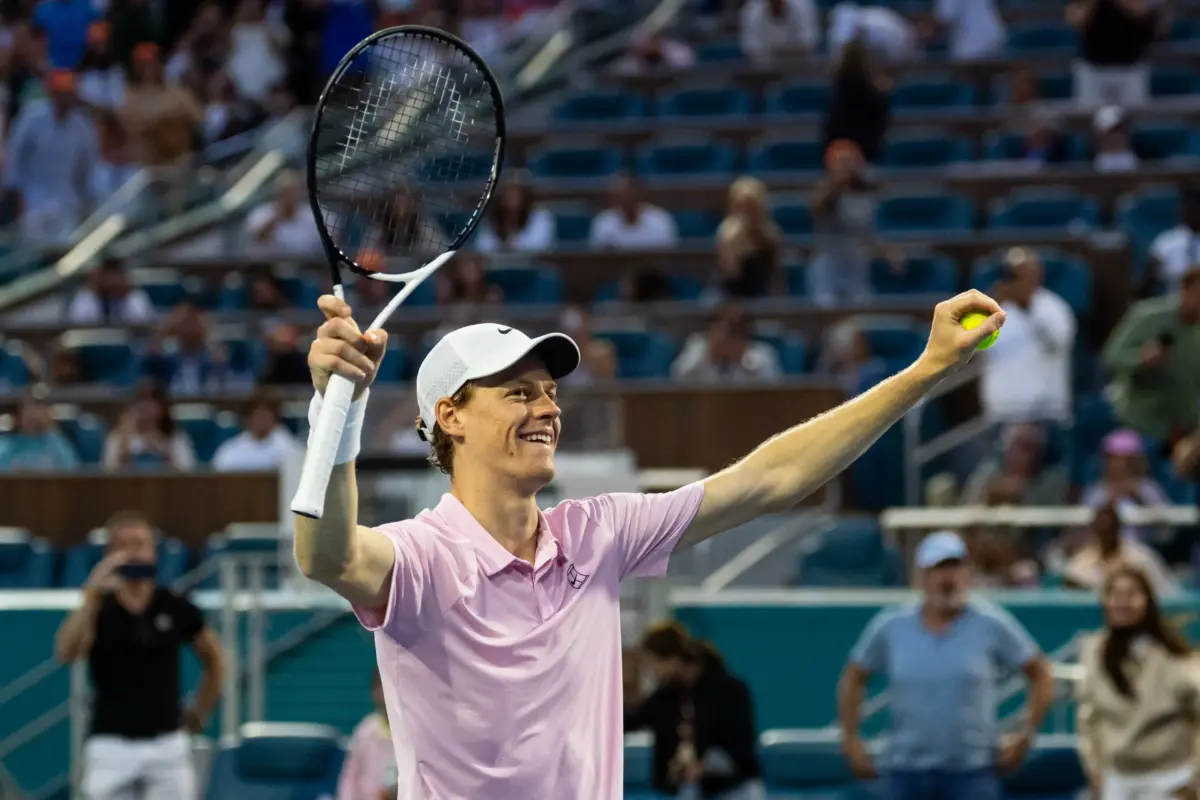
Jannik Sinner led Juan Manuel Cerundolo 6-3, 6-2, 5-1 at Roland Garros in May and lost the match 3-6, 2-6, 7-5, 6-1, 6-1. Read that scoreline again. The world number one, on a 30-match winning streak, a game away from a routine second-round victory, lost eighteen of the final twenty games. He cramped up, could not overcome his physical problems, and fell victim to one of the biggest upsets in Roland Garros history.
What is Happening to Sinner on the Court?
He described what he felt on court in plain terms: very dizzy, very low on energy, unable to find any energy despite playing good tennis. That description is telling. He did not mention muscular fatigue. Nor a joint problem. Dizziness, low energy, and a sudden inability to function physically, while the tennis itself was still there. He was hitting clean forehands from a standstill because his legs had stopped doing what he told them.
This is not the first time. At the Australian Open earlier in the year, Sinner suffered a similar physical episode in his third-round match against Eliot Spizzirri. He was saved only by the tournament’s heat rule coming into effect, the roof closing over Rod Laver Arena, and the cooler conditions allowing him to recover and close out a four-set win. He said afterward that he got lucky with the heat rule and acknowledged that, without it, his tournament might have been over that day: two major tournaments and two heat-related physical collapses. One of them ended his campaign. The other nearly did.
The common thread across both is the heat and the late stages of a long match. Sinner arriving at a fourth or fifth set in warm conditions and his body shutting down before his game does. That is a specific pattern, and specific patterns have specific causes.
What the Device on His Arm Actually Is
The device spotted on Jannik Sinner’s arm during practice in Monte Carlo ahead of Wimbledon is a continuous glucose monitor (CGM). Attached to the skin, it continuously measures the glucose level in the interstitial fluid beneath the epidermis. This is an important distinction from what most people assume when they hear the term “glucose monitor”. The sensor does not measure glucose in the blood directly. Instead, it measures glucose in the interstitial fluid, the fluid that surrounds the cells, and a transmitter wirelessly sends this data to a reader or smartphone app every few minutes.
Using a CGM does not necessarily imply a health problem. Unlike a standard blood test, this tool allows you to track glucose fluctuations throughout the day and observe how the body reacts to different factors: diet, physical exertion, heat, stress, or recovery. In elite sport, its application has expanded well beyond diabetes management. Athletes use it to understand energy metabolism in real time, to identify moments during training or competition when glucose drops to levels that impair function, and to build nutritional and hydration protocols that prevent such drops. The data a CGM provides across a five-hour training session or a four-hour match is qualitatively different from anything a blood test or static reading can offer.
The context helps to understand why Sinner, advised by his doctors, wanted to monitor his glucose. After his physical episode at Roland Garros, where he felt disoriented, low on energy, and nauseous, his team began what appears to be a systematic investigation into the cause likely covering blood analysis, cardiological review, hydration status, thermal stress, training load, recovery, and energy metabolism.
The CGM is one piece of that investigation, and it is the piece that points most directly toward a specific hypothesis: that Sinner’s collapses are connected to glucose drops during extended physical exertion in the heat.
Why This Hypothesis Makes Sense
The symptoms Sinner described at Roland Garros closely align with those that occur when blood glucose drops rapidly during intense exercise. Dizziness, sudden energy loss, inability to sustain physical output while cognitive function and motor skills remain relatively intact: these are textbook features of exercise-induced hypoglycemia, or more precisely. This glucose drop does not need to reach clinical hypoglycemia to impair an athlete’s ability to function at the level required to serve out a set in a Grand Slam.
The heat is a compounding factor rather than the primary cause. Sinner has deflected heat as the explanation both times, and he is probably right to do so. Hot conditions accelerate glucose consumption and increase the difficulty of maintaining stable levels through nutrition and hydration alone.
Still, they do not, if glucose metabolism is functioning correctly, cause the kind of collapse he experienced. What the heat does is expose an underlying issue that cooler conditions mask. The roof closing in Melbourne masked it. In Paris, there was nowhere to hide.
The technical dimension of Sinner’s game is also relevant here. His technique, built around heavy shoulder and body rotation rather than wrist involvement, is exceptionally physically demanding. The degree of core and upper-body work required to generate pace on every shot over three to five sets in warm conditions places a particularly high demand on energy reserves.
His style is one of the most physically taxing to execute on tour, which means that when his glucose drops, it does so in a context where the demand on his body is already near its ceiling.
What It Means for Wimbledon
Sinner has been the best player in the world for two years and, by a distance, the best player on tour in 2026. He swept all five ATP Masters 1000 titles before Roland Garros and carried a 30-match winning streak into Paris. None of what happened there diminishes that. What it does is introduce a question that did not exist before this year: Can Jannik Sinner be trusted to hold together physically in a long, hot Grand Slam match?
Wimbledon is not Paris. The temperature is lower, the surface is faster, matches tend to be shorter, and the tournament’s physical profile is kinder to a player who struggles in extended heat. He arrives as the overwhelming favourite and nothing about his game on grass suggests otherwise.
But the CGM on his arm in Monte Carlo is not a reassurance. It is a sign that his team knows there is a problem they have not yet fully solved. They are collecting data because they do not yet have the answer. The hope is that they find it before Wimbledon fortnight. The concern is that the most important matches in the world, on the hottest afternoons, are not the place to be still looking.
Main Photo Credit: Mike Frey – Imagn Images